
Two left.
~

~
 Birthdays
They come and go.
But when they come, they give
A gift that lasts throughout the year:
My age.
Oh my!
My birthday’s here.
And I’m not ready yet.
I’m old enough, so let’s wait ’til
Next year.
Happy
Birthday to me.
I wish me many more.
Maybe I’ll begin to count them
Backwards.
My day
Was quite well spent.
I got to do nice things.
And even got surprises too.
Four times.
In prose, I’d like to say thank you to all of you who sent me happy wishes and gave me such delightful surprises. God bless you.
~~~

 Tomorrow is my birthday: Yay for me!
~

Sometimes when I’m feeling sad and this ol’ world starts to creepin’ in on me — heavy-like — I take myself away from other people and huddle down in my old creakin’ rockin’ chair in my bedroom. I sit by the window just rockin’ away and lookin out — not seein’ anything in front of my eyes, but seein’ all kinds of things in my memories.
And at times like these — when I’m hurtin’ powerful bad in my soul — I like to remember Izzy best of all. Her real name was Isadora Bradshaw, but none of us kids ever called her Isadora — not me or my sister or any of our friends who came to visit. In fact, nobody I knew back then called her Isadora. She was just Izzy to all of us who loved her.
She was the best of the best was Izzy. About 200 pounds of love and laughter. Her full, round, black face would get all shiny with sweat whenever she was scrubbin’ the floors or haulin’ big loads of clothes from the wringer washer and carryin’ them out to the clothesline — or when she was standin’ at the ironin’ board with her feet in the tub of ice water.
Yes sir, I have to chuckle every time I think about it now. The picture’s still just as clear in my mind as it was every ironin’ day in the summer. Izzy said ironin’ on a summer day was the hottest one job in the whole world. She said it always made her think about how hot hell must be gonna be, and it made her want to go read the Good Book before she went to bed. Izzy loved that Good Book. And she loved the Lord. Gosh-a-mighty, I can still sing every old hymn that sweet ol’ black lady taught me.
But back to the ironin’ days: Izzy said she sweated so much the sweat would drip on the clean shirts she was ironin, so she decided to start standin’ in a big tub of ice water, and that way it kept her cooled down. When I was a little squirt, I didn’t understand how dangerous that could be, but when I got a little older and had learned a few things about electricity, I told her, “Izzy, you’re gonna electrocute yourself standing in that tub of water while you’re plyin’ that electric iron.”
“Lordy, Honeybear,” she’d say — she always called me “Honeybear” — from the day I was born I guess — but she’d say, “Lordy, Honeybear, if I was a goin’ to lectrify myself doin’ this, it would have done happened years ago. Now, you stop you’re worrin’ bout your old Izzy. If the good Lord did see fit to take me home while I was a ironin’, I don’t suppose it would hurt a thing — ceptin’, of course, you and your pa’s shirts would still be all wrinkled.”
I finally got to the place that I just laughed with her about it. And later on — when she was too old to work as our maid any longer and pa had a little three room house built out in the back for her to live in for the rest of her life, she and I would sit and remember those days and laugh ’til there were tears in our eyes. That was several years after I had finished high school and moved about a hundred miles away to take a job. I’d never been one to hanker after college, and I landed a job doing work that suited me and just stayed with it. I always made time to come home a couple weekends a month to see the family. But I got to be honest. It was Izzy that I really came home to.
Why that dear old black woman was like a second mama to me. My real mama was a good woman, and I know she loved me, but she was awful busy durin’ my growin’ up years with all of her society doin’s, and it was Izzy who made my breakfast, who listened to me read the stories in my grade-school reader, who listened to my hopes and dreams and fears when I’d spill ’em out non-stop the way a growin’ boy does when he’s goin’ through those years of change and uncertainty about life.
And it was Izzy who prayed for me all the time. I heard her prayin’ many a night. After she finally got her work finished up, she’d sit out on the back porch and talk to the Lord, and I’d sit by my bedroom window listenin’ to those prayers. Back then, I didn’t know the Lord yet, and my heart yearned for the kind of easy, lovin’ relationship that Izzy had with the God of the universe. And, of course, it was Izzy who finally led me to give my life to the Lord.
That one act made all the difference in my life, of course, but one of the most important things it did was to make me even closer to Izzy. She said once I was a Christian, that made her and me real family. Of course, to me, Izzy was always my family, but I eventually came to understand what she meant.
I came to understand a lot more than that too. Eventually, I realized that Izzy was a woman caught in a transition time in our nation. She wasn’t a slave. Nobody was a slave anymore. But she had been brought up by a family who had known slavery. Her own great grandparents – in their teen years – had been among the slaves freed after the Civil War. And livin’ in the deep south as they did, they just couldn’t seem to get more than one step away from it in their thinkin’ – mostly because the rest of the south couldn’t get more than one step away from it either. Their world revolved around an unspoken cast system, and Izzy and her family were still on the bottom.
She should have had opportunities for education and a career. She shouldn’t have been relegated to doing all the cooking, cleaning, and every other kind of drudgery work for someone else in someone else’s home. She should have had a home of her own with a good man and a passel of kids and a place in society where she could be involved with the rest of the world — just the way mama was able to do. But Izzy wasn’t a revolutionary. She wasn’t out to change the world. She took what came to her and thanked the Lord for a family to work for that she could also love.
By the time I understood all of these truths, Izzy was 78 years old and finally livin’ peacefully in her little 3-room house behind our big house. Most people called our house a mansion, but to me, it had always just been our house. And with Izzy there, it was all I needed for those growin’ up years.
I finally married, but we didn’t have any kids, and eventually my wife and I went our separate ways. I never took the chance again. Sometimes I wish I had, but wishin’ about it now is wasted energy. After the divorce, I used to sit and talk with Izzy about what I thought had gone wrong. She listened, but she never passed judgment on me — or on my wife. She just loved me, and that was enough.
Well, Izzy’s gone now — to live with her dear Lord. And me — I’m old and tired — and lonely. My family’s gone, and I miss ’em: my sister Ella and Mama and Papa. I miss the visits to the old home place. I live here in this place they call a “senior facility,” but it ain’t what I call really livin’. The truth is I’m just bidin’ my time until I go on home to be with the Lord too. Some days I have pain in my body, but most every day I have pain in my soul. Somethin’ in me still yearns to do things and go places and try out a few more dreams. But the will isn’t enough when the strength isn’t there.
So while I’m waitin’, I sit here in my quiet room, rockin’ and lookin’ out my window and rememberin’. And it ain’t so bad really — as long as I sit here and remember Izzy standin’ there at the old ironin’ board, her feet in that pan of ice water, and us laughin’ together to beat the band . . . and singin’ the old hymns, and . . . .
THE END
~

~

~
~
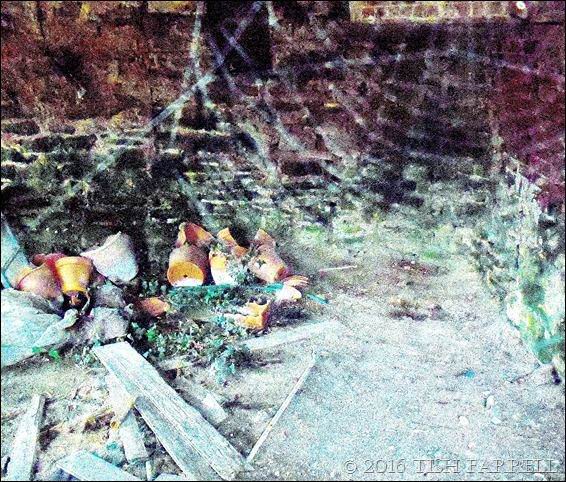
Tish Farrell has offered this photo as a prompt for a story, so I took up her challenge. My story is below the picture. Visit Tish’s site to find out how she came to take the picture.
BEYOND THE SPIDER’S WEB
Nessa was starting to feel a little chilly. When she’d left the group of picnickers, after the argument, she had intended to walk just a little while, until her anger dissipated, and then turn back. But somewhere she had taken a wrong turn and ended up in this wooded area. Now she was good and lost. The afternoon had turned brisk, and she’d left her sweater at the picnic site. She was pretty sure she needed to be heading in the direction the sun’s rays were coming from in order to get back to the group. She wondered about why she didn’t hear anyone calling for her, but, of course, they didn’t know she was lost.
After one more turn to head directly toward the sun, she spotted an old barn in a small clearing. One side wall was leaning awkwardly, and part of the roof had obviously fallen in. But she decided she needed to sit down and catch her breath, and at least this offered a little shelter.
As she got to the window, she peered inside to make sure no ferocious animal was making his home there. A huge spider’s web covered most of the window opening, and she had to move her head from side to side to see through the silken threads. But she saw no living creatures inside — just a pile of old flower pot, a rusty pitchfork, and several pieces of rotting wood that had fallen from the roof.
Moving to the left, she finally spotted a door, and pushing against it with all her strength, she managed to get it open enough to walk inside the building. The musty smell was strong: rotting hay, dust, dead foliage, and lots of mouse droppings, if she wasn’t mistaken.
But the relief from the wind was welcome, and there was enough light to look for a dry board or two to make a seat to sit down on and stretch out her legs. She sat for several minutes, enjoying the change in position, but gradually, she realized that she was hearing something besides the silence she’d expected. It was like a tapping — rhythmic but with pauses now and then — followed by the same sounds repeated. It was a pattern that spoke to her musical soul, but it wasn’t music. It was . . . what exactly was it? It was almost like code of some kind, but she dismissed that idea as ridiculous.
But it kept repeating — light, but insistent — until she couldn’t ignore it any longer and had to get up and make her way toward the direction from which it came. Trying to tell herself that it was just a loose board being blown against the wall by the wind, she continued in that direction. But by now she knew the tapping was too light to be just a board — and too rhythmic to be the result of the erratic wind. Her first twinges of uneasiness at being lost were now growing into outright fear at what she might find when she reached the source of the sound.
She stopped. She argued with herself. “I don’t have to go on. I can get out of here and keep walking. Besides, I need to keep moving while I can still be guided by the sun.”
That line of thought sounded good, but then the tapping caught her attention again, and she couldn’t dismiss the idea that if there was someone else here who needed help, she’d never forgive herself for running away. So digging deeper for what courage she had left, she eased herself forward toward an inner door. As she pushed the squeaky door open, the tapping suddenly stopped. There was dead silence for long seconds, and then a tiny voice, choked with tears called out: “Is someone there? Is someone there?”
Nessa’s heart almost stopped. She didn’t know whether to answer or not, but then thought how foolish to have come all this way to see if someone needed help and then refuse to offer it. Then the voice sounded again. “Please . . . is someone there? Please help me!”
Suddenly, Nessa’s heart took over from her terrified thoughts, and she answered, moving forward as she did. “Yes, I’m here. But where are you?”
“I’m up here!” the tearful voice called, and Nessa looked up for the first time. There, not ten feet from her, in the hay loft, a young boy was hanging out of a hole in the loft, with one leg still stuck up in the hole. He was holding onto a rope that hung from the loft as well, trying to keep himself balanced. With his other hand, he was tapping a piece of wood against the ladder leading to the loft. He couldn’t reach the ladder from where he hung, but he could hit it with the wooden stick.
“Oh, my goodness!” Nessa cried and ran toward him. “What happened?”
“I . . . I fell through a hole in the hay loft, but my leg got caught on something as I fell, and it won’t come loose . . . although I don’t want it to come loose if I can’t get a better hold on this rope because I would fall to the floor on my head. I called and called for help until my throat hurt too much to keep calling. Then I kept hitting this stick against the ladder, hoping someone would hear me.”
As she came closer, Nessa, realized the boy couldn’t be more than eight or nine years old. His tousledd blond hair hung down from his head as he hung almost upside down, and his face was dirty with smeared dirt and tears. “I’ll see what I can do to help you,” Nessa said, as she started to climb the ladder to the loft.
“Be careful,” the boy said. “That ladder has some rotten rungs.”
“Why on earth were you in here climbing it anyway?” she asked.
He sniffed. “I was running away from home.”
By that time Nessa was in the loft and had discovered that his leg was caught between two boards. She didn’t she any blood, but it was for sure he’d have a serious bruise on his leg when this was over. She tested the rest of the floor around the hole, and finding it solid enough to support her weight, she went to work slowly reaching down for the boy’s shirt and gradually pulling him back in the direction of the loft.
When she had him close enough to have a secure grip on him, she worked at loosening the boards around his leg with her other hand. It was slow work, and he cried out in pain once, but she finally managed to get his leg loosened enough for him to use it to help lift his own weight back toward the opening in the loft.
After a great deal of tugging and huffing and puffing by both of them, the boy was able to reach back through the hole with his own left arm and help pull himself the rest of the way into the loft. They both just sat there, catching their breath for some minutes.
Finally, Nessa spoke. “My name’s Nessa, by the way. What’s yours?”
“I’m Timmy Randall.”
“Do you live near here?”
“Yeah, just over that hill.” He hung his head and took a deep breath. “I didn’t get very far running away, I guess. I got tired, and I crawled up in the loft to take a nap. And that’s when I fell.”
“So why were you running away? Are your parents mean to you?”
“Well . . . they won’t let me have a horse.”
“What! Is that a good reason to run away from your family?”
“Well . . . they promised me a horse for my birthday, but when my birthday got here — yesterday — they said they didn’t have the money to get me a horse, and all they gave me was a new pair of shoes.” He started to cry again.
“But maybe something happened and your parents really don’t have the money to buy a horse,” Nessa argued.
“But you don’t understand. I bragged to all my friends that I was getting a horse for my birthday. They all laughed at me and said I was lying — that my parents were too poor to buy me a horse — and that I was stupid to believe they would. Now I can’t go back to school with all those kids. They’ll just laugh at me even more.”
Nessa studied him, weighing her options. Deciding her best bet was to get him to feel more sorry for her than he did for himself, she said. “Well, I’ll tell you what, Timmy. I’d like to help you, but the truth is that I’m completely lost out here. I was on a picnic with my friends, and we had an argument, and I did something as dumb as you did. I just took off walking. But now it’s almost dark, and I don’t know how to get out of these woods, and I’m so scared I don’t think I can help you at all. I’ve got to try to find my way home all by myself.”
Timmy looked at her for several seconds, his eyes wide, and his mouth hanging open. Here was someone with a bigger problem than he had. At least he knew how to get home — to a warm meal and a soft bed and someone to be sure he was safe for the night. Suddenly his green eyes lit up, and a grin spread across his dirty face.”
“Hey, you know what? I can take you to my house, and my dad can drive you home!”
Nessa feigned surprise. “You’d do that for me? But you’re running away.”
Tim thought about her words a couple more seconds. “Well, I figure it this way. You saved my life just now. If you hadn’t helped me, I would have hung there ’til all the blood ran to my head and I’d have had to let go of the rope I was hanging onto, and I would have fallen to the floor, hit my head, and died.
“But since you stopped to help me and now it’s too dark for you go get home, I’m going to take you home with me.” The last words were punctuated by another big grin. After all, there was no shame in changing his mind about running away in order to help a young lady in distress, now was there? He could go back home — where he’d really wanted to be all along — and save face at the same time.
“Well, Timmy,” Nessa said, as she stood up, “I’d be really, really grateful if you’d do that for me.”
Tim hopped up as well, wincing just a little as he put weight on his injured leg. His grin widened. “It will be my pleasure, Miss Nessa,” he said, holding out his hand to grasp hers as they made their way carefully back to the ladder to start their journey home.
THE END
~~~
~

~
 Fact: Eating chocolate is great therapeutic exercise.
~~~
 I’ve been participating in the “Six-Word Saturday” challenges for some time now, and I enjoy it. I don’t have something to say every single Saturday, but it’s fun to take part as often as I can. I also began posting a “Seven-Word Sunday” post on two of my blogs last year. And, again, I don’t hit it every single week, but I post as often as I can.
Now, this week, I got a really kooky idea. Why not do a post every day of the week — each day receiving its own number of words?
Monday = One-Word Post
Tuesday = Two-Word Post
Wednesday = Three-Word Post
Thursday = Four-Word Post
Friday = Five-Word Post
Saturday = Six-Word Post
Sunday = Seven-Word Post
So that’s what I’m going to do for the next three weeks. Now, I will be posting other regular posts as well, as the mood strikes me, but I’m going to challenge myself to say something relevant — or at least that means something to me — in the restricted number of words for each day.
I’d like to invite all my readers to take part in the experiment. There’s no challenge except to yourself — to come up with words that say something significant without any excess fluff.
If you take part, there’s no need to link back to me. You’re welcome to post a link to your own posts in the “Comments” of my post for that day if you want to do so. But there’s no requirement. And you don’t have to take part every day. Just think about it and see if you can have some fun with it.
Of course, on Saturdays, I will link back to the original hostess of the “Six-Word Saturday” challenge, just because I think it’s the polite thing to do.
Now — to get started on this unique posting experience!


 The Happy Wordcrafter