100 Word Challenge for Grownups –Week # 73

100 WORD CHALLENGE LOGOI couldn’t resist jumping in this week. Thanks to Julia for all these great challenges. They help so much with the “discipline” of writing, don’t they? This week’s prompt is  “… the notes from the piano ….” So here’s my take:

THE SILENT NOTES

Lucy couldn’t understand. One whole octave silent … dead. She’d been gone 20 years, but surely someone else played ….

Lifting the lid, she spotted the wad of papers — old — torn — wedged under the strings. Prying the papers loose, she studied them:  Letters!  Letters and notes!  And all signed by … him!

One whimper escaped.  Then a sob.  He really had written!  Father had hidden them, and when she’d gone, he’d stuffed them here.  Cruel joke!

Twenty years suffering a broken heart, and all that time ….

That’s what Father had meant when he’d whispered his dying words:  “The notes … from the piano ….”

To join in the fun, hop over to Julia’s place and check out the challenge. (You’ll also enjoy her terrific header photo. It just pulls you in and makes you want to stay awhile just looking at it.)

http://jfb57.wordpress.com/2013/01/14/100-word-challenge-for-grown-ups-week73/

Daily Post Writing Challenge: Starting Over

Sometimes “starting over” is as simple as letting go of something that has been usurping one’s focus and direction for too long. That’s the subject of this original poem.


MALE & FEMALE SYMBOLS

LET HIM GO

Let him go.
It’s time to admit you’ve been a fool
And take possession back of your own soul.

At first encounter
You saw the good was mixed with bad.
The right choice then, by now, would make you glad.

But foolish child,
You were intrigued, so closer crept
And threw out counsel that you should have kept.

“Do not touch.”
Three words so easy to understand;
Unguardedly, you opened both your heart and hand.

It’s harder now,
But still you have to make the choice.
And this time listen to the wiser voice.

You are in love,
But such a love that’s unrequited
Just leaves the soul living life one-sided.

Even if,
In truth, he shared the love you feel,
The danger of forbidden fruit is real.

Let him go.
And pray the feelings soon will die.
To hope for more would be to live a lie.

Let him go.

© 2011 Sandra Conner

To join in the challenge, find the rules at this link:
http://dailypost.wordpress.com/2013/01/14/writing-challenge-starting-over/comment-page-1/#comment-131582

Friday Fictioneers 100-Word Challenge – ‘Love’s Song’

I wanted to join in with the other Friday Fictioneer participants this week, but I have to admit that my contribution is ‘illegal’ — being closer to 180 words. However, since this is the little story that kept nagging at me from the very first moment I saw the picture below, I have written it anyway and edited it down as far as possible in the time I had available.

The challenge is hosted by Rochelle Wisoff-Fields. If you’d like to take part, hop over to see her at this link:

http://rochellewisofffields.wordpress.com/

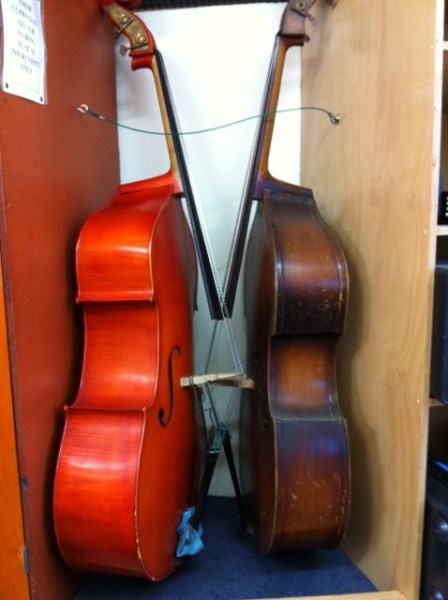
The prompt is the following picture, which comes to us courtesy of Roger Cohen at http://betarules.blogspot.com.au/

TWO BASS VIOLINS - CELLOS

LOVE’S SONG

They’d met at a rehearsal in this very theater. He, with his polished coat of dark walnut, was instantly captivated by her honey-maple coloring – but even more so by the sweet voice she gave to every note assigned her in the performances. Bravely, he’d professed his love, and she’d responded. They had made exquisite music together for 74 years.

Now, with their respective masters in their graves, the two aging instruments rested against the wall of an old closet behind the stage. His coat was battered and marred significantly. But her luster still had the power to draw music from him every time he looked at her. They sighed quietly. They still had each other – and the music that lived within them. He kissed her gently. She kissed him back. They embraced.

Outside, people slowed their stride as they passed the old theater. “There it is again,” said one. Others nodded in agreement.

“Strange,” said a young woman. “Every night, I’m just sure I hear music coming from inside, but there is never anyone there ….”


Anticipation

a poem by Sandra Conner

Coming and going,
To-ing and fro-ing,
Thoughts in a dither,
Stomach aquiver …

Scurrying, worrying,
Phoning, conversing,
Weighing last doubts,
Last chance to bow out …

Checking all pockets,
Fastening lockets,
Rosebuds and bouquets,
Fragrant, sublime haze …

Guest in their places,
Smiles on the faces,
Music on swelling tide,
“Here Comes The Bride.”

Love On The Line

a poem by Sandra Conner

I read about the “phone poem” challenge on “The Music In It” — Adele Kenny’s poetry blog site — and I decided to see what I could come up with.  As soon as I started thinking about the subject, I remembered reading the true story of a WWII sailor who had intended travelling to the midwest (while home on leave) to meet his girlfriend and propose marriage before he went back to duty.  A blizzard kept him from making it across country, but through the kind ministrations of a romantic telephone operator (remember when we had real operators instead of computers?), he was able to convey his proposal and receive an answer. This poem is based on that unique love story.

LOVE ON THE LINE

I read about a Navy guy;
‘Twas during World War II;
He felt that he was so in love
But one thing he could do.

He was on leave, New England way,
And running out of time,
Snowed in, he could not meet his love.
His only hope – a dime.

So in the pay-phone booth, he dialed
The zero. Faith was high.
He told his soulful story to
The operator, Vi.

He gave the number for his love,
St. Louis her address,
And Vi said, “There’s no promises,
But I will try my best.”

So, hanging on the line out east,
The sailor heaved a sigh
And waited with a pounding heart
Till he heard back from Vi.

“I have your party, sir,” she said,
Three minutes’ worth of time.
“Three minutes!” cried the sailor.
“That isn’t enough time!”

His darling’s voice broke through the wire,
Her voice so light and thrilled,
“What great surprise, your calling now!
I heard you’re snowed in, Bill.”

“Yes, dear, and now I can’t get there
Before my leave is through,
But there is something vital that
I have to say to you.

“You know I’ve loved you for a while;
And I have to know for sure — ”
But Vi broke in just then to say,
“We’ve lost connection, sir.”

“Oh, no!” he cried. “You’ve got to help!
I’m ready to propose!
I couldn’t go back overseas
Unless I’m sure she knows!”

“I’ll try again,” Vi said, but then
Back on the line, so sad,
“I can’t get you connected, sir;
The weather is so bad.

“But I can hear your party, sir,
And it seems she can hear me.
If you’d want me to relay your words,
I’d do so happily.”

He heaved a sigh, wiped tear from eye,
And drew deep breath somehow.
“All right,” he said. “It’ll have to do;
I need her answer now.

“Please say, ‘ I’m so in love with you
That before I go to sea,
I’m asking you to be my wife;
Please say you’ll marry me.'”

So Vi relayed the message sweet;
He waited in a stew
‘Till Vi came back online and said,
“She’d love to marry you!”

Now many years have come and gone,
The couple made their home,
And in every room the pride of place
Goes to the telephone.

I Am My Beloved’s and He Is Mine

I am currently working on a new non-fiction book entitled Love, Sex, and Falling Off Cliffs: It’s All About Trusting God. The title refers to the fact that often all three of those experiences can sometimes feel like one and the same thing. In reality, there is a huge difference, of course, but understanding those differences can be difficult to impossible – unless we look at things from the point of view of the One who is love, who created sex, and who catches us if we find ourselves going over the edge of a cliff. The following article is an excerpt from that forthcoming book. (Please note that the terms “man” and “he” are used here in the generic journalistic sense to represent the human being of either sex.)

Song of Solomon references are from chapters 2, 6, and 7.


I am my beloved’s, and my beloved is mine. His banner over me is love … and his desire is for me.” So says “The Song of Solomon” in God’s unique celebration of the sexual love and physical union that He has created for man and woman to enjoy. But even in this “song of songs” the reader can see clearly that physical union by itself was never God’s plan. Without the union of hearts and souls as well, man is functioning with only one-third of his being in a relationship, and he does so to his own sorrow.

The reason for that problem is that man is, at his very core, a spiritual being. God, who is spirit (according to Jesus’ own words in John 4: 24) created us in His own image (Genesis 1:26). It’s interesting to note that the Talmud says, in a strict translation of the original Hebrew language, that God created man as a “speaking spirit, just like Himself.”

God had a great deal to say about how important it is for the human being to understand that he is a spirit being, possessing a soul (mind, will, and emotions), and living in a body. (Two examples: John 4:24 and 1 Thess. 5:23). Man must also understand that what he believes totally in his heart and then speaks out of his mouth is what will come to pass in his life — both on this earth and in eternity. (Matt. 12:34-35, Mark 11:23-24, Romans 10: 9-10).

In fact, it is that unique “godly” ability to think with a multi-leveled consciousness (the soul, governed by the spirit) and then speak what we think and feel into the world around us, and into the lives of other people, that sets us apart from all of the rest of creation. God’s Word tells us that we are the crown of creation and that all the rest of what makes up this earth is dependent on our stewardship for its development and its very survival. (Gen. 1:26-28, Romans 8 19-23).

That being the case, we must guard our stewardship of our relationships with each other, especially in the area of love and its various modes of expression. Understanding that God, who really is smarter than we are, designed the man and woman to fit together perfectly so that their sexual union would give them the greatest amount of physical pleasure possible, also created them in such a way that the very pleasure itself would be heightened enormously by what was taking place in their souls and spirits at the same time.

So how does it all work, when it works correctly? Well, if my beloved “is mine,” then that means he has given up his rights to have “his own” way about everything or to put “himself” first. He has given himself to another person – as one gives any kind of gift – and that other person now has power over him. In fact, he can no longer just use that other person to satisfy his physical needs and longings, but has “given” himself to trying to satisfy his partner instead. And if “his banner over me” is love, that means he has spread himself and all that represents him (his name, his wealth, his possessions, and his authority) as a protective covering over his “beloved.”

A friend once made the statement that he knew he was really in love with the woman he was dating and was ready to marry her because he had come to the place where her happiness was much more important to him than his own. What a perfect example of the truth related here. And its these two kinds of commitment of the inner man – this complete giving away of self – by each partner to the other – that provide the foundation of a lasting union. They are what make this union a covenant, rather than just a legal agreement.

A covenant is more binding that a basic legal contract, because a genuine covenant puts the two parties into a relationship in which what belongs to one automatically belongs to the other. It also puts each partner in the position of being obligated to obey any request made by the other member of that covenant. And, lastly – and perhaps most important of all – a true covenant cannot be broken. Any physical union without this union of hearts and souls as well eventually creates a situation that is precarious at best and heartbreaking at worst.

As with all other problems that beset the human race, it was man’s unfortunate breaking of his spiritual link with his Creator that birthed the original problems now experienced so frequently in the sexual parts of life. But that Creator has managed to give us a way to restore that spiritual relationship through Jesus Christ, Who comes into us and renews our spirits again. As we take advantage of that restoration, letting the renewed spirit take charge of the rest of the being, the soul and body derive the benefits.

Now, nobody expects to get the very best performance and satisfaction from a car without operating it according to the owner’s manual. “After all,” we say, “this company created this car to work a certain way, and they know more about it and what will make it successful than anyone else. If I want the most I can get from this vehicle, I need to use it the way the manufacturer tells me to use it and take care of it as the handbook says.” So why should we be any less smart about using our bodies and our sexuality? Let’s go by the Manufacturer’s Handbook, and get the most we can out of our sexual experiences.

So as our spirit, restored to right relationship with God, governs our “love life,” including our sexual functions, we find that, not only does our sexual relationship meet our deepest need to be loved, valued, and secure, but it’s also a whole lot of fun. Those unfortunate people whose sexual experiences have incorporated the members of their physical bodies only have really missed out on the best. True JOY comes from the soul area, so true enJOYment of any act must include the soul in total agreement with the body. If all of your sexual experiences have been limited to those that tickled the physical nerve endings of certain body parts, and you thought that brought satisfaction and fulfillment, you “just ain’t seen nothin’ yet.” That experience is nowhere near the kind of fulfillment and fun God intended for you to have. But true fulfillment comes only when the body, soul, and spirit are all three satisfied that this thing that’s happening is good — really good. And since the Word tells is clearly that “there is none good but God” (Luke 18:19), then it means doing this thing God’s way.

The degree of satisfaction and fulfillment in this complete kind of love is really hard to put into words. Songwriters have been trying to do that very thing with all of the hundreds of great love songs that have passed through our generations. But when we get right down to the root of it, have any of them ever said more than the unique love song already recorded in God’s Word? “I am my beloved’s and my beloved is mine. His banner over me is love … and his desire is for me.”

An Old Maid: Poem by Lila Colloton

(This poem is the work of a very dear friend of mine, Lila Colloton, who, at the age of 80, is still an active poet and a journalist for an area newspaper.  Her poems have been published in several different venues, including her book Rhyme, Rhythm, and Reason. What makes this particular poem especially delightful, in my opinion, is that she wrote it at the tender age of 16.)

AN OLD MAID

by Lila Colloton

Being an old maid would be fun I guess:
No diapers to wash or children to dress;
You may go shopping whenever you can;
Don’t have to sit home and wait for your man.
Yes, being an old maid would be fun I suppose:
Just one person’s dishes and your very own clothes.

But just stop to think before you continue:
Don’t you feel sort of funny within you?
Kind of an empty feeling I bet.
Just suppose Mom and Dad hadn’t met.
Where would you be?
Nobody knows:
Probably just part of the breeze that blows.

So stop debating before it’s too late;
When he calls up, don’t break that date!


© 1932 Lila Colloton

If I Could Touch the Face of God

If I could touch the face of God,
I’d plant a tender kiss.
I’d wrap my arms around His neck
In such a sweet embrace.

I’d whisper in His ear
The words of love my heart cannot contain.

Oh …

If I could reach
To kiss the face of God.

~ ~ ~

© Sandra Conner 2009

Love’s Freedom

I turned to Love and said, “I must be free.”
And Love said, “Surely. Take your liberty.”

I asked, “In truth? You set me free to roam?”
Then Love replied, “Just please remember home.”

And so I flew to north, south, east, and west.
And finally back to home I came to rest.

Then turned to Love and said, “You were so brave,
To let me try my wings. So much you gave.”

Love smiled and said, “Refusal to set you free
Would mean I loved — not you — but only me.”

Love – Through the Eyes of Opie Taylor

In an episode of the uniquely popular TV program The Andy Griffith Show, an episode entitled “The Rivals,” Andy tries to help his son Opie come to terms with the troubling symptoms of being in the throes of first love. As they sit together in the living room, Opie opens the conversation: “Paw, when you like someone a whole lot, that means you love ’em, don’t it?”

It depends,” says Andy.

Well, when I’m with Karen, I get a lump in my throat, my ears ring, and my knees get all squiggly. Does that mean I’m in love?’

Either that or you’ve got a real bad case of the measles.”

Paw, if I marry Karen someday, her name becomes Taylor, don’t it?”

That’s right, and all your children become Taylors too.”

Children? … I don’t think we’d have any children, Paw. We already know enough kids to play with.”

And so – with childhood’s blurry vision of the details of this state called marriage — Opie easily dismisses one of the most important results of engaging in the deepest mysteries of the marriage covenant. Children are a very visible product of those mysteries.

But there are other products as well. Many of them are not so easily seen or identified, but they can be just as important and just as life-changing. There is a sense of fulfillment and a greater sense of wholeness. There’s a sense of security and oneness that melts away all the coldness of being alone. And there’s a new knowledge of self – an understanding of oneself on a new level. The man and woman who have previously been “their own person” have now, for the first time, realized that they are much more complex and much more capable of enjoying that complexity as a result of this new relationship and the new identity that results from it.

But all of this change is not easy. Nor is it simple. In fact, it is so complex that sometimes it’s weeks, or unfortunately even years, before one or both partners actually realize that they have become a part of a brand new whole and are no longer exactly the same persons they were before marriage.

That realization could be frightening if not seen through the plan of God. He, after all, is Love (1 John 4:8). He created this thing called marriage – and the sex that is an integral part of it. And guess what? He knows what He’s talking about. His plan is that each partner in this holy covenant relationship will find in the mate the answer to longings that have never been fulfilled; the key to opening doors in the soul that have never been unlocked; and the love that saturates and nurtures our unique gifts and abilities so that they mature and bring us to the highest and best we can be. In short, it’s this new person, conceived from the two, that is finally complete and whole in a way that nothing but a “covenant” marriage relationship can accomplish.

It is true that our mate cannot fill the place in us that is reserved for God Himself. And we will never be truly whole until He is at home in us, giving us all of Himself. But it is God Himself who has told us clearly, “It is not good for the man to be alone. I will make him a helper suitable for him. … And the Lord God fashioned into a woman the rib which He had taken from the man and brought her to the man. And the man said, ‘This is now bone of my bones and flesh of my flesh.’ … For this cause a man shall leave his father and his mother and shall cleave to his wife; and they shall become one flesh.” (Gen. 2: 18, 22-24, NAS). God said of his “perfect” man that he needed a woman to be complete. And He created the woman to be so much a part of the man that she would have a need of him to be complete as well. Isn’t it interesting that this “need” of each other was created into us as part of our perfection? And this unique completeness that results is probably the one most powerful and thrilling product of a man and woman entering into and enjoying the blessed mysteries of God’s kind of marriage.

I know in this 21st century – especially in the hollowed political halls of this world — it is not considered “politically correct” to make such statements. But, thank God, there is still one Document that supersedes all the political attitudes and postures of every society on the face of the earth. It still supersedes every new “law” on the books that would try to make marriage something different from the commitment of one male and one female partner in covenant with each other and with the God who created them. Thank God that Document — The Word of God – The Holy Bible – still gives the human race the blessed, supernatural opportunity to experience total completeness through love – when they enter into it the way God Himself created it to be experienced.

Truly, a Valentine gift to be treasured forever.

Where Did I Miss You?

Since I seem to be focusing on the subject of love during February, I can’t help but give some time to one unique aspect of how it comes – or fails to come – into our lives. No focus on the subject of love, in all it’s categories, could ever be quite complete if it did not include the concept of what love might have awaited us in different venues of life if we had made different choices along our way.

COBBLESTONE STREET - PARIS - cropped, credits
There is a theory espoused by some that there is actually an alternate experience of life that is running concurrently with the one we are aware of, and that if we could become aware of it as well, it would give us the experiences to which our alternate choices had ope
ned the door. Of course, I realize that, according to the Word of God, that concept is not a reality, but I am still aware that had I made just one or two choices differently – even the choice of what street to walk down, or what restaurant to visit, or what time of day I went to the library – a hundred things in my life might be completely different. 

The reality of this truth came home to me quite unexpectedly, and quite dramatically, one day a couple of years ago, while standing in a fast food restaurant. I’ve been fleetingly aware of other such experiences during my life, but this time, I was so touched by it, and my life so affected by it, that I immediately wrote it down and saved it, so that it would remain a part of who I am from that moment on. I share that experience with you now, and I hope you find it to be as much of a blessing as I do.

WHERE DID I MISS YOU?

I didn’t notice him as I entered the fast-food restaurant. His table was to my right as I entered the door. And he wasn’t in my line of vision as I stood in line at the counter, so I don’t know if he had noticed me as I came in or not. But as I carried my sack over to the end of the shelf where the napkins were located, I glanced up and met his eyes. It was for only the briefest second, because it was one of those situations where you know you’ve made contact, but you don’t know why and aren’t sure how to react. So you swiftly shift your eyes to the side, pretending to look at other things — as if you had just been letting your eyes sweep the area in general.

Why we do that, I don’t know. Maybe it’s a reaction only in those of us who have a measurable lack of self-confidence. Whatever the reason, though, I knew I had reacted that way when I really hadn’t wanted to do so.

But I felt the pull of his personality so strongly that I almost felt as if I’d insulted him by not smiling at him when our eyes had touched so fleetingly. Thinking it may have been just my imagination, I glanced his way again and found him looking at me again as well. But, again, I broke contact within mere seconds. And, once again, I was sorry. I now felt the pull of him so strongly that I knew I had to do something to connect with him, if only for one smile.

It was easier than I had expected, because at the table closest to his sat an old friend of mine. I usually tried to speak briefly to her whenever I saw her anywhere, so I decided I’d walk over to her table now, necessarily passing by his.

As I stepped past his table, my eyes still wouldn’t connect with his. So I just looked right at my friend and spoke. “How are you doing, Betty?”

“I’m doing fine. How are you?”

“I’m fine too. I’ll be even better after I eat this,” I added whimsically, holding up my sack. I glanced his way, and he was looking at me. He smiled. I smiled. He could hear every word I said clearly. I looked back to Betty, still holding my sack out in front of me. Then facing Betty, but letting my eyes drift in his direction, I focused on his left hand. He did have on a gold ring, but whether it was actually a wedding band or not I couldn’t tell. It was best if I didn’t know for sure anyway, but … disappointment pierced through me. It was a brief, stabbing feeling, and then sort of a dull resignation took its place.

But somehow, I just couldn’t quite let go of him yet. I held up my sack again – in Betty’s direction: “I don’t really need this … but … then again, I guess I do need it” was my next inane addition to the conversation. I glanced at him again, as if to include him in this “high-level” discussion. He understood. So I took advantage of that moment to look at him more closely.

There was nothing extraordinarily attractive about him. I mean he wasn’t the kind of man you’d naturally notice because he was gorgeous or was dressed in the height of fashion. His African-American complexion wasn’t ebony, but it was darker than brown. He had on a kind of knit cap that covered most of his short-cropped hair. His beard was mostly gray and extremely neat, but even though the beard was gray, the face was young. He was obviously overweight. Not fat, but certainly not sporting the kind of physique that normally caught a woman’s attention.

But it was his eyes and his smile. Or maybe it was his smile and his eyes. It doesn’t matter which, because his smile was so warm and genuine that it filled his eyes as well as his mouth. And it was that smile that made him really attractive — not the physical smile — the part of it that came from his soul. It was his soul that was in his eyes, and there was an invitation there: “I could sit and talk to you and understand you,” it said. “And you would understand me. We’d be friends.”

By that time (barely seconds) Betty was responding to my convoluted statement about the need for food, and she answered, “Yeah … you have to eat to live.” Brilliant answer!

“Right,” I said, looking back at my new friend. His smile was even sweeter — and even more inviting. He knew I wouldn’t — and couldn’t — sit down and talk to him. Why not? Because we had no connector. We had no tiny moment from our past that could have provided even the thinnest thread of oneness. We had just this one minuscule moment — taken out of time — to recognize, to dream, to wish. But he let me know that he had enjoyed talking to me vicariously and hoped that I had felt the same.

I smiled at him as generously as I knew how, hoping my message was in my own eyes: “I wish things were different. I wish I could sit down at your table and get to know you. Yes, we’d be friends; I’m sure of it. … Have a good day. Have a good life. … Bye.”

I walked out the door — sadder than when I’d walked in — poorer because of knowing there was a rich friendship out there that I would never own. Where in my life did I choose a path that put me in the position of never meeting him until today? Where did I miss finding him at a time when I could have known him,  owned him as a friend, and had my life woven in with his?  I wish I knew.  No … I wish I’d known then … and I would have chosen differently.

© Sandra Conner 2009

Photo: © Brenda Calvert, 2011

Love: It’s Universal


. . . and this is where the sun kissed the earth.


LOVE:  It flows throughout our universe!  In fact, it created our universe! (God is Love, 1 John 4:8).


(Photo thanks to craized.com)

Blessed Invasion

Most of my life I have been enthralled with the theme of Elizabeth Barrett’s poems that speak to Robert of how his love saved her from death.   Being a poet myself, I decided one day that I would like to re-affirm that theme in a piece of my own creation. The sonnet is not my personal forte (although I have written one or two over the years) so I have not tried to emulate that particular medium.  But I decided to try to express in my more comfortable style of verse what I believe is the substance of what Elizabeth and Robert experienced together, as well as what I believe to be the root source of that substance.

BLESSED INVASION

Invaded by pure Love, Death must submit,
And bow its ugly head and bend its knee.
As the target of a perfect marksman must take the hit,
So Death, in spite of struggling, had to set me free.
Though pressing down to close my coffin lid,
Death was thrust back by power: your love for me.

King Jesus led the way in warring thus.
He came with love so pure it pierced the gloom.
And taking on Himself the curse sin brought to us,
He opened up the way to enter our own tomb,
And facing Death, He said, “Your time is up.
My love strikes death to Death. Now Life will bloom.”

Even so, He seems to’ve passed His love to you,
And coming now upon me, frail and spent,
You have not wasted time in wondering what to do,
But instantly to my own lifeless heart you bent,
And kissed my lips with love as with sweet dew,
Dissolving Death. Now Life arises — permanent!

© Sandra Conner 2009

Photo: Jon, pdphoto.com


Love Letters: 574 and counting . . .

How do I love thee? Let me count the ways.
I love thee to the depth and breadth and height
My soul can reach when feeling out of sight
For the ends of Being and ideal Grace.
. . .
I love thee freely, as men strive for Right;
I love thee purely, as they turn from Praise.
I love thee with the passions put to use
In my old griefs, and with my childhood’s faith.
. . .
And if God choose,
I shall but love thee better after death.

(Sonnet # 43, Sonnets from the Portuguese, Elizabeth Barrett Browning)

As I type the words onto this page, the month of February, the ‘Month of Love’ has just blossomed. Valentine’s Day – and all the trimmings! Yes, whether we’re in the mood or not, we are going to be surrounded all month by reminders that it is a good thing to love.

The Word of God says that all of the Ten Commandments of Jehovah are fulfilled in living our lives in genuine love. It also says that fear is cast out of our hearts and our lives by love. And, most important of all, it tells us repeatedly that the God we serve is Love. He’s what it’s all about, and He’s the source of all genuine love. But when the Word talks about love, it’s referring to much more than just an emotion. Certainly, the emotion is important – and extremely satisfying. But the love that really makes a difference in this world is love that does something.

Love, according to the original language of the scriptures, is the fulfilling of a duty or a responsibility to another – whether to God or to the people in our lives. It works good toward another person whether it ‘feels’ something or not. The truth is that feelings of love – like feelings of anger, happiness, hurt, etc. – come and go. But the act of loving another person is fueled by that deliberate intent of the will to do them good. Like faith, real love is more of an action verb than a noun.

I’m grateful that in my life I have known a great many people who love in this active way. But every time I ponder the subject of love – and especially around Valentine’s Day, when people are prone to send little ‘love letters’ to each other in the way of commercial Valentine cards – my mind turns to two lovers of the past who knew and experienced the power of love to change people’s lives completely.

Poets Elizabeth Barrett and Robert Browning lived one of the most powerful and life-changing love stories ever experienced by human beings. Much of their poetry, especially “Sonnets from the Portuguese,” describes that love and the power it had to overcome enormous obstacles, and to vanquish debilitating sorrow and hovering death. While the best remembered and most often quoted lines from all of those sonnets are the words, “How do I love thee? Let me count the ways,” the truth is that some of the most riveting portions are Elizabeth’s descriptions of how that love destroyed death and renewed her life. In Sonnet VII she says this:

“The face of all the world is changed, I think,
Since first I heard the footsteps of thy soul
Move still, oh, still, beside me as they stole
Betwixt me and the dreadful outer bring
Of obvious death, where I, who thought to sink
Was caught up into love and taught the whole
Of life in a new rhythm . . . .”

In truth, it was that love that literally saved Elizabeth’s life and gave both lovers many happy years of marriage and fruitful writing that blessed the world for generations. It also gave them a son, whom they loved dearly.

But prior to their marriage, Elizabeth and Robert courted, primarily by letter, for a period of 20 months. During that 20 months, they exchanged a total of 574 love letters. Think of it: 574 love letters! In 20 months, that is an average of more than 28 letters each month. Never running out of ways to say “I love you,” and never growing tired of manifesting that love openly.

Have you, dear readers, experienced the joy of seeing that love gives life to those who need it? My Valentine’s wish for each of you is that you will experience that reality.

And, by the way, does the person you love know without a doubt how you feel? Why not take advantage of this ‘Month of Love’ to make sure?