Poems of Passion Week – Day 6 – ‘The Reason’


JESUS IN GARDEN - NEGATIVE  -KAREN'S WHIMSY


O, Lamb of God
So pure, so holy, undefiled,
You came so meekly,
Vulnerable, a tiny child.

You took our sin
And took all of its consequence.
You chose the cross,
And on it your lifeblood was spent.

But for what cause,
When tempted in the garden that night,
Did you still choose
To let yourself be crucified?

You told us, Lord;
If we’d just listen, we would know.
You said, “Because
I love the Father, I will go.”

Lord, work in us
That holy and obedient love,
That we, when tried,
Will speak and act only for God.

~~~
(Photo courtesy of Karen’s Whimsy)


~~~

Poems of Passion Week – Day 5 – ‘Christmas Promises Crucifixion & New Creation’


MANGER AND CROSS - NO WORDS

What will Christmas bring, Mom?”
“Why, Son, ’twill bring you lots of toys and joys.”
“What else will Christmas bring, Mom?”
“Well, fun and games with other girls and boys.”


“But later on in life, Mom,
Will Christmas mean a lot when I am grown?”
“Oh, yes, it will mean more, Son.
For as you grow, a great truth you’ll be shown.


“You’ll learn that Jesus came, Son,
Not just to be a babe in manger sweet,
But to grow up a strong man,
Horrible death and suffering to meet.


“He came to take our sin, Son
And pay the price for it on Calvary.
So God could look upon us all
And shout, ‘From sin and all its curse you’re free!’”


“But I love the little babe, Mom.
I don’t want to think He died for me.”
“That’s what makes Christmas grand, Son:
That Jesus came to die and set us free.”


“You mean, the little baby, Mom?
He had to die and never live again?”
“No, Son, on Resurrection Day,
He rose victorious o’er death for all men.


“This truth of Christmas time, Son,
I think you now begin to understand:
It was the birth of death to sin,
And of eternal life for every man.”


~~~


~~~


Poems of Passion Week – Day 4 – ‘Nathaniel’s Answer’

NAZARETH, ISRAEL - EDITED

Nathaniel was a man who knew no guile.
He walked with Jesus, loved Him all the while.
When first he heard His name, a question posed
But waited ’til the answer was disclosed.


“From Nazareth can any good come forth?”
He asked of those who knew that city’s worth.
He asked for meditation, not reply,
Yet found the answer true in Jesus’ eyes.


And although from the garden he did run
With others as they scattered one by one,
As Roman guards led Jesus, bound, away,
There came a reckoning after the third day.


As Mary ran to spread the glorious news,
Nathaniel, hidd’n with others, all confused,
Received her words with doubt, and hope, and fear,
And hungered so His Master’s voice to hear.


Then Jesus stood among them, His work done:
Salvation for the world from Nazareth comes.


~~~

(Scripture Reference: John 1: 45-51,  John 20)


~~~


Poems of Passion Week – Day 3 – ‘Sufficient’


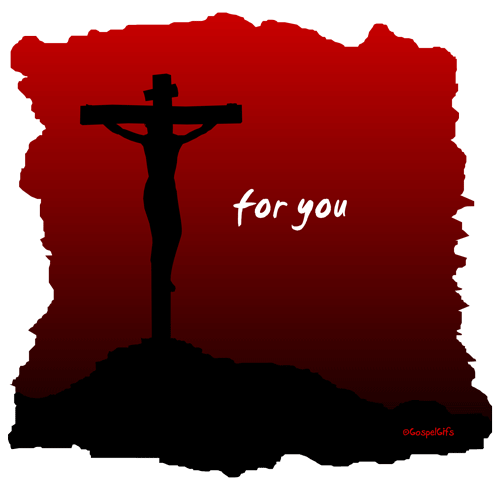
CRUCIFIX - FOR YOU - GOSPEL GIFSSeized and stripped and slapped and spit upon,
Scornful salutations; sorrow; shame;
Satan stalks the Son of God and Son of Man:
Scarlet stripes, scalding tears, searing pain;
Search the scriptures; surely they the story tell:
Insatiable evil strikes; the Lamb is slain.
But surely, it’s my sins He bore, my sorrow,
My sickness, my distress, my grief, my pain.
Submitted Sacrifice: He sealed the promise;
Sufficient, He bought me peace with God again.

~~~


~~~


Poems of Passion Week – Day 2


CROWN OF THORNS ULTRA MODERN


BARABBAS

My heart pounded
As they dragged me out.
They stood me close beside Him,
And I looked about.


The crowd was frenzied:
With rage and raw disgust.
I wasn’t sure the real cause–
Why they fumed and cussed.


I glanced beside me
To catch a glimpse of Him,
But what my eyes saw in His
Convicted me within.


When guards shouted,
“Who is it going to be?”
Then I understood they’d choose
To set one free.


“Free Barabbas!
Set Barabbas free!”
I could not believe my ears:
They chose, not Him, but me.


“What of Jesus?”
Then asked the guards.
“Crucify Him! Crucify Him!
He is not our God!”


My shackles fell off:
By law a free man.
Pilate called for water then
And there he washed his hands.


The day grew dark
As He hung there,
Upon a cross with thieves each side,
Then He said a prayer.


He prayed, “Forgive them.”
Did that include me?
When He said, “It is finished!”
I knew He’d died for me, Barabbas.


(Scripture Reference: Matthew 27)

~~~


~~~


Poems of Passion Week – Day 1


CROSS WITH CROWN OF THORNS - BLUEWell, I started off okay with NaPoWriMo, but as the days progressed, I haven’t kept up my end of the challenge. I don’t think I need to make that one of my goals this year. However, I do have a similar goal, though shorter. I am setting myself the task, during Passion Week, of writing one poem a day about the suffering, death, and resurrection of our Lord Jesus Christ. I want to focus in some special way on His suffering and death, and then His glorious victory and resurrection for my sake.

I can’t think of a better way than to create a poem every day from today – Palm Sunday – through Resurrection Day – Easter Sunday. In fact, since much of the church in several parts of the world celebrates Easter Week (the week following Resurrection Day), I think I will even write a poem for Easter Monday of that week as well.. I hope these poems add to your commemoration of our Lord’s loving sacrifice and to your celebration of His glorious salvation.


Here’s Today’s Poem:


SACRIFICE

A crown,
A diadem,
A shackle placed upon the brow.

Bestowed
Contemptuously,
And scarlet robe on shoulders bowed.

The grief,
The agony,
The tortuous, mutilating pain.

All born
By Innocence
To give me peace and health again.

A cross,
On Calvary:
To execute the Father’s plan.

A tomb,
Now empty stands:
He’s paid the price for every man.

~


~~~


Here Comes Jesus!


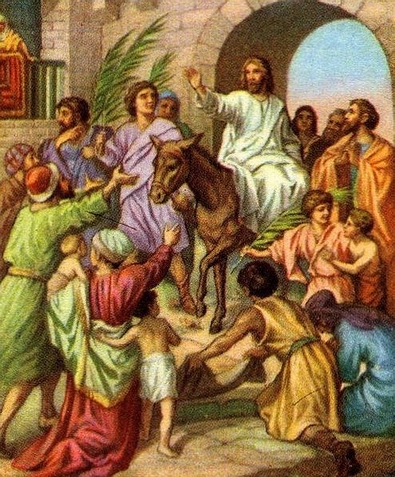
JESUS ON DONKEY - WIKIPED.“Here comes Jesus!”

“Jesus of Nazareth is coming!”

“Do you see Him yet?”

“Here He comes!”

“Here comes Jesus!”

Excitement was rampant, and cries of “Hosanna” filled the air. Shouts of joy and triumph could be heard for miles along the road, and people rushed to lay palm branches and their personal garments as a carpet of welcome. Jesus of Nazareth was coming to Jerusalem.

This carpenter-teacher who had journeyed among them for nearly three years, teaching them, healing them, feeding them, forgiving them, raising their dead. This miracle worker, this wise man, this man who was gentle enough to draw crowds of children to his side yet bold enough He would soon drive money-changers from the temple with a whip — this man whom many claimed was the prophesied Messiah of Jehovah — this man was coming again to Jerusalem! I’m sure, had we been there, we would have heard the message repeated over and over again for miles: “Here comes Jesus! Here comes Jesus!”

We in the Christian world celebrate that event on one special day out of the year, and we call it Palm Sunday. We have special services and some of us wave palm branches in the air to commemorate the day that is often referred to by church historians as Jesus’ triumphal entry into Jerusalem. But that event happened over 2000 years ago. One could say it’s all history now; it’s been said and done;  it’s over.

But not so, my friends! I am thrilled beyond words to be able to tell you that Jesus is still coming to anyone and everyone who would like to receive Him. He’s a living, vital, right-now Jesus. He is the I AM (The self-existent one who causes all other things to be; the one who is and becomes whatever He desires to become — Hebrew definition). And the great I AM desires to become everything that His creation needs.

Jesus of Nazareth is alive today, and He’s still loving people, teaching people, feeding people, forgiving people, delivering people, healing people and making  them whole. And, yes, He’s still raising people from the dead. He’s the same Jesus who fulfilled the words of the ancient prophets by riding  into Jerusalem on a donkey that day.  He’s the same Jesus who worked myriads of miracles for the people. He’s the same Jesus who went to the cross to pay for the rebellion and sin of all the human race.

He’s the same Jesus who rose from the grave and took His throne as Lord of the universe. He’s the same Jesus who promised that if we would call on Him and receive Him as Lord, He would freely fill us with His own eternal life and with power to serve Him. He’s the same Jesus who promised that after our life of service to Him on this earth, we would move on to Heaven and live with Him forever. No questions —  no if’s, and’s or but’s. No struggling to get there, no sacrifice, no hard work, no price to pay. Jesus did the work. We receive the benefit.  And the Word of God,  Hebrews 13:8, says “Jesus Christ, the same yesterday, today and forever.”

So I can tell you confidently: “Here comes Jesus!  He’s coming to you today! He’s coming because He sees your need; He sees your trouble; He sees your sorrow; He sees your pain; He sees your desperation; He sees your hopelessness; He hears your questions; He hears your confusion; He hears your private crying. He’s coming to you because He loves you.

Did you know that you don’t have to be a Christian for Jesus Christ to love you? Sometimes we who call ourselves Christians tend to flock together so tightly that we become almost like a clique, and the rest of the world feels as though they can’t break through the wall to become a part. But my message to the “rest of the world” today is that you don’t have to become a part of the “clique of Christianity.”  All you have to do is get to know Jesus, the real person.

And did you know that you don’t have to be a Christian to call on Jesus? That’s right. Jesus isn’t listening just for the call of the Christians. Certainly, He’s attuned to their cries and He rushes to their help when they need Him, but Jesus the Christ is listening — intently — for the cries of all the millions of  His creation in this world who don’t know Him at all. His heart is waiting expectantly for their voice to call out His name. And He’s ready to answer that call swiftly. He’s ready to come home with you at any time.

When Jesus walked the earth, He was often found in the homes of those who were not active believers. People whom the scriptures refer to as “publicans” and “sinners” found that Jesus was more than willing to spend time with them and teach them the truth about God — and show them God’s love by healing their sick and delivering those in demonic bondage. In fact, He often received hateful criticism from the religious leaders of His day because He gave Himself so freely to those who did not have a relationship with the true God. But Jesus’ response was simply that His main reason for coming into the earth was to find those who did not know Him and offer Himself to them.

Zacchaeus was one such man. (His story is told in the Word of God, the book of Luke, chapter 19.) Although technically a descendant of Abraham, Zacchaeus was chief among publicans — which means he made his living working for the Roman government, collecting taxes from his fellow Israelites — and, by his own admission, cheating them. He had heard about Jesus, but he was no believer. However, he was curious, and as Jesus passed through Jericho, right before his entry into Jerusalem on the donkey, Zacchaeus, a short man,  climbed into a tree so that he could see and hear Jesus easily. Jesus called him down from the tree and invited Himself to Zacchaeus’ house.

Zacchaeus recognized Jesus as the Messiah and opened to Him his home and his heart. We know that he invited Jesus in with his whole heart, because, after spending only a short time with Him, Zacchaeus voluntarily confessed his sin of cheating and promised to make restoration of everything with interest. Jesus did not ask Zacchaeus to do so. The man simply opened his heart to Jesus, and a changed nature was the result.

So, I will say once more: You do not need to be a Christian to call on Jesus. No matter what religious tag you wear — including that of “Atheist” —  that tag will not keep Jesus from coming to you if your heart is reaching out for Him and inviting Him in. What will happen to that religious tag after you meet Jesus? Who cares?  I can guarantee you — without qualification — that if you ever meet the real Jesus, you won’t care.

Here comes Jesus!  He’s coming to us today — Christian and non-Christian — He’s coming. With words of comfort and reassurance to destroy fear — with delivering power to destroy the yokes of the devil — with healing and wholeness for body, mind, and spirit — with wisdom and direction that leads to successful solutions — with the power of His Holy Spirit and all of the anointing for service — with eternal life to overcome death once and for all and forever.

Jesus is coming!  He’s coming to you!  Right now! Open your heart to Him and let Him meet all of your needs today.

~

Picture courtesy of Wikipedia commons: http://en.wikipedia.org/wiki/File:Jesus_entering_jerusalem_on_a_donkey.jpg


~~~


Now My Heart Must Sing

I’ve been going through some troubling situations lately and found myself feeling pretty low as a result. But in a time of prayer this morning, the Lord graciously reminded me of a poem He had given me almost two years ago. That poem was the record of another time in my life – many, many years ago – when things seemed very hard and very dark. But at that time, through means of a dream, the Lord showed me that I had nothing to worry about, and that He had worked everything out for me. So this morning, after being reminded of that poem, I sat down and read it again. It encouraged and cheered me so much that I decided perhaps I should share it on here again in case a few of my readers could use that same kind of encouragement today.

WILLOW TREE - credits

NOW MY HEART MUST SING


I woke to face another day,
No glad expectancy,
For heavy disappointments were all
Weighing down on me.

The day before had been so filled
With unsupportive words,
With problems piled four levels high
and everywhere closed doors.

The friends I’d counted on were not:
They came and went like rain:
All so enwrapped in their own lives
They couldn’t feel my pain.

It was just like so many days,
All running wearily,
So sad, with disappointments too,
All weighing down on me.

And though I knew I would survive,
That didn’t soothe my heart,
For sorrow deep and troubles too
Brought a longing to depart.

But then to Jesus I did run;
I saw it in a dream:
I stood below a gentle hill,
All carpeted in green.

When I looked up and saw Him there,
He stood beneath a tree,
And waited, smiling patiently;
He’d been expecting me.

I ran but didn’t feel the strain;
He grabbed me in His arms;
He wrapped them hard around me; held me
Strongly, safe and warm.

I’d never felt so light and free;
Engulfed with joy and rest;
No problem lingered to be weighed;
All I could feel was blessed.

And all the disappointments, though
So heavy they had been,
Took flight, and sadness too was gone,
Ev’ry conflict, ev’ry pain.

All threats and fears and torments sore,
All guilt, defeat, and shame –
In love so glowing and so strong,
All were dissolved away.

Then suddenly I saw a truth –
It caught me by surprise –
That Jesus’ joy exceeded mine;
I saw it in His eyes.

I’d known He would accept me, that
He’d made a place for me,
But never had I even guessed
How happy He would be.

He was so thrilled to have me there;
He laughed so loud and strong,
That all things not of joy and life
Just vanished in joy’s song.

And when I woke to this new day,
His laughter still did ring;
His arms still held me close and warm,
And now my heart must sing!

~~~


~~

The King and Queen of Valentines

HEART W. GOLD ARROW

I’ve shared this true story previously on my blog. However, since it is, without a doubt, the quintessential love story, I believe it has a right to be repeated as we celebrate this year’s Valentine’s Day. It takes a look at two of the world’s greatest lovers who have much to teach us about loving and communicating that love generously.

First, let me lay just a little foundation from the most important book ever written. God’s Word says all of the Ten Commandments of Jehovah are fulfilled in living our lives in genuine love. It also says that fear is cast out of our hearts and our lives by love. And, most important of all, it tells us repeatedly that the God we serve is Love. He’s what it’s all about, and He’s the source of all genuine love. But when the Word talks about love, it’s referring to much more than just an emotion. Certainly, the emotion is important – and extremely satisfying. But the love that really makes a difference in this world is love that does something.

Love, according to the original language of the scriptures, is the fulfilling of a duty or a responsibility to another – whether to God or to the people in our lives. It works good toward another person whether it ‘feels’ something or not. The truth is that feelings of love – like feelings of anger, happiness, hurt, etc. – come and go. But the act of loving another person is fueled by that deliberate intent of the will to do them good. Like faith, real love is more of an action verb than a noun.

I’m grateful that in my life I have known a great many people who love in this active way. But every time I ponder the subject of love – and especially around Valentine’s Day, when people are prone to send little ‘love letters’ to each other in the way of commercial Valentine cards – my mind turns to two particular lovers of the past who knew and experienced the power of love to change people’s lives completely.

Poets Elizabeth Barrett and Robert Browning lived one of the most powerful and life-changing love stories ever experienced by human beings. Much of their poetry, especially Sonnets from the Portuguese, describes that love and the power it had to overcome enormous obstacles, and to vanquish debilitating sorrow and hovering death. While the best remembered and most often quoted lines from all of those sonnets are the words, “How do I love thee? Let me count the ways,” the truth is that some of the most riveting portions are Elizabeth’s descriptions of how that love destroyed death and renewed her life. In “Sonnet VII” she says this:

The face of all the world is changed, I think,
Since first I heard the footsteps of thy soul
Move still, oh, still, beside me as they stole
Betwixt me and the dreadful outer brink
Of obvious death, where I, who thought to sink
Was caught up into love and taught the whole
Of life in a new rhythm . . . .”

In truth, it was that love that literally saved Elizabeth’s life. She had been plagued for many years by physical illness and an expected early death, and, although in her late 30’s, was kept almost a prisoner under her domineering father’s control. But Robert’s love encouraged her to believe for renewed health and to escape from the control of her father. That courageous action led them to many happy years of marriage and fruitful writing that blessed the world for generations. It also gave them a son, whom they loved dearly.

But something many people do not know is that prior to their marriage, Elizabeth and Robert courted primarily by letter, for a period of 20 months. During that 20 months, they exchanged a total of 574 love letters. Think of it: 574 love letters! In 20 months, that is an average of more than 28 letters each month. Never running out of ways to say “I love you,” and never growing tired of expressing that love openly. It’s no wonder I consider them the king and queen of valentines.

And what about you, dear readers? Have you experienced the joy of seeing love give life to those who need it? My Valentine’s wish for each of you this year is that you will experience that reality — whether for the first time or the hundredth.

And, by the way, does the person you love know without a doubt how you feel about him – or her? This time of year offers a great opportunity to make sure. Grab some inspiration from Elizabeth and Robert and make a little extra effort this week to show your love in generous ways.

~ ~ ~


~ ~ ~


In Need of Healing?

COMMUNION BREAD & WINE - RED FOR BLOG 2Just want to remind my readers about the “Healing From Jesus” blog. If you or a loved one is in need of physical or emotional healing, be sure to visit the site. You will find pages and pages of anointed teaching from God’s Word that will strengthen your faith and help you learn how to receive health from the Lord’s hand and from His Word. You will also find personal testimonies that will encourage you even further to trust the Lord for your health. You can visit “Healing From Jesus” at this link:
http://healingfromjesus.wordpress.com/


~~~


a ~ different ~ kind of halloween story

RACING COVER - PING -FOR BLOG POSTA story that reveals the indelible connection between satanism, witchcraft, and halloween.

When witchcraft invades a small town, threatening the lives of the children and the future of the whole community, how will the citizens learn to overcome that evil with a Higher Power?

There’s one man who can lead them … but will he?

Exhausted from a battle with supernatural forces, Sheriff Noah Bennett, with his white stallion Moondancer, travels to a small coastal community seeking rest and healing for his battered soul. There he befriends David, a 6-year-old boy with a love for horses, and David’s aunt, beautiful Serenity Lawrence. Recuperation and a possible romance are delayed, however, when the still weary Noah has to find a way to overcome his own fear and weakness in order to commit himself to fighting a new battle against forces from beyond this world.

Read Chapter One Here Free:

RACING TOWARD THE LIGHT
by Sandra Conner
Published by St. Ellen Press

CHAPTER ONE


He was forcing his way through bushes and tree limbs that pulled at his sleeves and scratched his face. Moving as quickly as he could, he wasn’t even trying to be quiet. There wasn’t time to be quiet. Please, God, let us be in time! Please let us be in time! But it was so dark. Was it usually this dark? He’d camped in these woods, but he didn’t remember the feeling of being smothered in thick darkness like he was experiencing now.

Three deputies flanked Noah Bennett on either side, each of them sweeping the wooded terrain with the same kind of high-powered flashlight that he was carrying himself. I should have tried harder! I should have made myself stay focused on this! His breathing was ragged and his chest so tight; he wondered if he might actually be having a heart attack.

Over here,” one of the deputies called out, and Noah turned abruptly toward the clearing on the right, crushing a portion of a bush beneath his boot to get past it in a hurry. All the light beams converged on the spot the deputy was looking at on the ground. There was the pentagram. And close to it a recently dowsed fire.

This has to be the place,” Noah heard himself say, and as he began to sweep the beam of his light around, one of the other deputies pointed out a silver flash with his own light. The steel of the ritualistic knife glittered tauntingly at all of the men, as one of them reached down to pick it up with a gloved hand.

And then … they saw her.

Noah felt the agonizing groan begin in the deepest part of his abdomen. He felt the full force of it as it raged all the way through him. He felt his knees hit the ground with a painful thud as the groan finally escaped in a tormented cry ….


Sheriff Noah Bennett woke up sobbing like a child … again. He was wringing wet with sweat, and his sobs shook his whole body. He finally sat upright and grabbed his head. By sheer willpower, he managed to swallow the bile working its way up from his stomach. Gradually, after he managed to take enough deep breaths, the sobbing subsided.. When he was under control enough to be able to move, he shoved himself off the bed and onto his knees beside it. Burying his head in the damp sheets, he tried to pray … again. This had to end. … Sometime … this had to end!


A mile out from shore, the ocean was a vast, undulating, lead-gray blanket. But as the currents approached the beach that held them in check by the decree of God, the waves became gentle, but persistent swirls of iridescent silver. As they washed against the land, their substance danced high into the air as if a huge bottle of champagne had been poured out into a giant punch bowl.

The dramatic change in the water’s color resulted from the fact that a lighthouse stood atop a modest knoll whose base stretched across the beach almost to the very edge of the water at high tide. The arm of light rushed out to meet the darkness, which was made more intense because of heavy clouds that almost rested on the surface of the water a couple of miles out and covered most of the sky over the coast. The only opening in the cloud cover was just to the right of the lighthouse itself, but it wasn’t letting any moonlight through. So the only radiance came from the beam that swept its ruling arc across its vast domain every fifteen seconds.

But the darkness was no match for that penetrating light. The beacon was so intense that it forced, not only the ocean, but even the heavy clouds, to reflect that light into the atmosphere. It was in the brilliance of that light that the caps of the waves became like silver lace, and the hundreds of water droplets like sparkling diamonds.

The wind had picked up. But it was often stronger on this part of the beach than it was farther inland, and the combined sound of wind and waves usually served more as a lullaby to the inhabitants of the lighthouse than it did a disturbance. At least that used to be the case . . . until the last couple of weeks. The light itself had been automated several years ago, but the house was still a quaint, but quite livable place. That being the case, the old man who had operated the light during the last decade had opted to lease the house for his home, with the understanding that he would service and repair the equipment that carried on most of the operations now.

His six-year-old great-grandson David had come to live with him almost a year ago, along with his aunt Serenity, the old man’s elder granddaughter. David’s mother was Serenity’s younger sister, and she and her husband had died in an accident while traveling abroad, leaving their son in the guardianship of his aunt.

The boy was sitting now in the window seat of his bedroom, looking out at the beach, the light beam sweeping enough light through the window periodically to bring a glow to his room and turn his blond head into a bright halo. He had his chin propped in his hand, his elbow propped on the windowsill, and he was deep in conversation with the Lord.

And if I did have a horse, You know I’d take really good care of him, so Gramps and Aunt Sere wouldn’t have to do anything at all. I’d feed him and brush him and clean out his stall . . . well . . . when he had a stall.” That point was where he always got stuck in his well-rehearsed plan. He had his eye on an old shed that stood in back of the lighthouse and even had a rather wobbly fence part of the way around it. But he hadn’t figured out a way to convince his grandfather and aunt that he was old enough to help fix both the fence and the shed so as to allow for the housing of a horse.

Well, Lord, I bet Trent’s dad would help fix it all up,” he finally said now. Trent was the seven-year-old boy whose parents had moved to Hamsted the week after school had let out for the summer. The boys had become almost inseparable friends over the next two weeks, and now they shared their dreams and plans with each other. Naturally, Trent thought the idea of David’s having a horse of his very own was “super,” and he had assured David that he would help all he could to figure out a way to make it happen.

Happily involved in those daydreams, David paid little attention to the broad expanse of sand that stretched away from the lighthouse, eventually spreading out in front of the summer cottages that dotted that area for about two miles along the coast. He couldn’t see the first cottage from his room, but up in the top of the lighthouse, he could see almost all of them. They were spread out far enough to allow each family to feel as if they had their own private part of the beach, but were within easy walking distance of each other.

As his blue-gray eyes automatically scanned the wave-swept coast, seeing only dim outlines except when the rhythmic arc of light swept around, David suddenly came to attention. Was he seeing things? Had he fallen asleep and started dreaming, he wondered. He sat up straighter and squinted his eyes to try to see better, but he had to wait for the light to pass over the beach again to be sure.

Yes!” he said out loud, jumping to his knees on the window seat and pushing out the lightweight, temporary screen so that he could lean out of the window. “A horse . . . a real horse!” Right before his eyes a large, solid white stallion came galloping straight toward the lighthouse. A short distance away, the horse stopped and seemed to turn in circles and prance around for a while, almost as if he were frolicking in the surf. Then he ran toward the lighthouse again, stopping again every several yards to dance at the water’s edge.

David was enthralled. He’d never seen such a beautiful animal. He’d often imagined what his own horse would look like, but he’d never imagined anything like this. He laughed softly as he watched, enjoying the horse’s antics almost as much as the stallion himself seemed to do. Suddenly, the horse stopped and arched his neck, whinnying softly. He looked right at David and started to trot toward the house.

By this time, David was leaning way out of the window, reaching his arm out to encourage the horse to come closer. He was aware that he needed to be quiet if he didn’t want to wake his aunt, but he just couldn’t resist calling softly to the horse. “Come on, Boy,” he said, trying to keep his voice down, but finding it very hard to do since he didn’t want to miss a chance to pet this horse. “Come on, Boy,” he said again, motioning the horse toward him from where it had stopped a few feet away from the house. Slowly, the stallion sidled up to the window, snorting and blowing softly, and David was finally able to touch his nose and pet him.

You’re the best horse I’ve ever seen in my whole life!” he said now, and was rewarded with the horse’s moving close enough to nuzzle David’s shoulder as he hung way past the window ledge. Finally, David couldn’t resist any longer. He climbed swiftly out of the window, thankful that it was only a couple of feet from the ground, and stood beside the stallion. He hadn’t realized quite how big the horse was until he was standing in his bare feet beside the animal. But he wasn’t afraid. This horse must be an answer to his prayers.

Of course, his very next thought was that he probably belonged to somebody living in one of the cottages, but . . . well . . . he could pretend for a little while, couldn’t he? “Would you let me ride you?” he asked the horse now, and his only answer was the same soft blowing sound the animal had made before. So David figured it was worth a try and began looking around for a way to get up on the white stallion’s back. Finally he spotted the small boat that was turned upside down on a sand dune off to the side of the lighthouse, and he slowly moved toward it, never letting his hand slide from the horse’s neck.

Come this way, Boy,” he said, and the horse moved with him as if he had been obeying the boy his whole life. As soon as David had himself and the horse in position, he climbed up on to the highest part of the boat and reached up to grab the horse around the neck. He threw his strong young body into one giant jump and managed to land on the stallion’s back, holding onto his mane in a vice grip so as not to slide off. He had no idea it would feel this way to be so high off of the ground. But as he felt the horse shift its stance slightly, moving beneath him, he felt as if they were one, and he knew he was right where he’d always wanted to be.

Okay, Boy,” he said, leaning over the horse’s neck to talk as close to his ear as possible. “Take me for a ride.” He pulled very gently on the mane to try to turn the animal’s head in the direction of the beach, and then he nudged his heels . . . also very gently . . . against the stallion’s sides to encourage him to get started. “Giddy up,” he said, not knowing what else to say to a horse to get him moving, and to his great delight, the stallion began to trot across the lighthouse yard and move along the beach, back the way he had come. Once he was several feet away from the house, he began to run along the surf’s edge, and David, holding on for dear life, was laughing with delight. By this time, he was far enough away from the house to feel pretty sure he wouldn’t wake his aunt or Gramps.

They raced along the beach, boy and horse, free as the wind and the waves, flying past the first cottage and then the second, but still within the protective arc of light that swept over their path in its appointed intervals. But the wind was picking up even more, and thunder started to roll through the clouds that had continued to thicken during the past hour. After another minute, lightening began to flash in jagged arrows out over the ocean as the brewing storm began to move inland.

Those warning signals, which would have meant a great deal to any adult considering going out at that time, were lost on the six-year-old boy, who was finally realizing the power of a dream come true. And besides, he’d lived on the ocean long enough to see a number of storms there, especially recently, and he didn’t have any fear of them. Why should he? As far as he was concerned, they were all just part of the water, the sky, and the earth that he’d come to appreciate with a new passion since he’d come here to live. So he felt free to abandon himself to the ride as only a child can do.


About a mile down the beach, in the fourth cottage, Noah Bennett was wakened from his sleep for the second time. As he turned over, he heard the heavy roll of thunder and noticed that the lightening looked pretty intense. Exhausted by the earlier sobbing prayer, he had finally managed to get back to sleep only an hour ago. There was just no rest tonight. But since he was wide awake again, he decided to get up and step outside to see what was going on with the weather. It wouldn’t hurt to check on Moondancer either. This was the stallion’s first night in the makeshift corral on the beach, and he wasn’t sure how the animal would take to it in rough weather.

He slipped a pair of blue jeans over the underwear he usually slept in, and since he knew the wind over the ocean was usually chilly, he grabbed up his lightweight jacket and put it on over his tee shirt. When he stepped out the door, he sniffed the air, aware that there was something about the atmosphere that made him feel edgy. It was nothing he could put his finger on, but . . . he just stood on his porch, looking out over the water at the fast approaching storm, trying to figure out what it was he felt.

Storms didn’t frighten him. He’d worked right through some of the worst of them in his years in law-enforcement. When he’d been a cop in a midwestern city, he’d had his share of experience with weather catastrophes. Then when he’d made the switch to a deputy sheriff position in the Southwest, and had eventually been elected sheriff himself, it was torrential rainstorms and the dangerous flash floods that he’d had to concentrate on in order to protect his people. He shook his head now, in thought.

No, it wasn’t the fact that there was a heavy storm approaching that made him feel this way. But it was something in the air. Almost as if the whole atmosphere were boiling with a menacing attitude, and as if the storm were just the outward manifestation of whatever it was that was at the root of the situation. Finally, he shrugged his shoulders. He’d come here to get some rest and recuperation. He’d better stop letting his gut feelings have so much effect on him if he expected to be successful at getting that much needed rest.

But he knew the Lord had given His followers spiritual authority over the elements of nature, and since he’d become a believer, it was his habit to take that authority over storms. He did so now. “In the name of Jesus Christ of Nazareth, I take authority over all of you elements of weather right now. I command you to submit to your Creator, and I bind you from becoming destructive in any form anywhere along this beach, or in the town connected to it.” Then he spoke to the Lord personally. “Father, I thank you for that authority, and for Your protection in the name of Jesus. Amen.” He stepped off the porch then and started for the corral and shed where he had installed Moondancer.

But what he saw when he rounded the cottage stopped him in his tracks and struck him dumb. The corral gate was open and Moondancer was gone. He shook his head. That horse! There wasn’t even a moon out tonight, he thought, looking up at the sky and around the beach. Of course, there was the lighthouse, and that arc of light was brilliant. It just might have been enough of a calling card for a horse that seemed to have been born to frolic at night when the moon was bright. He’d never seen a horse so fond of racing around and just plain having a good time in the middle of the night.

That’s how he’d come by his name, of course. Noah had bought the stallion when he was just a year old, and from the first time he’d taken him home, he’d recognized that he had a horse with a unique personality. But it had suited Noah most of the time, because some nights when he’d come home, burdened down by some of the crime he’d had to deal with, Moondancer was literally champing at the bit to get out in the moonlight and run. They’d raced across many a field and country road at night, and even in the wee hours of the morning, letting the crisp night air and the star-studded sky wash Noah clean from the crud that seemed to cling to some parts of his job.

But tonight was different. Moondancer wasn’t at home. He was in a strange place. Noah decided he’d better walk along the beach and see if he could find him before the storm really broke. He didn’t have to guess which way to head. That horse always ran toward the light. Noah chuckled softly to himself at that thought. Well . . . that was a good plan for a man as well as for a horse. Wasn’t that what the Word of God said? Jesus came to bring light . . . and He was the light of men. So no matter what was going on in a person’s life, his best plan was to always turn toward the light and head for it as straight as he could go.

Noah had been walking along with his head down, thinking, but now suddenly he jerked it up. He thought he’d heard a horse whinny. Sure enough, here came that beautiful white stallion, flying like the wind, the ocean spray splashing around his ankles.

But then Noah looked closer. “What on earth!” he said aloud. There was someone on Moondancer’s back. That horse never let anyone ride him unless Noah got on his back with the new rider and let Moondancer get used to him gradually. And then he still refused most riders. How in the world did that boy get Moondancer to take him up and allow him to stay there?

As they came within a few feet of Noah, the horse slowed to a trot and gradually sidled up to his owner. Noah could see now that the boy was the great-grandson of the lighthouse manager. He’d met the family last season when he’d been here visiting his sister and brother-in-law for a week. He’d really liked Clint, the grandfather, and they had swapped some good fishing stories. Then he’d spoken momentarily to David and his aunt on the beach two days ago. He looked up at the boy whose face was wreathed in an enormous grin. As he did so, he reached out and placed an authoritative hand on Moondancer’s neck. The horse knew to stand still and wait for instructions.

Well, well,” Noah spoke to the boy in a friendly voice, “what have we here? Are you playing cowboy in the middle of the night?”

Is this your horse, Mister Bennett?” David asked, excitement still filling his voice as a result of the ride.

Yep. He’s mine. His name’s Moondancer. And my first name’s Noah, by the way. Why don’t you call me that?”

Okay. Do you remember my name?”

It’s David, right?”

David nodded his head. “Right.”

Well, David, I’m just wondering . . . do your aunt and grandpa know you’re out riding at this time of night?”

David looked a little sheepish, dropping his eyes and letting his tongue slip out between his lips and slide back and forth slowly . . . a habit he had when he was nervous or unsure of himself. Noah almost grinned, but he knew he’d blow his whole image as a disciplinarian if he did, so he fought the urge. “It looks like you’re in your PJ’s to me. Aren’t you cold?”

David looked up then and just shrugged his shoulders. Noah figured the boy was probably just now discovering how chilly it was out in this damp wind and that he wasn’t going to admit it for any reason. “I’ll tell you what, why don’t you come on in and have something warm to drink, and then I’ll see about getting you back home, okay?”

David nodded, and Noah began to lead Moondancer toward the cottage, David still on his back. “Why do you call him Moondancer?” the boy asked as they sauntered along.

Well, from the time he was barely more than a colt, he’s loved to go out at night and race in the moonlight. Sometimes, when I don’t have time to ride him myself, I’ll look out and see him trotting and prancing around almost like he’s putting on a show. So the name just seemed to fit him. What do you think?”

David nodded again. “That’s what he was doing over by my house. And then he just came right up to my window and let me pet him.”

How did you get on his back?”

I climbed up on an old boat that was turned upside down and then I jumped the best I could, and there I was!”

And Moondancer didn’t seem to mind?”

Huhnuh! He stood real still.”

Noah just shook his head. It was certainly a first. But by that time, he had the boy and horse back to his cottage, so he reached up and took David off Moondancer’s back and stood him on the porch. It was beginning to rain steadily, so he said, “You step on inside where it’s dry, and I’ll be right in . . . as soon as I make sure old Moondancer here can’t do any more running around on his own.”

When the horse had been secured to Noah’s satisfaction, he returned to the cottage and put some milk in the microwave for some cocoa. He got a towel and dried David off the best he could and then dried himself. He slipped off his wet jacket and went into the bedroom for a shirt to put around David to help get him warm quicker. “You know, Dave, I think I should call your aunt and let her know you’re safe, because it’s raining so hard now that we may have to sit here a while before I can take you home. We don’t want her to worry if she checks on you and finds you gone, do we?”

David shook his head, but he was holding it down, knowing there was bound to be some trouble when his aunt found out what he’d been doing. But after a brief moment, he looked up at Noah, his eyes shining, and declared, “It was worth it!” He didn’t have to say anything else, because Noah knew exactly what he meant.

In fact, Noah was a little envious right at that moment. It had been a long time since he’d done something just because it fulfilled a dream or a great desire of his heart, not stopping to count the cost, but just throwing himself into living the moment and savoring it. He reached out and tousled David’s blond hair. “I’ll ask her to go easy on you,” he said, and then added, “but . . . I want you to promise me that you won’t take off in the middle of the night for any reason at all without telling your aunt first . . . not for any reason.” David looked at him out of very solemn eyes, and Noah continued. “If you’ll promise me that, I’ll think about letting you ride Moondancer sometimes in the daytime, when it’s safer. What do you say?”

David’s eyes grew bigger and brighter, and then his little face took on a serious demeanor. “I promise,” he said, nodding his head for emphasis. “I promise.”

Good,” Noah said, and reached into the microwave to get the cocoa. He set the mug in front of David and turned to the phone. 

 ~

© 2009 Sandra Conner
The entire novel is available from St. Ellen Press

~

~

Thankful Hearts: A Gift From Our Heritage


FIRST THANKSGIVING - PUB DOMAINA LESSON IN THANKSGIVING

Pilgrims reached the blessed shore,
But bitter winters were in store.
Death and anguish played their part.
Still, ’twas with a thankful heart
That they gathered to expound
Upon the God whose gifts abound.

We, who in their footsteps trod,
Though they lie beneath the sod,
Now do take the lesson learned
From their lives, and, in our turn,
We prepare to thank and praise;
To that same God our anthems raise.

And just as they faced troubled days,
Through hardships grievous made their ways,
So, now, such grievous times we face,
That ne’er before have taken place.
Yet from their lesson we take heart
And lift our songs with grateful hearts.

We will not bow to troubled thoughts,
Nor in the throes of fear be caught,
We have too rich a heritage.
So with forefathers we engage
To praise and sing and laugh and play
And celebrate Thanksgiving Day.

~~~

I Drank From the Colored Fountain

(Throughout this article I will be referring to people of the Negroid race as Negroes or black people. I do not use those terms in any derogatory manner. It’s currently considered “politically correct” in the U.S. to refer to people of this race as “African-Americans,” but, to me, that is a slap in their faces. To separate these people with darker skin color into a “segregated” group and label them AFRICAN-Americans rather than AMERICANS just like the rest of us is a terrible insult. I have always and will continue to use the proper name for their race: Negroid — and the proper name for my own race: Caucasian.  

But since we have for generations considered it acceptable to shorten those formal race identifiers to simply “black” and “white,” I see nothing discriminatory in continuing to use those less formal terms. I believe that my words (labels, if you will) show more respect for the race than does the term that labels all black Americans as “Africans.” Should anyone reading this article feel required to take offense at my terminology, feel free to stop reading at any time. I am not a “politically correct” journalist, nor will I ever be one. But I will continue to write honestly and passionately about what I know, what I believe, and what I feel.)

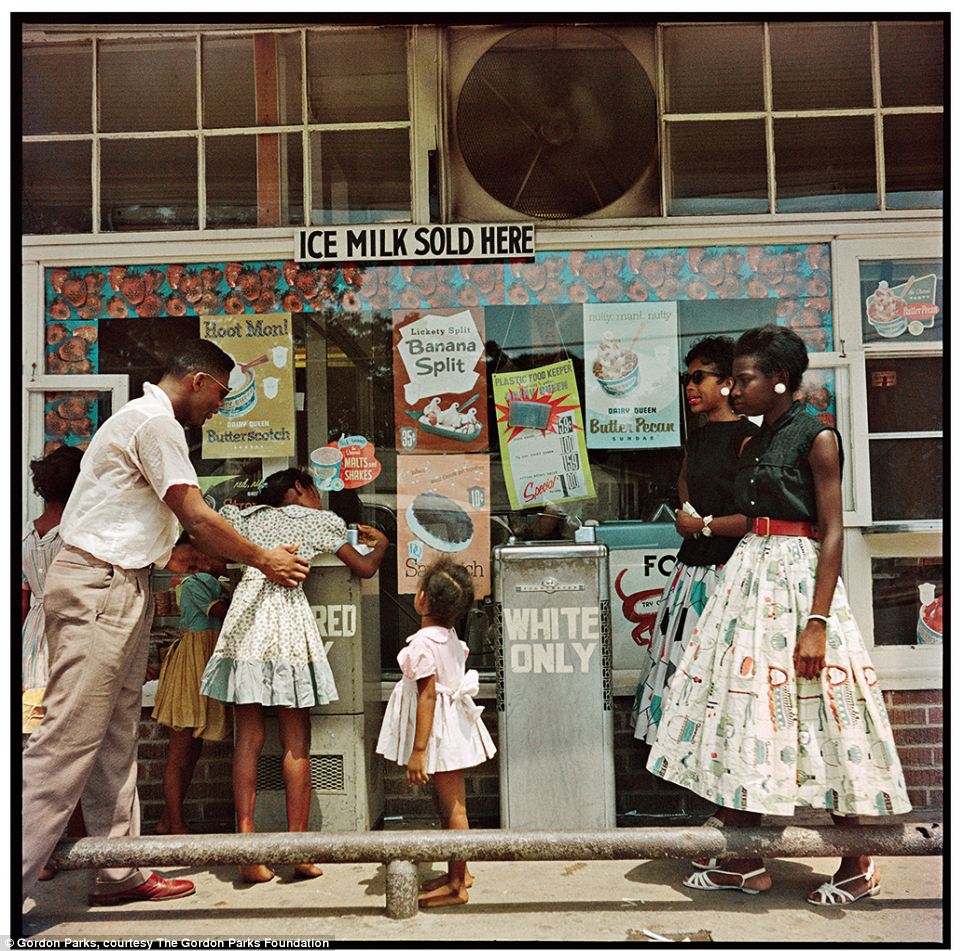
DRINKING FOUNTAINS - GORDON PARKS

I Drank From the ‘Colored’ Fountain

I was 10 years old. My parents, my little sister, and I had moved to Nashville, TN, from a little town in Southern Illinois the previous year. We were on an adventure, and everything – but everything! – was different.

Most of those differences were good and wrapped us in happy experiences and precious memories. The people were warm and friendly – eager to help in any capacity at all. We began making instant friends from the very first day, and many of those friendships lasted far into future years. In fact, I can honestly say that my greatest disappointment when we eventually moved back north was that there was absolutely no answering friendliness or help coming from the people in our new hometown. And developing genuine friendships when back in Illinois again seemed very hard.

The schools in Nashville were different as well. They seemed to be much more education oriented, with no ‘playing around’ like that allowed in our schools back in Illinois. Structured lunch periods, structured recess (for only one half hour each day), and intensely focused academic work at every grade level were the earmarks of the Nashville school system. In fact, when we returned to Illinois, my sister and I were almost one whole year ahead of the students in the same grades in our new school.

And then, of course, there was so much more to see and do than there had been in our former hometown. The all-night convenience stores had never even been dreamed about in Southern Illinois back then, but they were prolific in the big city and its suburbs. There were multiple museums, libraries, movie theaters, restaurants of every conceivable sort, lovely little independent bookstores, and huge department stores.

Our favorite department store was right in the middle of the city. It was the epitome of the department store of the 1950’s. Everything you could possibly want in the way of clothing, furnishings, appliances, entertainment equipment, and tools could be found under one roof. Prices ranged from exorbitant in some of the departments to modest when customers shopped the “Bargain Basement.” But everyone shopped the basement as well as the rest of the store, and it wasn’t unusual to see one of the big stars in country music purchasing petticoats in the basement right beside “ordinary folk.”

There was an exquisite restaurant on the fourth floor, with food and service that made guests glad they had “dressed up” to visit. But there was a “Lunch Counter” in the basement, and that was just as much fun in its different way. The counter was shaped in a huge square that wrapped around the center area where the food prep was done. Most week days, it was so crowded at the middle of the day that there were people standing and waiting their turn to sit down and order.

I loved that department store, and it was in that very store that I experienced a strange and disturbing epiphany. It was there that I first came face-to-face with the one difference in lifestyle that was not good – not good at all. Strange and disturbing as it was, though, I welcomed it and have been grateful for it ever since. The experience was not one that took place in a split second, as epiphanies often do. This experience developed within me over a period of time, mainly because I was gradually accumulating data and meditating on all of that data, examining my own emotions and my responses. And let me hasten to add that this one department store was not the only place where the situation I’m addressing could be found. In fact, it was in every public place throughout the city – throughout the south. And years later, I was to learn that many places in Illinois and other northern states had their own version of this problem, but it was not emphasized quite so publicly.

My epiphany began one seemingly inconsequential day as I stood in the midst of that department store and realized I needed a drink of water. Mom found the water fountains. There were two. One was labeled “White.” The second was labeled “Colored.” We were busy, so mom directed my sister and me to drink from the one labeled “White,” which we did and hurried on our way.

But the next time I was in that store and wanted a drink of water, since I knew where the fountains were located, I went on my own. I stood in front of those two fountains and read the signs and wondered. The question rolling through my ten-year-old mind was “Why would one have colored water?” And, naturally the next question was “Why couldn’t I have some of the colored water?” But because I had been admonished to drink from the one labeled “White,” I did so and went on my way.

Now, a handful of readers might possibly surmise at this point that I was lacking in normal intelligence. So just to put those ideas to rest I will tell you that I had been reading from my toddler years and had taught myself to write in cursive before I ever started into second grade. I frequently carried on conversations with adults and held my own. So, no, the explanation for my confusion does not lie in the level of my intelligence — but rather in the fact that I was fortunate to have Godly and wise parents.

My parents had never, in all my ten years, hinted in the slightest manner that black people were unequal to white people. They never talked negatively about black people, nor did they treat them any differently in business or social activities. In fact, my dad, in later years, told us about a Negro gentleman who had been a great friend to my grandfather in the years before I was born. Moreover, my mother was descended from the Cherokee nation, and that being an altogether different race as well, we knew that our blood line was mixed. However, the point never seemed important to us, nor did it ever come up in conversations. There had not been a great many Negroes living in the Illinois town where we lived, but I do remember one or two people of that race who crossed our paths occasionally, and I don’t recall having any feelings about them that differed from my feelings for white people.

In short, I was totally ignorant about racial prejudice and discrimination. To any readers who do not believe that racial prejudice must be carefully taught in order to be carried on from generation to generation, I will tell you that I am living proof you are wrong. I honestly did not know that it existed. And having absolutely no frame of reference for discerning the meaning of those labels on the two water fountains, I had no choice but to believe that the labels referred to the water itself.

So I continued to believe that the water fountain labeled “Colored” held colored water. And finally one day, as I stood alone before those fountains, preparing to get a drink, I took my courage – or my rebellious nature – into my own hands. I had been instructed that the store did not allow me to drink from the “Colored” fountain, so I assumed the store authorities would be watching to make sure I did not. But I just had to sample that colored water. So I looked around to make sure no one was watching. Not a sole was looking my direction. In fact, no adult was even within speaking distance at that moment. So I hurried up to the “Colored” fountain, pressed the lever, and waited expectantly.

It’s difficult to describe my level of disappointment. “Why it’s just plain water – just like the other one,” was my obvious overt reaction. But I drank anyway, hoping maybe it would taste different. Again, disappointment. But inwardly, I was more than disappointed. I was thoroughly confused.

That confusion stirred me to the point that I was willing to face punishment for my “crime” in order to get my curiosity satisfied. So I confessed to my parents that I had drunk from that fountain. “But the water wasn’t colored at all,” I complained. “It was just like the water in the “White” fountain.” When my parents confirmed that they had known that fact all along, I asked. “Then what does that sign mean?”

They explained the situation the best they could to a 10-year-old, emphasizing the fact that they did not agree with the practice, but that it was the law in that state. I was just flummoxed. Never, even in my inordinately active imagination, had I ever dreamed that people were treated this way because of the color of their skin. And for the first time, I think I realized that I should give some serious thought to who black people really were.

Adding fuel to that decision was another peculiar phenomenon that I became aware of during the same time. My sister and I discovered that black people were allowed to eat only at the lunch counter in the basement, and never in the Carousel Room. Then when we went into the store’s public restroom, which always had a black lady in attendance, we found that there were two stalls with unlocked doors, and one locked stall that required the person to pay in order to use it. By asking insistent questions, I was finally able to ascertain that no black people were allowed to use that pay stall, and white people who wanted a stall that they “believed” to be “cleaner” paid to use that particular stall.

Now, my parents were not paupers, and paying a nickel to use the toilet would not have affected their financial standing at all, but my mother never chose to use the pay toilets – except on the rare occasion that the restroom was packed with a waiting line, and we were rather desperate to go. On such occasions, she would acknowledge that wisdom dictated using the pay stall and getting the job done quickly. But my point here is that my mom never even considered that the restroom used by black people was any less clean than that used by whites. Again – I had no frame of reference for racial prejudice.

I cannot adequately describe how troubled I was as a result of those experiences. There was a heaviness and a sadness in my heart every time I thought of it from that time forward, just knowing that one group of people treated another group so shamefully. I had been taught the Word of God all my young life, and I believed it in my own heart. And, try as I might, I could not rationalize that holy Word with such unholy treatment. Yes, those two experiences dealt with seemingly minor issues, but they were just the tip of the iceberg – the surface symptoms of a raging internal disease. And the injustice of all of it weighed heavily upon my heart.

When I returned to that store, I wanted to stand by those drinking fountains and announce to people, “Hey, I drank from this “Colored” water fountain, and everything’s fine! We’re all the same! There’s no reason to separate us! You can take off the signs!” There wasn’t anyone around who cared to know, of course, but in my own ten-year-old heart, I was so glad that I had drunk from that fountain and could testify that we really are all the same.

My mind turned to the problem frequently during my growing up years, and the sadness grew as my understanding grew. I am now about five decades past those experiences, which initiated me into a level of man’s inhumanity to man that I would not have dreamed up even for a piece of fiction. Unfortunately, the years that followed would teach me much about that inhumanity and how painfully real it was in this world – not just for blacks, but for all the American Indians as well.

I want to think that some few things I’ve written, or said, or prayed over the years have made a difference. And most assuredly, the Lord has brought into my life an enormous number of Negro brothers and sisters who are believers and have become part of my family in the Lord. Those precious saints have enriched my life so much, and I can’t bear to think that they could be subjected to such treatment as that which has stained our past history. I do want to think – and believe – that the prayers and actions of each one of us individually – just like those of a ten-year-old child – can make a lasting difference.

I never freed a slave. I never took part in a civil rights march. My name won’t be found on any of the legal documents that gave black people the right to vote or that ended segregation in this nation. Nor am I listed in any roster of heroes of the Civil Rights Movement. And, no, I still have never been forced to pay for the privilege of using a public restroom. Nothing I did will seem the least bit important to anyone else, and there’s probably no one who would credit what I did as having any significance in the battle against prejudice and inhumanity in our society. But I know. And that’s enough. I drank from the “Colored” fountain, and I was so glad that I had done so. And it matters to me that, in the depths of my ten-year-old heart, I took a stand against those evil forces.

The signs are gone now from the water coolers. And all the doors on the stalls in the ladies’ bathrooms have swung free for years without the deposit of any coins. But the echos linger. Every time I remember, tears fill my eyes. And even though thousands of us honestly felt no prejudice whatsoever, I still feel some faint sense of guilt on behalf of all of us who called ourselves “white” back then. And I worry sometimes – plagued by the hints I see and hear every now and then – that the prejudice and inhumanity are not really gone from our land. But I pray: “Lord if, in the future, we ever face another time like that time – in which we dehumanize our God-created brothers and sisters for any reason — please give me the courage once again to deliberately drink from the ‘Colored’ fountain.”

~~~
(The photo is the personal work of photographer Gordon Parks, whose photographs were well-known by readers of Life magazine. His works have been published in a collection by Steidl, and can be found at this site: 
http://www.steidl.de/flycms/en/Books/A-Harlem-Family-1967/2940425559.html.
More information about Parks and his work can be found at the Gordon Parks Foundation site:
http://www.gordonparksfoundation.org/)

Along The River

When I chose the photo for my submission to this week’s WordPress Photo Challenge — Focus — I couldn’t resist looking through several other photos of a second river that I enjoyed during the same trip last fall. As I thought about that river, I also thought about the poem I wrote last April that shared some of my thoughts and feelings connected with it. So I went back and read the poem again, and I enjoyed it even more than when I wrote it. It goes without saying that I love this poem, mostly because it so honestly describes my response to the beauty and power of God’s creation and its ability to influence us. So — I decided I’d just re-post it and share it with my readers again. After all, many of you were not a part of my blogging family way back in April. Any of you who aren’t into poetry reruns can feel free to skip this post with my blessing.

Exif JPEG

ALONG THE RIVER

The sun is playing hide and seek with clouds
Along the river.
The clouds are gray, but friendly, soft, and free
Along the river.

I move unhampered by the flirting breeze
Along the river,
Breathing deeply of the moistened earth
Along the river.

Quiet now invades my mind and soul
Along the river.
I’m letting go of tumbling, troubled thoughts
Along the river.

My past recedes; my future quiet rests
Along the river,
And water speaks to waters deep within,
Along the river.

I sit and contemplate historic days
Along the river:
The generations served by this same stream
Along the river.

And sense that I belong to something great
Along the river:
A part of something bigger than myself
Along the river.

And far beyond my power to understand,
Along the river,
An elemental knowing I am known —
And I am loved —
By the Creator of the river.

~~~


In Answer to Questions Concerning My Personal Faith

Over the past several of years I have been so privileged to meet and get to know many wonderful people through this blog. So many of you are from completely different cultures and have multiple interpretations of man’s spiritual destiny. I value each and every one of you, and I’m honored that you want to know about my personal religious faith. One of the best ways I can explain my faith is to re-post an article that I originally posted on one of my ministry blogs. The article gives the clearest explanation of what I believe concerning the human race’s situation with regard to it’s need of a God, a Savior, and a guarantee of a joyous eternity. So I am posting that same article here in the hope that it will help answer those folks who want to understand my faith more thoroughly.

CROSS - PLAIN, THICK - QUESTS.What Is This Thing Called ‘Salvation’?

“Therefore, if any man is in Christ, he is a new creature (Greek: new species); the old things passed away; behold, new things have come. Now all these things are from God who reconciled us to Himself through Christ, and gave us the ministry of reconciliation, namely, that God was in Christ reconciling the world to Himself, not counting their trespasses against them, and He has committed to us the word of reconciliation. … Therefore, we … beg you on behalf of Christ, be reconciled to God.” (2 Corinthians 5:17-19).

“What’s it all about? This “being saved”? This being “born again”? What’s it all about? I just don’t understand it. And I could never get my life straightened out enough and cleaned up enough to fit in with Jesus Christ anyway.”

Ever felt that way? Have you ever felt that you might really like to turn your life over to someone stronger and wiser, who could get it straightened out and make some real sense out of it – give it some lasting purpose and value? But you just don’t think you measure up to God’s standards enough to come to Him?

Well, the good news – shouted loud and strong – in the scripture passage above is that you do not have to measure up to God’s standards – or anyone else’s. You don’t even have to get one little thing about yourself or your life made right before you come to God.

That’s right. I mean what I said. And I can say it with absolute confidence, because God Himself said it first. And He said it over and over again. The passage at the top of this article is just one instance, but, to me, it is one of the most important of those instances. I have two other favorite passages like it in importance: Romans 5:6: “Christ died for the ungodly.” 1 Tim. 1:15: “This is a faithful saying and worthy of all acceptation, that Christ Jesus came into the world to save sinners.”

Now, of course, if you don’t think you need a savior – if you believe you are holy enough to live in the presence of the holy God of the universe, nose to nose, eye to eye, breathing the same air He breathes for all eternity, without being cleaned up at all – then I’m not talking to you. But if you realize that you are not on the level of that holy God – that you are not righteous and pure enough by your own merit to live with Him – then I am talking to you – and so is He!

The simple truth is that the work has already been done for you. Jesus did it all. He gave up the privileges of being on the throne of Heaven, came to this earth as a man, and lived a perfect life for you. Then God laid all of the sinful nature (to which you are heir) and all of the rebellion, disobedience, ugliness, and hatefulness of all the sin in the human race on Jesus (2 Cor. 5 21), and put all the punishment for that sin on Him as well. He bore it all for you, and after His death on your behalf, He came up out of the grave – also on your behalf – with eternal life and the right to bestow that new life on you. We have “been crucified with Christ,” (Gal. 2: 19-20) and “even when we were dead in our transgressions, [God] made us alive together with Christ … and raised us up with Him.” (Eph. 2:5-6).

But when we decide we’d like to have that salvation and that new relationship with our Creator, we often hold back because we feel powerless to separate ourselves from sin or the world’s way of life – or even from our own selfish nature. We feel powerless to make ourselves “worthy” of Jesus’ sacrifice for us. Well, if you feel that way, rejoice! Because that means you know the truth: We are powerless! But that is okay. Because the work of saving us is His – and His alone! And it’s already been done.

That’s what our beginning scripture is telling us. When God raised Jesus from the dead, He raised Him up as the head of a body – which would be made up of believers – everyone who would believe in that finished work. That’s what the verse in Ephesians means when it says He “raised us up with Him.” And that’s what the passage in 2 Corinthians means when it says that God was – in Christ – reconciling the world to Himself. That word reconcile means to bring back into original or proper position and make the relationship right again. That’s what the Word says God was doing when He crucified Jesus Christ and raised Him up again and seated Him in power and authority forever. He was bringing “the world” back into right relationship with Himself.

Now look at the rest of that verse: “not counting their sins against them.” Who is the pronoun “their” referring to in this verse? The church? The “good” people? The people who call themselves Christians? NO! The only plural noun in that whole verse that the pronoun “their” can refer to is the word “world.” Do you get it? God was – in Christ – not counting the world’s sins against them any longer. God was – in Christ (only in Christ) – forgiving all the people in the whole world for every sin counted against them. Can you grasp that exciting truth? In the mind and heart of God, it is already done. In the mind and heart of God, all of your sins are already forgiven – in Christ!

You see, that’s why there is no other way to salvation and eternity with God. There is no other religion, dogma, or program that has inherent within it the forgiveness of all sin and the eternal life granted by God. That forgiveness and that life are only in Christ – because He’s the only one who paid the horrible price of suffering and separation from God that was complete enough and perfect enough to buy freedom for the whole human race.

So, your next question is probably going to be, “Well if it’s already done, then what is my part?” Our part is believing and receiving. Even before Jesus’ crucifixion, when His disciples asked Him, “What shall we do, that we might work the works of God? Jesus told them, “This is the work of God, that you believe on Him whom He hath sent.” (John 6:28-29).

Now, I do need to explain that the word “believe” from the original language means much more than mental assent. It means “yielding or surrendering to and obeying.” To truly “believe” means that you give yourself to it completely. But that is the beauty of it all. We do not have to do the work of salvation. We just have to surrender to that work and let it produce its fruit in us. How do we surrender? We simply pour out our hearts to this great, loving Jesus, who has done all the work. We simply tell him in our own words that we know we need what He offers and gladly give Him control in our hearts and our lives. (That’s what it means to make Him our “Lord.”)

Once we totally surrender, Jesus comes to reign on the throne of our hearts. From that position, He can begin to clean up everything else about us that needs cleaning up. You need never fear. Once He has the position of authority, willingly given to him by you, He knows how – and is well able – to do the rest of the work.

So what about that term “born again”? Go back to our original verse: “Therefore, if any man is in Christ, he is a new creature (Greek: new species).” When Jesus Christ comes in, our real man – the spirit man — is literally born again. A brand new species (the God-man species of Jesus Christ) comes in and generates its life in our spirit. (You must remember that man was created by a spirit God and therefore is primarily a spirit-being, having a soul and living in a body). Therefore the Word tells us again and again the we are to be aware of the fact that we are now “children of God.” (Romans 8:16, 1 John 3:2).

Now all of this work is done – finished. In God’s heart and mind it’s a “done deal.” But remember: it is done ONLY IN CHRIST. Therefore, it is only when we make the decision to yield ourselves to Jesus Christ and receive Him into ourselves and our lives that we get the benefit of this finished work. Although it is done, if we choose not to access it, we get no results from it in our personal lives.

You might compare it to the process of getting data from the Internet. You know there is data out there covering the subject about which you need information. But that data will do you absolutely no good at all unless you sit down, turn on your computer, take yourself to that site, open up the channel, and deliberately download that information. So — you must open up yourself to Jesus Christ and all He has done for you, and by believing (yielding, surrendering) download every single bit of it. It’s all yours. It has your name on it. But you have to hit the download (I Believe) button to receive.

So what is salvation? It is the free gift of a loving Father who has paid the deepest, truest, most sacrificial price to restore His rebellious children to Himself. It is the free gift of the brother Jesus, who has given Himself in our place and paid the full price, receiving brand new life to pass on to each one of us. The work of salvation has absolutely nothing to do with us. Our only work is to believe what He has done and surrender to it.

“For God so loved the world, that He gave His only begotten Son, that whosoever believes in Him should not perish, but have everlasting life. For God sent not His Son into the world to condemn the world; but that the world through Him might be saved.” (John 3:16-17).

~~~