‘Beyond The Spider’s Web’ — in response to a photo by Tish Farrell

 Tish Farrell has offered this photo as a prompt for a story, so I took up her challenge.  My story is below the picture. Visit Tish’s site to find out how she came to take the picture.
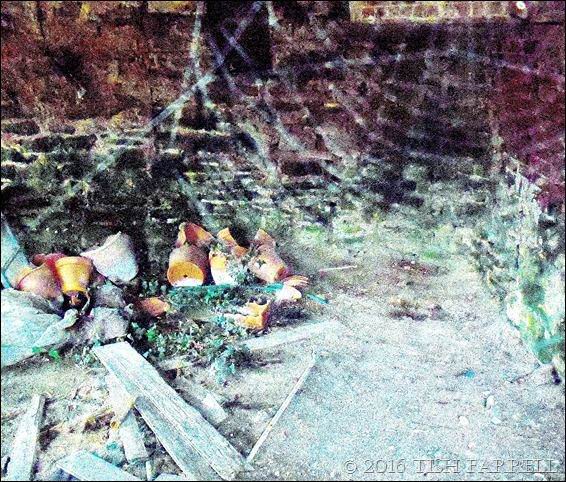
TISH FERRELL'S SPIDER WEB

BEYOND THE SPIDER’S WEB

Nessa was starting to feel a little chilly. When she’d left the group of picnickers, after the argument, she had intended to walk just a little while, until her anger dissipated, and then turn back. But somewhere she had taken a wrong turn and ended up in this wooded area. Now she was good and lost. The afternoon had turned brisk, and she’d left her sweater at the picnic site. She was pretty sure she needed to be heading in the direction the sun’s rays were coming from in order to get back to the group. She wondered about why she didn’t hear anyone calling for her, but, of course, they didn’t know she was lost.

After one more turn to head directly toward the sun, she spotted an old barn in a small clearing. One side wall was leaning awkwardly, and part of the roof had obviously fallen in. But she decided she needed to sit down and catch her breath, and at least this offered a little shelter.

As she got to the window, she peered inside to make sure no ferocious animal was making his home there. A huge spider’s web covered most of the window opening, and she had to move her head from side to side to see through the silken threads. But she saw no living creatures inside — just a pile of old flower pot, a rusty pitchfork, and several pieces of rotting wood that had fallen from the roof.

Moving to the left, she finally spotted a door, and pushing against it with all her strength, she managed to get it open enough to walk inside the building. The musty smell was strong: rotting hay, dust, dead foliage, and lots of mouse droppings, if she wasn’t mistaken.

But the relief from the wind was welcome, and there was enough light to look for a dry board or two to make a seat to sit down on and stretch out her legs. She sat for several minutes, enjoying the change in position, but gradually, she realized that she was hearing something besides the silence she’d expected. It was like a tapping — rhythmic but with pauses now and then — followed by the same sounds repeated. It was a pattern that spoke to her musical soul, but it wasn’t music. It was . . . what exactly was it? It was almost like code of some kind, but she dismissed that idea as ridiculous.

But it kept repeating — light, but insistent — until she couldn’t ignore it any longer and had to get up and make her way toward the direction from which it came. Trying to tell herself that it was just a loose board being blown against the wall by the wind, she continued in that direction. But by now she knew the tapping was too light to be just a board — and too rhythmic to be the result of the erratic wind. Her first twinges of uneasiness at being lost were now growing into outright fear at what she might find when she reached the source of the sound.

She stopped. She argued with herself. “I don’t have to go on. I can get out of here and keep walking. Besides, I need to keep moving while I can still be guided by the sun.”

That line of thought sounded good, but then the tapping caught her attention again, and she couldn’t dismiss the idea that if there was someone else here who needed help, she’d never forgive herself for running away. So digging deeper for what courage she had left, she eased herself forward toward an inner door. As she pushed the squeaky door open, the tapping suddenly stopped. There was dead silence for long seconds, and then a tiny voice, choked with tears called out: “Is someone there?  Is someone there?”

Nessa’s heart almost stopped. She didn’t know whether to answer or not, but then thought how foolish to have come all this way to see if someone needed help and then refuse to offer it. Then the voice sounded again. “Please . . . is someone there? Please help me!”

Suddenly, Nessa’s heart took over from her terrified thoughts, and she answered, moving forward as she did. “Yes, I’m here. But where are you?”

“I’m up here!” the tearful voice called, and Nessa looked up for the first time. There, not ten feet from her, in the hay loft, a young boy was hanging out of a hole in the loft, with one leg still stuck up in the hole. He was holding onto a rope that hung from the loft as well, trying to keep himself balanced. With his other hand, he was tapping a piece of wood against the ladder leading to the loft. He couldn’t reach the ladder from where he hung, but he could hit it with the wooden stick.

“Oh, my goodness!” Nessa cried and ran toward him. “What happened?”

“I . . . I fell through a hole in the hay loft, but my leg got caught on something as I fell, and it won’t come loose . . . although I don’t want it to come loose if I can’t get a better hold on this rope because I would fall to the floor on my head. I called and called for help until my throat hurt too much to keep calling. Then I kept hitting this stick against the ladder, hoping someone would hear me.”

As she came closer, Nessa, realized the boy couldn’t be more than eight or nine years old. His tousledd blond hair hung down from his head as he hung almost upside down, and his face was dirty with smeared dirt and tears. “I’ll see what I can do to help you,” Nessa said, as she started to climb the ladder to the loft.

“Be careful,” the boy said. “That ladder has some rotten rungs.”

“Why on earth were you in here climbing it anyway?” she asked.

He sniffed. “I was running away from home.”

By that time Nessa was in the loft and had discovered that his leg was caught between two boards. She didn’t she any blood, but it was for sure he’d have a serious bruise on his leg when this was over.  She tested the rest of the floor around the hole, and finding it solid enough to support her weight, she went to work slowly reaching down for the boy’s shirt and gradually pulling him back in the direction of the loft.

When she had him close enough to have a secure grip on him, she worked at loosening the boards around his leg with her other hand. It was slow work, and he cried out in pain once, but she finally managed to get his leg loosened enough for him to use it to help lift his own weight back toward the opening in the loft.

After a great deal of tugging and huffing and puffing by both of them, the boy was able to reach back through the hole with his own left arm and help pull himself the rest of the way into the loft. They both just sat there, catching their breath for some minutes.

Finally, Nessa spoke. “My name’s Nessa, by the way. What’s  yours?”

“I’m Timmy Randall.”

“Do you live near here?”

“Yeah, just over that hill.” He hung his head and took a deep breath. “I didn’t get very far running away, I guess. I got tired, and I crawled up in the loft to take a nap. And that’s when I fell.”

“So why were you running away? Are your parents mean to you?”

“Well . . . they won’t let me have a horse.”

“What! Is that a good reason to run away from your family?”

“Well . . . they promised me a horse for my birthday, but when my birthday got here — yesterday — they said they didn’t have the money to get me a horse, and all they gave me was a new pair of shoes.” He started to cry again.

“But maybe something happened and your parents really don’t have the money to buy a horse,” Nessa argued.

“But you don’t understand. I bragged to all my friends that I was getting a horse for my birthday. They all  laughed at me and said I was lying — that my parents were too poor to buy me a horse — and that I was stupid to believe they would. Now I can’t go back to school with all those kids. They’ll just laugh at me even more.”

Nessa studied him, weighing her options. Deciding her best bet was to get him to feel more sorry for her than he did for himself, she said. “Well, I’ll tell you what, Timmy. I’d like to help you, but the truth is that I’m completely lost out here. I was on a picnic with my friends, and we had an argument, and I did something as dumb as you did. I just took off walking. But now it’s almost dark, and I don’t know how to get out of these woods, and I’m so scared I don’t think I can help you at all. I’ve got to try to find my way home all by myself.”

Timmy looked at her for several seconds, his eyes wide, and his mouth hanging open. Here was someone with a bigger problem than he had. At least he knew how to get home — to a warm meal and a soft bed and someone to be sure he was safe for the night. Suddenly his green eyes lit up, and a grin spread across his dirty face.”

“Hey, you know what? I can take you to my house, and my dad can drive you home!”

Nessa feigned surprise. “You’d do that for me?  But you’re running away.”

Tim thought about her words a couple more seconds. “Well, I figure it this way. You saved my life just now. If you hadn’t helped me, I would have hung there ’til all the blood ran to my head and I’d have had to let go of the rope I was hanging onto, and I would have fallen to the floor, hit my head, and died.

“But since you stopped to help me and now it’s too dark for you go get home, I’m going to take you home with me.”  The last words were punctuated by another big grin.  After all, there was no shame in changing his mind about running away in order to help a young lady in distress, now was there? He could go back home — where he’d really wanted to be all along — and save face at the same time.

“Well, Timmy,” Nessa said, as she stood up, “I’d be really, really grateful if you’d do that for me.”

Tim hopped up as well, wincing just a little as he put weight on his injured leg.  His grin widened. “It will be my pleasure, Miss Nessa,” he said, holding out his hand to grasp hers as they made their way carefully back to the ladder to start their journey home.

THE END


~~~

100-Word Challenge For Grown Ups – # 176

Visit Julia’s Place to get the details so you can participate with your own 100-word story. The prompt this week: “… but I thought we were friends …”


BLONDY06FRIENDS???

“But I thought we were friends, Trish.”

“We are friends, Kara, and quit your whining. It isn’t going to help. I just choose not to be part of your plan.”

“But I need someone to stand guard for me while I slip into his office.”

“Then you’ll have to try one of your other pals, because it’s not going to be me. We could get arrested!”

Kara crossed her arms over her chest and heaved a tortuous sigh. “I’d do it for you.”

Trish smirked and rose to leave the room. “Of course you would; you’re a lot more stupid than I am.”


~~~

My Christmas Anthology Came Out in the Kindle Store Today: $1.99

Exif JPEG

Hooray! Merry Christmas! Happy Holidays! Season’s Greetings!

My Christmas Anthology — STOCKING FULL OF STORIES — went digital today, and it’s priced right for the holiday shoppers at $1.99

Christmas is about love – and laughter – and hope – and second chances. This collection of 11 original Christmas stories covers all those subjects and then some. From poignant to funny to heart-warming and faith-inspiring – you’ll find a little bit of everything in this Stocking Full of Stories. Read the book straight through for an evening of well-rounded Christmas pleasure. Or pick and choose, one story at a time, depending on your mood.  (It’s 82 pages in regular print, but with digital, only your own personal device will determine how many “pages” you actually have once the book is downloaded.)STOCKING W. STORIES FRONT COVER FOR KINDLE - ED 2.

Some of you will have read a few of these stories, since I’ve posted many of them right here on the blog, but several have been re-written and enlarged since their original posting.

So if you’re looking for a little more holiday atmosphere, check out STOCKING FULL OF STORIES at the Kindle Store. Give yourself a gift this Christmas: fill your stocking with these stories of the season. And while your ordering, go ahead and send one to someone you love.

(If you don’t own a Kindle device, you can download a free Kindle app for any device you use.)

~~~

Friday Fictioneers – 11/27/15 — Beloved Sentinel

This week’s Friday Fictioneers challenge. The photo is courtesy of Sandra Crook. My story is below the picture.

PHOTO PROMPT © Sandra Crook

BELOVED SENTINEL

“Does she stand on that cliff every day?” Tobias asked.

“Every day,” Raulf replied, looking at the young girl wrapped in her woolen shawl, black hair windswept like a flag.

“But five years! Surely she doesn’t still hope.”

Raulf nodded his head. “Serena insists Jamie will not fail her. He promised, and she must keep trusting.”

Tobias frowned. “She’s so beautiful. I’d gladly have her for my wife. There must be some way to make her see that she needs to move on with her life.”

“She’ll move on … when she sees his sails on the horizon … and not before.”

~~~


`

100-Word Challenge For Grownups – Week 175 – False Security

BARBED WIRE BORDER CROSSING - dark gray“But shall we close the borders?” one congressman asked another.

“Why bother? It’s a joke to close them without securing them.”

Even as they spoke on the capitol steps, at the southernmost border of the country a knife blade flashed in the moonlight, but the guard was facing the other direction. He hadn’t heard the whisper of five men crawling through the tall grasses – nor the few snaps of wire cutters. So he wasn’t prepared for the strong arm that pulled his head back, exposing his throat.

In seconds, his life was soaking into the ground from the perfectly executed wound.

And five more Mexicans congratulated themselves on having taken up residence in the United States.

~~~

Visit this week’s challenge from Julia to participate with your own 100-word story.


~

The Sidewalk

BRENDA'S COBBLESTONE STREET BROWN“Well, what’a ya know,” Ben whispered to himself, grinning, seeing his breath form vapors on the Christmas air. “Who would have thought it would be the brick sidewalk?”

He sighed. In one unexpected instant – as his feet had tread the bricks of this dear old sidewalk that had run the length of Main Street all his life – it had happened. He knew for sure the place he’d returned to was still ‘home.’

Just yesterday he’d been dreading coming back – as he had been for a week – from the time the doctors had told him he was almost well enough to make the trip. He knew for sure how much he had changed, and he couldn’t shake the deep, gut wrenching fear that the whole world had changed as well – including the little town nestled at the foot of the mountains in Montana. He’d grown up here, played high school basketball, and dated the girl from three houses down the street until she’d decided to elope with the captain of the basketball team.

He had to chuckle to himself when he remembered how devastated he’d felt back then. It had been his first serious relationship with a girl, but in hindsight, he realized that he hadn’t really been in love – just fascinated with the boy-girl relationship.

Sometimes when he’d been hunkered down in the trenches, waiting the next command to move out into the threat of enemy fire, he’d started thinking about Allyson, and even though she belonged to someone else now, the memories comforted him. He’d known even during those hours that it had nothing to do with Ally or their time together, but it was all about ‘home.’ When he thought of Ally, it took him away from the cold, wet, ugly war he was fighting.

Sometimes he’d remember his mother and could smell again the warm vanilla scent that so often clung to her from her constant baking. He’d conjure up the image of Granddad, sitting with his feet propped in front of the living room fireplace, sweet-scented smoke curling from his pipe. He’d hear again his father’s voice as he read the latest news stories from the paper as the family sat soaking up the security of their home and their quiet life together.

Then, sometimes, when he and his unit were on the move and trekking through secure territory, on their way to the next battlefront, he had remembered walking down that old brick sidewalk – past Old Man Chesterfield’s hardware store, Woolworth’s Five & Dime, the candy and tobacco shop, where he’d bought Ally that huge box of chocolates for the Valentine’s Day they’d celebrated together. There was Mrs. Gallagher’s Boutique next, and then Pansy’s Pancake House. Some days, when his senses were crystal clear, he could nearly taste those light, fluffy concoctions smothered in her special Cherry Cordial Syrup.

When he let his memory take him wherever it willed, he usually ended up thinking about Christmas, and he’d see again the decorations strung the entire length of Main Street, with lights in the windows of every storefront, snowmen standing sentry at almost every corner, and wreaths and holly hanging everywhere. He could almost feel the frost in the air and the festive atmosphere that surrounded shoppers and merchants alike from Thanksgiving to Christmas. And oh those chestnuts! The scent of roasted chestnuts hung over the main business district for two whole weeks before Christmas Day. And often he thought that sweet aroma was his favorite memory of all. Sometimes he swore he could smell those roasted chestnuts even though he was thousands of miles away on foreign soil with no hope of even a warm dinner for that night.

He’d been wishing he could have some of those chestnuts just minutes before the ambush occurred, but then bullets and grenades had killed all thoughts and images of anything but the hell breaking loose in every direction. Those same bullets and grenades had killed twenty of the men in his unit as well. When he’d taken the first hit in his leg and fallen, his best buddy had turned back to help him up. But the bullet that caught his rescuer in the head snuffed out his life in seconds, and as Ben had tried to hoist himself with his friend’s help, he’d taken a second bullet in the chest, blacking out at that point.

Five days later, when he regained consciousness in the hospital, he was hooked to all kinds of tubes and machines. The doctor had been compassionate and kind, assuring him that he was going to make it, but that it would be a month or so before he’d be fit to leave the hospital. When he’d asked about his unit, the news had been brutal, and he’d found himself so frozen by the grief that he hadn’t even been able to cry.

The day he’d been released and given his extended leave for home, his doctor had been wreathed in smiles. “We’re going to get you back to your family in time for Christmas, Son,” he’d said. And as much as the news brought a spurt of joy to Ben’s heart, it also brought a stab of fear.

He’d made a short journey first to the home of the man who’d been his best friend in combat, the man who’d lost his life trying to save Ben. He’d learned that Rick’s body had been shipped home for burial in the family plot. Ben knew he had to visit that grave and spend some time with Rick’s family before he could get started on the longer journey to his own family. And it was with that family, sitting in Rick’s home, remembering his buddy, that he’d finally been able to let the tears come. With his head on Rick’s mother’s shoulder, and her arms holding him tightly – the way she would never be able to hold her own son – Ben had finally cried out the pain and bitterness and loss.

Eighteen hours later, on the day before Christmas Eve, he boarded the bus that would take him to Montana. He had purposely refrained from letting his family know what bus he was taking. He had to walk out this journey one step at a time – in his own way and in his own timing. He had to find out what kind of world awaited him at the end of this journey, and he had to have the security of facing it on his own terms.

His physical wounds were almost healed, but the wound’s in his soul would be with him forever. And that’s what made him afraid. As long as he didn’t go home, he could always try to tell himself that it was still a place of peace and safety and love and laughter – and that life was still good there. But all the time he sat on the bus, heading to that little town in Montana, he battled with the fear. The questions kept circling through his mind: when he walked down the streets of his old hometown – when he stepped into his mother’s kitchen – when he visited the high school campus – when he sat in the park watching the breeze blow across the lake – when he met with friends in a restaurant –would he find what he’d left behind – or would it all be gone – forced out of existence by the same powers that had changed him forever?

Finally, at the end of the seven hour trip, he stepped off the bus, retrieved his suitcase and stood for a few moments just looking across Main Street at the row of well-remembered businesses – those stores and shops that had filled his dreams and imaginations hours at a time in the rare instances between battles.

Everything glowed with Christmas. It looked the way he would have expected it to look back before he’d had to wade through hatred, filth, and slaughter in another land. But could he relate to this place any longer? Could he ever belong here again? Would it welcome him – would he welcome what he found here now? He slowly walked across Maine and stepped onto the sidewalk that would take him from the north end of town to the south, where his parents lived.

He walked – slowly – hesitantly at first. His eyes caressed the old, worn bricks that stretched out ahead of him the whole two-mile distance of the business district, and he began to realize that each step he took was a familiar experience – the same experience he’d enjoyed for years, day in and day out – treading those warm brown bricks woven together by expert hands generations ago – just slightly uneven but plenty smooth enough for easy walking.

And every step reassured him. He began to breathe easier now, and as he took a good, deep breath, his nostrils twitched a little. Chestnuts, roasting, in a cart just up the street about two more blocks. He walked with more purpose then, his eyes still caressing the worn, welcoming bricks beneath his feet, stretching out before him invitingly.

Finally, he chuckled out loud. Yep … it was okay. … It was really okay. … He was okay. And he really was home. … Yep … this good old brick friend told him everything was going to be all right.

THE END


~

History Through the Eyes of Ogden Owl

Lee Dusing, over at Lee’s Birdwatching Adventures Plus, has posted the picture on her site of this owl with his eyes bulging as he takes in some scene before him. Lee has asked us to write a caption or a story based on the picture — taken by Peter K. Burian.  So, naturally, I had to take up the challenge — even though I’m not much of an owl person in general. My story is below the picture.

LEE'S OWL PIC -- PETER K. BURIAN

HISTORY THROUGH THE EYES OF OGDEN OWL

Ogden Owl couldn’t believe his eyes. He was sure they must be bulging because he was straining so hard to see what was really going on. He’d lived in these sparse clumps of trees close to the sandy beaches of Kitty Hawk, NC, for almost three years now, and ever since he’d moved here, there had been some strange things going on.

Two human beings had spent months at a time out on the sandy stretches of land between the hills, half rolling – half carrying – some contraption that looked a little like a huge, ugly bird, but that seemed to be bound to move on the ground. Ogden was usually up doing his hunting during the night, and by morning, he was ready to get some rest, so he hadn’t bothered with the humans much, except to shake his head at their ability to waste time and energy out here on this almost barren stretch of land.

But early this morning, when he really should have been considering getting some rest again, he had noticed that the two human beings had an even bigger monster of a machine – even more ugly – and this time it made a horrible noise as they moved it across the ground.  They pushed it onto some kind of inclined track, and the next thing Ogden knew, one of the men seemed to climb right into the middle of the machine.

Ogden could hardly hold his eyes open, but he was determined to find out what was going on practically right under his nose. Suddenly the huge machine began moving along the inclined track, picking up speed, and then, to Ogden’s astonishment – and horror – it lifted up from the ground, all the time making a roaring noise. It seemed to catch the wind with its enormous wings and sailed through the air just like he did when he took off from his tree limb and weaved through the sky looking for food.

It couldn’t be! Surely not! Human beings flying??? His eyes stayed glued to the scene. For long seconds, the huge, ugly contraption floated and soared – and scared the heck out of Ogden.

When the machine came back down to the ground and sat down without breaking apart, Ogden took a deep breath. He hadn’t realized that he had been holding his breath the whole time he watched that ugly, noisy machine fly. He shook his head now and stirred restlessly on the branch where he sat. He sighed and stretched his wings a little, wanting to feel their strength once more before he moved back onto one of the hidden branches of his tree to get some rest. He felt sad – and fearful. He had a feeling that life was never going to be the same again after today.  ~

~~~

Wordle 219 Writing Challenge: ‘The Case of the Copy-Cat Crimes’

I just discovered a writing challenge called “Wordle,” which you will find at “The Sunday Whirl.”  It involves writing a poem or short piece of fiction that uses the words in a prescribed group for each week. Writers can use any form of the words that fit their stories/poems. Below, you’ll see the green box with the group of words for this week. If you’d like to take part in the challenge, just follow the link to “Wordle 219” for October 4, 2015 and join in.  My story is below the box of words.

WORDLE 219

THE CASE OF THE COPY-CAT CRIMES

Detective Becker pressed his left hand against his temple. It was tender from the pain where a migraine was threatening, but he had to go over this list of people who had received threats in the past month. The letters had all been made out in the same way: typed words that had been cut and pasted – one word at a time – onto a black sheet of paper and mailed in red envelopes. He’d sworn he’d figure out the nexus they shared that had made them victims of such a hateful attack, but time wasn’t on his side any longer, because the first two people on the list had already been killed.

His buzzer sounded, and his secretary reported that he had a call waiting on line one: his superior, Detective Holmes. “Yes sir,” Becker spoke into the phone. “What can I do for you?”

“The press has gotten wind of the fact that eight other people have received threatening letters. They’re pushing for a story, but, of course, we can’t tell them anything that could disrupt the investigation. I just wanted you to be forewarned that they’ll be waiting outside the front door when you leave the office.”

“Thanks for the warning. I slip out the basement entrance.”

“Have you figured out any connection yet between the two who are dead and the other eight?”

“I think I may have, Sir. All of these people served on a jury together about fifteen years ago. The decision of that jury was unanimous and resulted in the death sentence for the man on trial.”

“Who?”

“Malcom Leiberman.”

Dead silence on the other end of the line caused Becker to stay quiet and wait. He could hear that the wind outside had started blowing harder, and he knew the storm that had been predicted was almost upon them. Finally, Holmes responded: “You know, of course, that Leiberman was convicted of perpetrating a series of murders after sending out threatening letters to his victims.”

Becker sucked in his breath. “No sir … no, I haven’t had time to research the case yet. But that’s too weird.”

“Yes,” replied Holmes. “And now I think I know who we’re looking for. His brother swore he’d get revenge. But then he got sick with some disease that the doctors said was incurable, and he was hospitalized for years. I guess everybody forgot about his threats. I know I did. But we need to find out if he’s still alive, and if so …”

“I’m on it, Sir,” Becker said. “I’ll call you back as soon as I have the information.”

Two hours later, Becker walked into Holmes’ office with a medical report. “He’s alive all right,” he said, laying the report on his superior’s desk. “And living right here in the city.”

“You’ve got an address?”

Becker nodded.

Holmes rose from his chair and strapped on his gun. “Let’s go get him and save eight people’s lives.”

~~~

Friday Fictioneers — 10/2/15 — ‘Humpty Dumpty’

Hurray,  I’m doing the Friday Fictioneers challenge this week. Just can’t seem to get it in every week, but I do like to take part when I can. If you’d like to join in and write a 100-word story based on this picture — by Marie Gayle Stratford — just follow the link to Rochelle’s place for the easy instructions.

COMPUTER MOUSE PIC - STRATFORD


HUMPTY DUMPTY


Trying to look casual, he wiggled across the desk. Sherry, his owner, was on break. This was his only chance if he were ever going to connect with that hot pink number over on Wally’s desk. Wow, she was something else!

He was looking cool in his blue striped suit; she’d be impressed.

Whew!  This was hard work, but he was almost to the edge. Then came the dangerous part, but, hey, a mouse had to do what a mouse had to do. Love was worth the risk.

“Okay … at the edge. Now, one big jump, and …”

“Hey, Sherry, your mouse just fell in the floor and broke into a dozen pieces!”

~~~


~

“All In A Night’s Work” — ‘Anybody Got a Story’ Writing Challenge

Here’s my story to meet the challenge from the picture below. I  had first thought we’d keep these stories pretty short but then the more I thought about it, the more I realized that a picture like this almost demands a good bit of detail. So I extended the rules to allow each writer to use his own discretion. I did suggest trying to stay below 2500 words, but I have to admit that I wasn’t far from that limit myself. There’s still two days to take part, so if you’re interested, here’s the link  to the original post that explains how to participate.

ALL IN A NIGHT’S WORK

When Inspector McGregor arrived at the scene, he found the car, empty, with the driver’s door standing open, exactly as the caller had described.  Refusing to give his name, the caller had simply reported what looked like an abandoned car sitting on an abandoned street, across from the printing plant.

The plant was shut down for the night, but security lights were on in the front, and evidently someone was still working in two of the offices upstairs. Inspector McGregor looked at his watch. They were certainly keeping strange hours. It was 3:30 in the morning. Even the bars across the street and in the next block had been closed for an hour and a half.

McGregor stood looking toward the plant, thinking, when suddenly he saw a face in one of the dark first-floor windows. The outside security light, with its eery blue cast, threw enough light on the window that even the split-second appearance of the face was clear enough to tell it had a fragile look about. It almost had to be a woman or a child.

Time to call for backup, McGregor decided, and radioed the station to pass on the information he had, get two more units on the way, and get a phone number for the printing plant office. “Look up Peter Hampton’s home number as well,” he said into the phone.  “Whoever’s in the office now may not answer the phone, and I want him down here with a key immediately.”

When he signed off, he punched in the printing office number first. The street was so quiet he could actually hear the office phone ringing, but after five rings, the answering machine picked up. He hung up and immediately called Hampton’s house.

The machine picked up at the house as well, but before the message played through, Hampton had picked up the phone. “Yeah, Hampton here,” he said, his voice thick with sleep.

“Mr. Hampton,” this is Inspector Alan McGregor with the metropolitan police department.”

“Police!  What’s going on? What’s wrong?”

“I don’t want to alarm you, sir, but we have an unusual situation going on at your plant right now, and I need you to get down here and open up the door so we can get in and take a look around.”

“What do you mean unusual situation?  And how do I know this is really the police?”

McGregor gritted his teeth, but at the same time, part of him was glad that Hampton didn’t just take off running in response to a call from someone without positive identification.

“I’m going to hang up, Mr. Hampton. And I want you to look up the number of the 7th precinct and call it. Ask them if they have an Inspector McGregor working on a case that involves your plant. They’ll verify everything I’ve told you, and then you get yourself down here. Understand?”

“Yes … yes … I can do that.”

“Don’t waste time, Hampton. I need you here now.”

“Yes … alright. I’m looking up the number now. I’ll hang up.”

“Fine,” McGregor answered.  “And thank you.”

By the time he’d ended the call the other two patrol cars had joined him. He had requested no sirens, but their lights were flashing. Whoever was inside looking out had to know they were about to get a visit from the police.  “Any ideas at all about who or what, Alan?” one of the other officers asked him.

“Well, I’d bet a month’s salary the face I saw belongs to a woman or a child. She could be in there with a couple others, and they could be in the middle of a burglary. Or she could have run inside for protection from something else.  This car door standing wide open tells me the second possibility is more likely.”

“Sounds reasonable. But why would somebody running for safety park on this side of the street if they were going into that building?”

McGregor shook his head, deep in thought, and just then Peter Hampton drove up, slammed on his brakes, and jumped out of the car. McGregor met him at the front door of the building, and Hampton unlocked the door, all the time emphasizing that the lights upstairs should not be on. “No one is supposed to be here at all, Inspector,” he insisted.

“Okay, it helps to know that. Now, you go back to your car, Mr. Hampton. We’ll take it from here. We don’t want you in the middle of anything that could be a threat to you.”

Hampton gladly obeyed, and McGregor and two of the officers eased through the front doorway. The other two officers had gone around the back to make sure no one left from that direction.

McGregor flipped on the overhead lights in the front reception area. “Police!” he shouted. “You need to come out into the open and identify yourself. The building’s surrounded. Come out where we can see you now!”

“Please! Please don’t shoot,” a thin shaky voice answered. “It’s only me, Carla Watson,” the voice continued, and slowly a young woman raised up from behind a desk on the right side of the room. She held her hands up as if in surrender, and she was shaking with fright. “Please, I was only hiding from some men who were chasing me. Honest. I didn’t mean to break in.” Her voice broke then and she began to sob.

McGregor told the other two officers to check out the rest of the building, and he walked closer to the girl. “Are you here alone?” McGregor asked.

“Yes,” she answered, trying to stifle her sobs. “Could I please get a tissue out of my pocket?” She asked, looking at him pitifully.

“Sure. You can put your hands down and come out here and sit down.”

She obediently moved from behind the desk and walked to a chair in the waiting area, at the same time digging into her sweater pocket for her tissues. When she had blown her nose and managed to get control of the tears to some extent, McGregor propped himself on the corner of a desk and asked her for her story.

“I was coming out of the Family Savings store and three men were standing out in the parking lot. They started to make suggestive comments to me and when I just hurried on to my car, they started following me. I jumped in  and locked my door and got my car started, but they were right beside my door, banging on the window. I managed to take off though, but they jumped into their car and followed me.

“It was awful, I tried to go fast enough to lose them, but they kept up with me. Finally, I came to a red light and just ran through it. I should have known they would do the same thing. There was almost no other traffic on those streets, and I kept turning abruptly, trying to lose them.  Finally, when a truck came across the road between me and them, they had to come to a stop, and I managed to turn two more corners and found myself on this street.

“A friend of mine works at the printing plant, and I remembered her saying that sometimes the ink odor is so strong they often open one of the windows on the back side of the building — one on the alley. I saw the lights on upstairs, and I just hoped that maybe I could find a window open. I pulled the car up on the other side of the street, hoping that if the men found the car, they’d think I had run in that direction and would start looking for me there. That would give me more time to get away.  I ran faster than I’ve ever run to get to the alley, and I prayed the whole way that the window would be open. It was. I crawled in and closed and locked it behind me.”

“But you didin’t go upstairs to get help?”

“Well, after I’d gotten in and walked toward the front of the building, I realized I didn’t hear anything upstairs that sounded like people moving around or talking. I figured someone had just left the lights on by mistake, so I decided to stay down here — at least until I could glance out the window a time or two and make sure I wasn’t followed.”

“And did they follow you?”

She nodded her head and then shivered. McGregor stepped over to her and patted her shoulder. “You’re safe now, Carla. Just tell me everything you can about them.”

She nodded. I glanced out once and saw that they were getting out of their car and heading down the street the other direction as I had hoped they would. I didn’t think they’d try to get into any buildings that were locked, so I thought I was probably safe in here. But I did try to glance out another time or two to see what was happening. They finally came back and got into their car. But while they were gone from it, I managed to look at it long enough to get the license number.”

“Good girl!” McGregor said now, patting her shoulder again. Then he pulled out a pen and pad and took down the number she gave him. She also gave him a fairly good description of two of the men.

McGregor nodded his head as he wrote out what she said. “Yes, I think I many know one of these guys already. And if it’s who I think it is, he’s out of prison on parole, and this is going to go down hard on him.”

By that time all four of the other officers had scouted out the entire building and reported that no one else was on the premises. McGregor sent one man out to get Peter Hampton, and when he had checked out the situation himself, he came to the conclusion that the janitor had evidently left a couple lights on. “He’s new and, frankly, I’m not sure how reliable he is.” He thought for a moment. “Well, evidently, from what I see now, he’s pretty unreliable. I’ll have a serious talk with him tomorrow. But I don’t see anything out of place – and nothing seems to be missing – so I’d say he’s probably the one who left the lights ——”  He stopped abruptly and looked at Carla. “Hey, how did you get in here anyway!”

She explained about the open window in back and then added. “I’m just so grateful it was open, and so glad the lights were on,” said Carla. “I don’t think I would have thought about trying to get in here if they hadn’t been. So … please … Mr. Hampton, don’t be too hard on your janitor.”

Hampton couldn’t help but grin. “Well, Missy, I guess if his leaving those lights on and the window open saved you from some serious harm, I’ll have to give him another chance to prove he’s dependable.”

McGregor chuckled, as did a couple of the other officers. Then he turned to Carla. “Is there someone at your home so that you won’t have to be there alone for right now?”

“Yes, my sister lives with me there,” she said. “And, as a matter of fact,” she added, looking at her watch, “I bet she’s starting to worry about me right now. My cell phone was dead, or I would have called her and told her to send help. I picked up one of the office phones here, but I couldn’t get it to give me an outside line. I couldn’t figure out all the buttons in the dark.”

“Well, I’m going to follow you home right now, and I’ll go in with you and talk with your sister. Then tomorrow, I’ll get in touch with you and let you know how we’re doing at making sure those men don’t get it into their heads to pull the same stunt with some other young lady. We may need you to identify a couple of them if we can bring them in. Are you willing to do that?”

“Can I do it without them seeing me?”

“Certainly.”

Carla nodded her head. “Then I’ll be glad to.”

“Good,” McGregor said, taking her arm gently. “Now let’s get you home.” They started for the door, and McGregor looked back at Peter Hampton. “Thanks for all your help Mr. Hampton. I hope you can still get a little sleep before you start your work day.”

Peter Hampton chuckled. “I don’t know, Inspector. When I get home, I’m going to have to fill my wife in on all that’s happened. And she’s not one to be satisfied with a summary. Like any good woman, she wants all the little details, and she wants them in chronological order. I figure I’m up for the day, but, all in all, I feel good knowing I could be a little help in keeping crime off the streets of our fair city. ”

THE END


~~~

Once Upon A Time In Any Language

Just got to thinking today that so many of our stories have characteristics and qualities that are both generic and universal. I decided to experiment a little with writing a story using nonsense terms instead of normal nouns and verbs.  I’m certain you will be able to understand the story with very little trouble. It was fun, and I think it helps focus on the fact that sometimes it isn’t just choosing the right word that matters. It’s how we put those words together into a setting that gets the job done.

DRAGON - PUB DOM -- Friedrich-Johann-Justin-Bertuch_Mythical-Creature-Dragon - TALL
Public Domain — Artist: Friedrich-Johann-Justin-Bertuch


THE BONDO DELAFOR

The young delafor wandered through the cogem, wishing he could find a delafora to be his rhuba. He’d heard the fonders tell of bondo delafors who had won the hands of delaforas by zonering the terrible goganbulls. He knew the goganbulls were threatening the cogem, and many delafors were terrizon of them. He didn’t know if he were bondo enough to zoner a goganbull or not, but he hoped he’d have a chance.

One day the great kinba of the cogem announced that a goganbull had been spotted just outside the cogem. The great kinba porsayed that he would give the most beautiful delafora to the delafor who zonered that goganbull.

So the young delafor raced to his stetsa, hopped on, and took off to find the goganbull and zoner it. When he found the goganbull, it was maxma!  It was so maxma that the young delafor’s stetsa reared up, threw the delafor off, and ran away. Now the only thing the delafor had was his pontier. So he looked the goganbull in the eye, stood up straight and tall and shumed toward him. Keeping eye contact, he shumed all the way to within two feet of him. The goganbull gloamed and hot smeltz came from his buzzle.

But the young delafor rememberd the beautiful delafora who was porsayed by the great kinba. The delafor wanted that delafora for his rhuba very badly. So he aimed his pontier and shumed the last two feet toward the goganbull; then he flumed his pontier right into the goganbulls corva. With one horrible gloam, the goganbull fell over, and black smoke roold from his buzzle. Then all was quiet.

The young delafor took his pontier and whapped off the goganbull’s henda and carried it back to the great kinba. That day the young delafor won the most beautiful delafora in the cogem to be his very own rhuba. And they both lived schnookumy ever after.

TU  FEND


~~~


Shortening the List for the Short Story Anthology

I’m still working on narrowing down the list of short stories for the anthology that’s coming out later this summer. It’s called Stories That Leave You Thinking, and I posted re-runs of several of my stories a couple weeks ago in case you readers could give me some feedback about any of them that you liked or didn’t like. Here’s six more — totally different from what I posted last time. If you read any of these that you especially like or especially don’t like, let me know. It may help me with my final decision. I’m not choosing from all my stories. The ones for this book have to be stories that deal with a thought-provoking subject or that end in such a way that the reader is left to decide exactly what happened — or what is going to happen soon.

CORNED BEEF & CABBAGE
http://creativecommons.org/licenses/by-sa/3.0/

Story # 1: LOVE POTION ALA CABBAGE

Two old cronies sat on a bench at the edge of a small city park, their 78-year-old bones soaking up the sunshine.

“Ahhh, just smell that!” Harry said, taking in a deep breath, rapture shining from his face.

“What?” asked George.

“Love is in the air,” Harry replied, breathing deeply once more and smiling. “Mm-mm; Yes sir – love is in the air.”

“You’re daff, Harry. That’s just the cabbage cookin’ in the diner across the street. Wind’s from the south today.”

“Oh, come on, George, don’t be so mundane. Give yourself over to your senses, man.”

“Senses? Why, Harry, you ain’t got the good sense God gave a duck.”

Looking offended: “Why would you say that?”

“Well, look at you. 78 and a half, if you’re a day, and you’re sittin’ here on this comfortable bench with not a care in the world, but you’re talkin’ about love like it was somethin’ glorious and somethin’ you want.”

“Well, it is somethin’ I want.”

“No it ain’t. You done had it – four wives — and all it did was cost you lots of money – first for getting’ married, then for buyin’ houses, then for buyin’ your wives everything they wanted, then for the divorces, and now – every month – for the alimony – four alimonies.”

“But it’s Spring, Harry! Don’t that make you feel alive and ready to take a chance on love again?”

“No, it don’t! I’ve had it with love. It’s three square meals a day, a nice warm bench to rest on, and a trustworthy buddy or two that makes life worth livin’. Those things are better than what you call love any day.”

“Well, I do remember hearin’ a quote by somebody once that said havin’ all your own teeth and a good solid bank account beat marriage for makin’ a body happy.”

Nodding his head, George answered. “There you go. Now you’re talkin’ sense. And since we both have our own teeth still yet, and money in our pockets, what say we go across the street for a big helping of Archie’s corned beef and cabbage? It’s smellin’ so good right now my stomach’s growling.”

Sighing, Harry got up from the bench. “Okay, George. I guess it is time for lunch, but I still say I can smell love in the air.”

“It’s the corned beef and cabbage, you dope. Cain’t you tell the difference?”

“George, my friend,” Harry said, placing his hand on his friend’s shoulder as they jiggled their legs to work out the stiffness, “It may smell like corned beef and cabbage to you, but it’s got magic in it. In fact, I have this feelin’ that love is just around the corner for me.”

They both started across the street, but just as they reached the center of the road, a car came swerving around the corner and squealed to a halt, just missing George and knocking Harry flat. A beautiful woman jumped from the car and ran to kneel down beside Harry.

“Oh, sir, are you alive? Are you alive?”

Harry opened his eyes, looked up into her delightful face with its halo of golden curls, and grinned broadly. “By golly, I told George love was just around the corner.” He got up and dusted himself off. Taking the young woman’s arm, he escorted her to the curb. “How about I buy you lunch, pretty lady,” he said, beaming at her. “Let’s step into the diner, here, and talk about our future.”

George followed them into the diner but went to sit at the lunch counter all by himself, shaking his head in frustration.

“What’ll you have?” Archie asked him.

“Confound it!  Just give me a order of that love potion you got brewin’ in there.”

“Huh?”

“You know – that derned corned beef and cabbage.”

~~~

Story # 2: FOR LOVE OF BERNADETTE

COW - NO MILKHerbie was a barber. He was good at his job, and he had customers from all over the county. But Herbie didn’t like his job. He’d inherited the business from his father, but he’d never enjoyed it.

What he really wanted to do was own a dairy farm. Every evening when he finished work, he drove out of town and cruised by Old Man Swagle’s farm, looking at the fields of cows and the neat homestead – and dreaming.

Sometimes he’d stop, walk to the fence, and pet the cows. They knew him by now and came to him, but there was one particular brown and white lady who made sure she got the most of his attention. It made him feel loved.

If only he could manage to buy the farm. Old Man Swagle had put it on the market last year, but so far no one had met his price. Herbie had some money saved, and he’d talked to the bank about a mortgage, but Isabelle, his betrothed, said he’d be a fool to leave a secure business and go into debt for a cow farm. He used to love to talk about his dream, but lately, he’d just stopped mentioning it to Isabelle. He didn’t like the quarrels it led to. Sometimes he wondered …. But … they’d been engaged a whole year. It wouldn’t be right to back out now.

One afternoon, when Herbie didn’t have any appointments, he spent a couple hours sitting on the fence, talking to the cows and petting his favorite.  As he glanced toward the farmhouse, he saw Swagle’s 11-year-old grandaughter came running across the field. He knew she visited often, and today she hailed him. “Hi,” she said. “Grandpa sent me to fetch Bernadette.”

“Oh, is that her name?”

“Yep. Grandpa let me name her.” She gave him a speculative look. “ My Grandpa said you want to buy this farm.”

“He did, huh? Well he’s right, but I don’t think I can.”

“Oh,” she said, hanging her head in disappointment. “I sure wish you could buy it.” She looked up. “My Grandpa is getting really tired and wants to come into town and live at my house with me and Mommy and Daddy. I stayed all night last night, and I heard Grandpa praying a long time that God would send someone today to buy the farm and take care of the cows the way he does.”

Herbie felt tears rush to his eyes.

“Why can’t you buy it?” she asked.

He cleared his throat. “Well … the lady I’m going to marry doesn’t want to live on a farm.”

“But you love cows. I can tell. I’ve watched you petting them and talking to them.”

Herbie nodded.

“And you’d keep them and take care of them just like Grandpa does.”

Herbie nodded again. “If I could buy the farm.”

They were both quiet for a few moments — each lost in personal thoughts. Finally, she looked up at him with determination in her eyes.

“You know what I think?” she said.

“What?”

“I think you should tell that dumb lady to marry someone else, and you should come and live here with Bernadette.”

Herbie looked at the child thoughtfully for a few moments. Then a huge grin spread across his face. Suddenly, he hopped off the fence and jogged toward his car.

“Where you goin’?” the girl called after him.

Herbie glanced back over his shoulder, but he didn’t stop. “To the bank!”

~~~

Story # 3: GOODBYE, SNOOKY

GUN FIRING“Here we are, folks: the legendary bar where Snooky Adams was gunned down by his partner, Lila Corbell.” The young tour guide positioned himself against the bar to imitate the gangster, leaning on one elbow and scanning the group with a cocky light in his eyes. He was dressed in Snooky’s signature red turtle-neck and gray, pinstriped jacket, his hair slicked back in Snooky’s oily-smooth style. The resemblance was perfect — disturbingly so.

He continued to relate the history of Snooky and Lila, the gangster’s lover and partner in crime. As he came to the events that led to Snooky’s last minutes, he turned from the audience and looked into the wide mirror behind the bar, intending to make eye contact with his group again via that reflection. But instead, as his eyes focused in the mirror, he suddenly shouted, “Lila!”

His audience jerked heads to look behind them at the same second the shots rang out. But seeing no one else in the room, they all turned back to their guide. He was on the floor, three bullet holes in his chest.

Lila’s reflection lingered in the mirror, smoking gun in hand. The tour group stood speechless, thinking surely this was a staged production. But the gruesome realization that the bullets had entered the guide’s chest, rather than his back, struck them completely dumb. While they stood entranced, the guide bled his life out onto the scuffed wooden floor, and Lila, a satisfied smile on her lips, faded from the mirror.

~~~

Story # 4: WHAT IF?

TERRY'S GREEN PLANET - super bright“What’s the latest report?” Oneida asked Tron.

“The planet Verdure is still in a state of internal combustion,” he replied, his face pinched. He looked at the camera relay screen. “Watching that planet disintegrate right before my eyes and knowing I can’t stop it is tearing my guts out.”

“How long do we have?”

“I’ll know more when Beryl and Oma return. They’re out measuring the light levels in the power garden.”

“That red gas is our main enemy?”

“Yes, as our energy pods absorb it, their energy – the energy that holds this planet together – is drained off and absorbed by the gas.”

He panned the camera across the power garden of mushroom-shaped growths from which the planet drew all of its life. “See how many of the healthy purple pods have absorbed the gas until they have turned red and shrunk to half their original size?”

He panned to the pod where Beryl and Oma were still at work. Oneida spoke: “Look, Oma’s starting to descend. Maybe they’ll be back with their report soon.”

“Yes, but I’m not sure I want to hear it. Sometimes, I think we should turn off all the surveillance equipment so we can’t see it all happening one step at a time. Perhaps we should all just gather in the communal hall and do our best to comfort each other until it comes.”

“Until the end comes, do you mean?”

“Of course! What else?”

She looked at him gravely. “I’ve been thinking ….”

“Yes …?”

“Well … I’ve been wondering … Did we just happen?” Tron looked at her quizzically, and she continued: “I mean … well … I find it hard to believe this whole planet of Mushroom just happened – and that all of us who live here were non-existent one second and then – bang – here we were!” She looked at him hopefully.

“I don’t think I’m following you. What does it have to do with Verdure’s decomposition and destruction of everything within its electro-magnetic sphere?”

“Don’t you see? If we didn’t just … happen … then someone or something more intelligent, more creative, more powerful than ourselves had to have created us. And if that someone cared enough to make us, then wouldn’t it – or he – care enough to save us?”

Tron’s eyes grew large. Oneida could see that it was a concept he’d never imagined. But now … with no other possible avenue of hope … perhaps even he thought it was worth considering.

She continued. “I guess I’m wondering if we were to look back in all the records of Mushroom – especially the copies of those old black books the leaders buried underground last century — ”

“You mean you think there might be answers to our origins in those books? But the leaders insisted that they were lies and made it illegal for any citizen of Mushroom to read them.”

“But what if we could find out … and … what if … just what if we learned that there was a creator … and we could find a way to connect with him —”

“That’s impossible!”

“Is it? Our survival is impossible as we are now. But, just think, Tron … What if ….?”

~~~

Story # 5: THROUGH GEOFFREY’S WINDOW

GIRAFFE W. CREDITS
Special thanks to Bob Mielke at Northwest Photographer for his gracious permission to use this picture, which inspired the story. We used this photo for the cover of an eariler anthology which featured this story as well.

“Oh, look!” Sally called out to her brother as she ran toward the odd wooden door that had a window with a giraffe painted on it. Jackie followed more slowly.

“That’s sure a funny-lookin’ door,” he said. “It isn’t hooked to any walls.” His eyes searched the area on either side of the door. “And, look … there’s nothing behind it either!”

“But it has a pretty window,” Sally answered.

By that time, they both stood before the door, staring up at the giraffe in the window. Suddenly the giraffe spoke: “Hello, there.”

The children sucked in their breath at the same time and looked at each other with eyes made huge by the shock.

“Did you hear that?” Jackie asked.

Sally nodded and turned back toward the window. “Did you say something, Mr. Giraffe?”

“Yes, I did. I said Hello.”

“Oooh, Helloooo!” Sally said. “We didn’t know you were real.”

“Well, I’m not real to everybody, of course.”

“You’re not?”

“No, no. In fact, most people just pass right on by and never even stop to look at me, so I remain just a picture to them.”

“Then why are you real for us?” Jackie asked, skepticism in his young voice.

“Because you believe in make-believe,” the giraffe replied.

“May we come in?” Sally asked.

“Don’t be so dumb, Sally,” Jackie said, taking hold of her arm. “There’s nothing behind the door.”

“I’m back here,” said the giraffe.

Sally reached up and turned the knob.

+ + +

Suddenly jolted out of her reverie by the ringing of the phone on her desk, Sally jumped. She had been reminiscing again. She smiled. She did love to remember how it had all started some twenty years ago. She picked up the receiver. “Hello.”

“Hey, sis, how’s it going?”

“Great. Just finished the 10th book in the series.”

Jack laughed on the other end of the line. “I just can’t get over it, Sis. Who would have thought your turning that doorknob to step into Geoffrey Giraffe’s world would have landed you nine best-selling children’s books.”

“Well, Geoffrey was so grateful, you know. He had lived in there for so many years with no one believing, and was so lonely for friends.”

“He certainly found a faithful one in you. And your Through Geoffrey’s Window series has made him famous.”

“Yes. And now thousands of children believe. You know, I think it’s about time I went back for another visit. I’ll read him this new story, and I know he’ll love it.”

~~~

Story # 6: CELLO LOVE

CELLO_6CELLO_1They’d met at a rehearsal in this very theater. He, with his polished coat of dark walnut, was instantly captivated by her honey-maple coloring – but even more so by the sweet voice she gave to every note assigned her in the performances. Standing beside her during a performance always brought out something in his own tonal quality that he knew would not have been there if he hadn’t been playing to impress her. And as the sounds from each of them blended in the symphonies, his heart soared.

Eventually, bravely, he’d professed his love to her, and she’d responded exactly as he’d hoped. From that moment, their harmony became something so rare that many a conductor had commented on it to the musicians who owned them, and they had made exquisite music together for 74 years.

Now, with their respective masters in their graves, the two aging instruments rested against the wall of an old closet behind the stage of the theater that had been home to so many of their performances. His coat was battered and marred significantly. But her luster still had the power to draw music from him every time he looked at her. They sighed quietly – in unison. They still had each other – and the music that lived within them. His strings touched hers in a gentle caress. Her instant response released the beginning notes of a new song.

Outside, people slowed their stride as they passed the old theater. “There it is again,” said one young lady, as she stopped and inclined her head toward the old building. Others stopped. “Do you hear it?” she asked them. They nodded, looking at her oddly because the theater was completely dark, and the doors had been boarded up.

An elderly gentlemen ambled toward them and stopped as soon as he heard the music. “Aaahhh, yes, I thought it was about the right time.”

The young woman looked at him. “So you were expecting to hear it too?”

“Oh, yes,” he said. “Every evening.”

“That’s what’s so strange,” she said. “Every night, I’m sure I hear music coming from inside — some of the most beautiful music I’ve ever heard. But there is never anyone there.”

The old man smiled. “My dear, there may not be any people inside, but somewhere within these old walls, there is still love. And where there is love, my dear, there is always music.”

~~~

`

10-Word Story Challenge

Okay, folks, this challenge is ridiculously difficult, so, of course, I had to try. You can find the details for getting involved yourself at “esthernewtonblog.”

Instructions: Write a 10-word story that includes the following 5 words.

Fedora
Patagonia
Pink
Melancholy
Pneumonoultramicroscopicsilicovolcanoconiosis (a lung disease caused by inhaling very fine silica or quartz dust.)

My story is below:

NEWSPAPER - SEPIATRAGEDY IN THE NEWS

Infected pink fedoras in Patagonia led to melancholy and Pneumonoultramicroscopicsilicovolcanoconiosis.

~~~

Waking Up in the 21st Century

BOW & ARROW -- QUIVER COVER FOR KINDLE - beige - NARROWEDI don’t like to think of myself as old-fashioned or boring. I enjoy the fact that 21st-century technology has made our lives a lot easier and made communication a lot richer. On the other hand, I do begrudge the quiet time, face-to-face interaction, and just plain good manners in the company of others that were thrown out the window with the adoption of some of that technology.

However, I have faced the fact that the world has changed dramatically during my lifetime. Life is now digital with a capital ‘D.’ So I have finally come to the place that I am eager — okay maybe not eager — but I’m very WILLING —  to get involved in making all of my written work available for the readers out there whose lives are now 90% digital.

And there are so many of them. I’m completely outnumbered. I’ll never forget the day one of my editors (considerably younger than I) said, “Just e-mail me the manuscript.” I looked at him, shocked, and said, but then you’ll have to print it all out yourself.”  He looked back at me with what I’m sure was a mixture of impatience and pity, and said, “We read from the screen now.” I’m sure the words that were really going through his young mind were something like, “You poor, old-fashioned little thing. The world is passing you by, and you don’t even know it.” Now, about 10 years later, I’m finally used to the fact that people love reading words that are not delivered in the form of ink on paper.

That being the case, my publisher and I finally set up shop in the Amazon Kindle store this past week. And several of my books will be available through that market by the end of the month.

Now, don’t misunderstand; I’m not going overboard technologically.  I still have my little flip phone rather than a smart phone or an Android. And I still use my trusty old desktop PC with a tower that weighs nearly a ton. So I’m not going super modern here. But I do want all those folks out there who have been asking me for the past couple years if my books are available for e-readers yet to finally hear me say, “Yes, you can get them from Amazon.”

So, there we have it. You’ve heard it here first — well, almost. One or two other people who are excited about the fact that they can FINALLY read my books while they travel have been spreading the news around. But, other than those few, you readers and my Facebook followers are the first to know.

One of the novels that went up this week is A Quiver Full of Arrows, and many of you who were following me last year will remember it. I had written only half of it about three years ago, and I decided to write the rest of it in serialized form right here on the blog — one chapter a day — until I had made myself finish it. You were very gracious in your response to it, and I’m so glad you enjoyed it. It will no longer be posted here for a free read, however, since it is now in the Kindle store.

If you’re one the folks who read it and enjoyed it, I hope you encourage friends to buy it. And if you were not following at the time I posted it, then that’s a good reason for you to visit the Kindle store and take a peak.

Hint:  If you click on the picture of the book cover above, it will take you to the page where three of the books are already listed in the store.  There should be at least four more in the store by the end of May. You’ll also find the link to my Amazon author’s page in my right sidebar.

Progress is a good thing, generally, but it can also be just a tad poignant. I came close to shedding a tear or two when I said goodbye to my trusty old Canon typewriter several years ago. But I do like the ease with which I can edit and correct text with a computer document program instead. And I’m sure I’m going to enjoy the world of electronic books just as much  — now that I’ve finally gotten myself in gear. So look out, 21st Century: here I come!

~~~

Friday Fictioneers, 5/8/15 — ‘Soul Ties’

This week’s Friday Fictioneers photo just pulled the following story right out of me. Had no idea it was in there, but that’s half the fun of writing, isn’t it? Photo is courtesy of Madison Woods.  My story is below the picture.

BUCKET WITH FAUCET
Photo – © Madison Woods


SOUL TIES

“Margo, you’ve been staring at that spigot for twenty minutes.”
“What?” Margo suddenly looked at Jane.
“Why are you just staring at that spigot?”
“I was … uh … I was remembering ….”
“Remembering what?”
“You know … the prison camp.”
“What prison?”
“We were each allowed only one small cup a day.”
“You were never in a prison camp!”
“Yes.”
“I’ve known you all your seventeen years. You’ve never been in prison.”
“The Nazis ….”
“That was your great-great-great grandmother. You never even met her.”
Margo turned questioning eyes back to the spigot. “But I remember … being so desperately thirsty … and how slowly the water ran out ….”


~~~