

To access other lessons in this series, click on “Creative Writing Class” in the navigation bar and scroll through to find the lessons you need.
 LESSON 8: EDITING – MAKING SURE WE’VE SAID IT IN THE BEST WAY POSSIBLE.
(What do we look for? How do we fix it?)
1. GENERAL MANUSCRIPT FORM – For both fiction and non-fiction:
If your material is published in book form, you will automatically have a title page, and a copyright page on the back of the title page. All of your identifying data for the book, for you, and for the publisher will go there. But if you are not to that point yet, and you’re preparing a manuscript to send to an agent or a publisher, there are some basic rules you want to follow. They are mostly just good sense and thoughtfulness, but sometimes people who are genuinely talented in creating stories have never had much training in laying out their material. So this section is primarily for those people.
Use regular letter size paper, and, in general, it’s best to leave the pages loose. Staples can sometimes get in the way when an editor reads. It’s often good to use a title page as your first page, and you’ll want to put the title, your name, and the copyright information on that page. Also, be sure to check the submission guidelines from whatever company you’re submitting to, in case they want other information as well. It’s a good idea to also include the word count on that title page as well.
On the first page of the actual text — if you have a short story — repeat the main title at the top and go down at least 3 or 4 lines (more if you like) before beginning the story. If you’re submitting a novel, then you don’t need to repeat the title at the top of that page; the Chapter number is sufficient.
Double-space every single line of the paper so that the editor can write between all the lines. (And even if you’re writing the final draft for yourself, having those blank spaces lets you do a lot of editing and re-writing where it can be easily read.)
Indent the first sentence of every paragraph at least 5 spaces to the right.
Leave at least a 1-inch margin on top, bottom, and both sides. (Always remember that white space is your friend.)
Use 12pt. Or 13pt. font for text of the story at all times. (Anything else is too small for comfortable reading, and anything larger causes your manuscript to be too bulky.)
In the top left corner of each consecutive page, put your last name and the title of the story. Put page numbers in right-hand corner.
All of these rules may seem unimportant, but you want to remember that all of those editors and agents you’re sending to generally have so many hundreds of manuscripts pouring in weekly that they cannot possibly read them all. As a result, they will just naturally gravitate to the manuscripts that are neat, easy to read, and pleasing to the eye.
2. GRAMMAR AND WORD CHOICE:
Run-On Sentences
One of the most common errors in the manuscripts I see is the run-on sentence. That problem develops when a writer tries to tie two complete thoughts together with just a comma between them. It has become so common in today’s society that I see it even in published books. But it is a serious mistake and often leads to confusion for the reader. I have listed several examples of run-on sentences below along with a couple possibilities for fixing the problem. The fix is generally just a matter of replacing incorrect commas with periods or semi-colons, which tell the reader that one thought is complete and another thought is beginning. When those two thoughts are very closely related, the semi-colon is an acceptable punctuation. Otherwise, use a period.
EXAMPLES:
I have this problem, well, more like a gift, no on second thought it’s a curse.
Correction: I have this problem, well, more like a gift; no, on second thought, it’s a curse.
Or: I have this problem, well, more like a gift. No, on second thought, it’s a curse.
Well, you won’t have any trouble with it, it was easy.
Correction: Well, you won’t have any trouble with it; it was easy.
Or: Well, you won’t have any trouble with it. It was easy.
Or: Well, you won’t have any trouble with it because it was easy.
She just stared at me, all of them did.
Correction: She just stared at me; all of them did.
Or: She just stared at me. All of them did.
Or: She just stared at me, as all of them did.
 Active Voice vs. Passive Voice Verbs
Every year at Christmas, hundreds of lights had been strung throughout the property, and each Christmas Eve carols were sung by the townspeople who gathered there.
Correction: Every year at Christmas, the owners strung hundreds of lights throughout the property, and each Christmas Eve, the townspeople gathered there and sang carols.
A wonderful time was had by all.
Correction: Every one had a wonderful time.
Papers had been drawn up by the city council to create a historical monument of the old mansion.
Correction: The city council drew up papers to allow for creating a historical monument of the old mansion.
The sale of the property three years ago had been handled by buyer’s attorney.
Correction: The buyer’s attorney had handled the sale of the property three years ago.
Lunches are packed, clothes laid out, and dogs let outside. Now it’s time to wake three sleepy headed children. Teeth are brushed, hair braided, backpacks are in front of the door. Warm coats, hats and gloves are put on the children.
Correction: After packing lunches, laying out clothes, and letting out the dogs, Dawn is now ready to tackle the job of waking three sleepy-headed children. After breakfast, she braids hair, and once the children have brushed their teeth, she helps them get their backpacks in front of the door and bundles them into warm coats, hats and gloves.
Parallelism
I had been fired, thrown out of my room, condemned to die, and had numerous curses about my future heaped upon my head.
Corrected: I had been fired, thrown out of my room, condemned to die, and cursed for the rest of my future.
She loved to sing, dance, play the piano, and talking with her friends.
Corrected: She loved to sing, dance, play the piano, and talk with her friends. – OR –
She loved singing, dancing, playing the piano, and talking with her friends.
She was intelligent, serious-minded, and liked being alone.
Corrected: She was intelligent, serious-minded, and introverted.
Punctuation
Quotation Marks:
Use quotation marks at the beginning and end of any words that are dialogue.
All commas and periods go INSIDE quotation marks — ALWAYS.
Question Marks and Exclamation Points go inside the quotes if they are actually part of the quoted material, but if they are not, they go outside.
“When do we eat?” he asked.
Did you hear him say “We will eat at six.”?
Also use quotes for titles of poems, songs, articles, chapter headings, or short stories.
Special Note About Dialogue: When writing dialogue, be sure to start a new paragraph every time the speaker in a conversation changes – even if the speaker says only one word. Being sure to change paragraphs helps your reader understand who is speaking in each sentence, and this procedure also cuts down on the need to use as many tag words (such as he said, she asked, etc.)
When you need to use tag words, try to use words that will not disrupt the important words in the dialogue itself. Occasionally a word like yelled, shouted, mumbled, etc. can be effective, but the vast majority of the time, writers need to stick with the simple words like said, asked, answered. Those words are generally acknowledged by the reader’s brain without the reader actually having to interrupt the flow of the dialogue to give them any attention. Never use tag words that do not fit the tone and vocabulary level of the rest of the story or that require a reader to have to figure out the meaning or run for a dictionary.
Example: “I think you need to re-think your decision,” he interposed. (Rather, simply say, “I think you need to re-think your decision,” he said.)
Italics:
Use italics to show emphasis of a word in your narration or in the dialogue of your story.
“I absolutely refuse to accept your excuse.”
Also put titles of books, newspapers, magazines, plays, major works of art, court cases, ships, aircraft, and spacecraft in italics.
(Titles of poems, articles, or short stories are put in quotes.)
Italicize foreign words and words, numbers, and letters referred to as such. (A few foreign words have become so accepted into the English language that they do not require italics, but if you have no idea whether that is the case or not, you may always italicize the foreign word.)
Your v’s look like u’s.
I can’t say the word detritus.
What is the meaning of the word moi?
Non-Essential Elements in a Sentence
All words or phrases that are not essential to the main meaning of a sentence – which are added simply for the sake of emphasis or as extra information – are set off from the rest of the sentence with a set of commas, parentheses, or dashes.
She gave her speech, surprisingly, without saying one critical word about her opponent.
My little dog (a fuzzy gray mutt) is very good with kids.
When interrupting the flow of a sentence in a manner that could confuse the reader – or when you want to draw special attention to the interruption – always use dashes on either side of the interrupting phrase.
Also use dashes when using dialogue in a story, and one character interrupts another.
“I will not listen –”
“Don’t tell me you will not listen to me.”
Past Perfect Verb Tense (Using the helping verb had)
When you write a sentence in past tense, but are also referring to an action that took place farther into the past than the main action of the sentence, you must use Past Perfect Tense for that previous action.
Donald worked with the equipment exactly as his dad had taught him.
We all knew that the teacher had endured all she could take from us for one afternoon.
Adjectives and Adverbs
Avoid using adjectives and adverbs whenever possible. Make every effort to use such strong, colorful, specific nouns and verbs that modifiers are unnecessary.
Instead of saying this: She wore a bright red dress. Say this: She wore a scarlet dress.
Instead of saying this: The man walked slowly down the road, as if his feet weighed a ton. Say this: The man plodded down the road.
In general, follow this rule: Never use two or more words then one will do the job.
Pronouns and Antecedents
Every time a pronoun is used, it MUST CLEARLY refer to a noun that has been used previously. And the pronoun must agree with the noun to which if refers (known as its antecedent) in both gender and number.
Examples: Everyone cleaned their plates. (Everyone is singular, so pronoun has to be as well.)
Correction: Everyone cleaned his plate.
Sarah was with Kate when she signed up for the play. (‘She’ is ambiguous; which ‘she’?)
Correction: Sarah was with Kate when Sarah signed up for the play.
Be especially careful with words such as this, that, which, it. When using these pronouns, double-check to make sure your reader will know exactly which noun used earlier is the antecedent, and if there is no one single noun to which they refer, avoid using those pronouns and find a noun to use instead. One of the biggest mistakes inexperienced writers make is using this or that or it to refer to a general idea or some vague concept that was mentioned earlier. The antecedent must be one single noun that can be pointed out easily.
Example:
Writers often misuse pronouns. This results in confusion.
Correction: Writers often misuse pronouns. This misuse often results in confusion.
Or: Writers often misuse pronouns. Such mistakes often results in confusion.
Or: Writers often misuse pronouns, thus causing confusion.

Wordiness and/or Repetition
When you edit, one of your main jobs will be to cut out any words that are not absolutely necessary.
EXAMPLE 1
He was headed towards her. She wanted to run but knew he would see her. As he came closer, she sneaked around the tree. so he wouldn’t see her. She let out a sigh of relief as she watched him disappear over the hill. She knew what she had to do now. Run.
Just deleting the words is enough correction of this section.
EXAMPLE 2
She ran, heading for the path she had taken to get there. She was running for her life. or that’s how it felt anyway. She continuously looked over her shoulder, making sure she didn’t see the gunman. The scene of the gunman throwing his victim in the well kept flashing in her mind as she ran.
Corrected: She continuously looked over her shoulder and tried to keep scenes of the gunman throwing his victim in the well from flashing through her mind as she ran.
(This change cut 28 words out of the text without changing the meaning or the effectiveness of the scene. In fact, making the scene this much tighter makes it more effective in capturing the emotions of the reader.
EXAMPLE 3
The next step was to go to Cherokee and sign into our room and get ready. We had not taken into account the many curves in the road that have to be taken at twenty-five and thirty miles per hour when we had estimated the miles and time from Pigeon Forge to Cherokee. The drive seemed to take forever …..
We then headed for Cherokee to sign into our room and get ready. We were surprised by all the curves in the road and the twenty-five to thirty miles an hour speed limit. The drive seemed to take forever ….
(This change cut 20 words out of the text, and a reader involved in the story will appreciate the cut.)
Descriptions
When describing people, places, or events, keep in mind that you and your reader are concerned about three main aspects:
Space
Mood/Tone
The 5 Senses
When describing places, be sure to keep in mind how the reader will “see” the picture you are giving him. Ask yourself these questions:
Are you moving Front to Back, Side to Side, Top to Bottom, Bottom to Top, and are you consistent in those movements?
Are you moving Up a Hill or Down a Hill?
Are you entering through a door or looking through a window, and can you really see everything you’re describing from that vantage point?
When setting the Mood, be sure to use words that have connotations that will stir up the right emotions and thoughts in your reader.
Don’t forget to make use of all five senses whenever possible. Many writers resort to sight and sound for all of their sense information. But smell, touch, and taste can be very powerful descriptors and make your writing stand out.
Transition Words:
When connecting thoughts, ideas, or actions within a paragraph or in the move from one paragraph to another, be sure you do not leave your reader wondering what relationship the ideas/actions have to each other. Make use of good transition (connecting) words to avoid problems.
If you want your reader to understand that one idea or action causes another, using words like “therefore” or “as a result” or “thus” to begin the next sentence can be very helpful.
If you have been showing one side of an issue or idea, and you are now going to look at some aspect of the opposite side of the issue, words like “however” or “but” or “nevertheless” help the reader prepare his mind to switch gears.
If you are continuing to add multiple examples or layers of information to make your point, using words like “also” or “in addition” or “furthermore” will help keep the ideas connected.
Be sure the words you use for transition make absolutely clear what the relationship is between the ideas or actions. If in doubt, look up the words you are considering in a dictionary and be sure of their meanings before using them. Use of a thesaurus (lists of synonyms) is also helpful. If, for example, you know you want a word that means “also,” but you do not want to use that particular word again, you can use a thesaurus to get a good synonym that will do the same job. As you edit, look for places that need transition words or phrases, or that may be using words that confuse the issue.
Remember: Never add words just to add words. Be sure you NEED them to make the text flow well. Your number one rule is still to say as much as you can, as specifically and colorfully as you can, in as few words as possible.
Paragraphs:
Each individual paragraph should be devoted to developing one point or aspect of your article or story. In non-fiction, whatever you focus on in the first sentence of your paragraph should then get some detailed development before you move out of that paragraph — and any other main points should be saved for another paragraph, rather than having all the thoughts thrown in together. (Some writers use a form that does not make the main point of each paragraph in the first sentence, but until you are a seasoned, experienced writer, you will have much more success if you try to get your reader focused on the main idea of each individual paragraph with the first sentence.)
In fiction, paragraphs can change more irregularly. For example, in dialogue, every time the speaker changes, a new paragraph begins. And sometimes, in order to heighten suspense, authors may use a separate paragraph for each step of action in an especially important scene. Still, you want to be sure you are changing paragraphs for a specific and necessary reason, and not just because you don’t know how to develop ideas. Fiction allows for more freedom of form, but you want to be sure you decide on the form you will use throughout the story and stick with it from beginning to end.
When I teach my college creative writing classes, we don’t usually have much class time to spend on basic grammar. The curriculum assumes that students have learned the basics and used them for years prior to taking the writing classes. However, there are always students who, for one reason or another, never got a good grounding in grammar in the past, so I do try to include a lot of these basics in the material I hand out for them. We generally take one class period to go over most of these points, and then they take this chapter home to study. But they can ask questions throughout the rest of the term if they need to do so.
You may do the same. If any of these rules of good writing cause confusion or raise other questions in your minds, please feel free to leave your questions in a “Comment” window below.
Happy Writing.
* Releasing the Creative Writer in You, © 2013 by Sandra Pavloff Conner
~~~

 Cinquain
It is my sin:
To take the easy way.
No rhyming and no meter strong.
Guilty!
But still
I plead my case.
It gives me more than joy.
It disciplines my use of words:
Aids skill.
So now,
My guilt assuaged,
I’m free to give myself
To writing even more cinquain.
Hooray!
I discovered recently that I have written so much cinquain over the past two years that I have enough to do a book of nothing but original cinquain.
So, I just might.
`


Hey, St. Ellen Press is offering a terrific sale of my Smoky Mountain Series e-books this month — in honor of the series coming to Amazon in paperback versions. Book # 1 in the Series – Set Free To Love – just went onto the Amazon market in paperback about a week ago, and Book # 2 – Cameron’s Rib – will be available there by the end of next week.
So —– to celebrate —- the e-book version of Set Free To Love goes on a wild sale for $0.99 for the next 7 days — beginning at 12:00 a.m. U. S. Pacific Time today, May 6.
And that’s not all: Beginning today, the three other books in the series will also be on sale for 2.99 for the rest of the Month of May. I’m excited. To read about each book and check out the reviews start at my Amazon Author’s page, where you’ll find links to all of them, as well as some other information.
Want a tiny hint about the stories?
Maddison Holt is a private detective who is so bound by grief, guilt, and self-incrimination that he feels unfit to love. Cameron McDaniels is a pastor who believes he has found the one woman who is the answer to his prayer for a helpmate, but she is still mourning the death of a past fiance and is afraid to love again. Lionel Butler has caused many a girl’s heart to flutter, but he never even notices because he’s convinced he’s destined to be a bad husband and father. His future looks bleak and hopeless. Professor Jonah McDaniels is a talented violinist and conductor. He’s intelligent, charming, and ‘knock-em-off-their-feet’ gorgeous. But he feels unworthy of being loved by the one woman he knows is the only woman he’ll ever give his heart to.
These 4 men’s lives intertwine as “The Smoky Mountain Series” carries the reader through the 4 novels. Read their stories and let God’s great plan for restoring their lives inspire and encourage your own heart.
P. S. Or maybe I should make that Pssssssst. I just had a thought. Mother’s Day is coming up, and if mom enjoys reading inspirational fiction, these would make a great gift. And Amazon offers a free app for any device, so she doesn’t even have to own a Kindle.
***

Good morning, all you coffee lovers. Here we are at another “Coffee Thursday.” I do love these posts — mainly because I love coffee. Today I decided to focus on some interesting material I came across for iced coffee lovers. I’m inserting links to two other sites with information you’ll enjoy.
First is a site that focuses on coffee ice cubes. I have to be honest and say I never thought of that. I do drink iced coffee occasionally, but even when I drink it hot, sometimes when I first pour it from the pot it’s too hot to drink immediately, and I’ll grab a small ice cube to throw in and cool it off just a dab. But, of course, it does weaken it. If I made coffee ice cubes, that would be perfect. Also, I agree with what the author of this article says about the last couple inches of iced coffee left in a glass. It’s sooooo watery. Now, with coffee ice cubes — problem solved.
HERE’S THE LINK TO ‘COFFEE ICE CUBES.’
Now the other interesting treat I came across this week is coffee popsicles. Wow! Do they look good!!! Here’s the article that gives a great recipe. There are other recipes out there, of course — some made with cream and some not. (These are made with a little cream, by the way.) I think I’m definitely going to try these soon. Hope you enjoy reading about these 21st-century coffee adventures.
LINK TO ‘ICED COFFEE POPSICLES’
If you try either of these suggestions, let me know. And, as always feel free to share your own coffee post on your blog and hop over here with your link.
Enjoy your coffee today. Bottoms up!
~~~

^^^
 My newest release is a Crime & Romance Novella — Book 1 of the Simon Stone Detective Series. The series is composed of ‘On Target, Quick-Read’ Novellas that should appeal to busy readers.
Book 1 is a story that I originally wrote right here on this blog: INNOCENT UNTIL PROVEN GUILTY
Here’s a peek at what it’s about:
Deanna Forbes is a suspect in a murder investigation, but that fact doesn’t interfere with her desires. And, as a woman, she finds herself attracted to Detective Simon Stone, who conducts the two interviews with her before she is taken off the suspect list. She surprises Stone, and herself, when she invites him to have dinner with her so she can get to know him better.
Simon is a detective with a heart, and, so far, that heart has never been broken. So falling in love with a woman he suspects of murder doesn’t seem like a smart thing to do. But sometimes the heart has a mind of its own. He may be the sharpest detective on the force, but love is not a subject covered in the standard law enforcement manuals.
Paperback – $4.99 – from Amazon.
~~~

***

The scent of you —
When first I wake to greet the day —
The warm, intoxicating pleasure of your fragrance touch:
It triggers tiny conflagrations deep inside of me
That spark a thousand more responses and then rush
To touch my mind. And then my senses come alive —
Each one: to taste, to hear, to touch, to see, to smell.
It is your smell that lingers, captivating all of me —
Throughout the day, constantly reminding me —
The sweet scent of the only one I’ll ever love so well.
♥ ♥ ♥
`
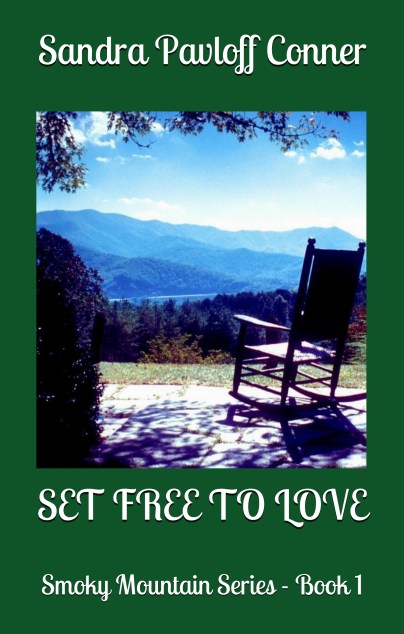 This week Book 1 of the Smoky Mountain Series took it’s place in the Paperback Inspirational Novel section of the Amazon book store. I’m really happy to report that this first book of the series —Set Free To Love — is now available at a new lower price — only $8.99.
It’s only a story — but when Private Detective Maddison Holt, Uncle Matt, Beth Hanover, and her young brother Lex get hold of your heart, you won’t feel like it’s just a story —– and you won’t want to miss picking up Book 2 of the series as soon as possible. The Smoky Mountain Series brings you stories where strong, loving, courageous characters meet the challenges of life with the power of God’s Word, and where true romance wins out over all.
Set Free To Love
As his vision suddenly blurred, Maddison realized he’d let it happen again. He swiped at his eyes with a thumb and forefinger, trying at the same time to pinch back more tears. He’d have to pull off the highway if he didn’t get better control of himself. The next moment, he could feel the anger boiling up from deep inside, needing an outlet. He’d swung back and forth like this relentlessly, between tears and anger for … how many weeks had it been now? Way too many … but then not really enough … not enough to dull the pain or answer any of the questions.
This first book in the Smoky Mountain Series follows private detective Maddison Holt’s journey from grief, guilt, and self-incrimination to a place where he is released from all of those burdens and able to freely give himself to loving and being loved. Order it here.
^^^
`
A short Coffee post today. It’s a really busy time for me, but I do still love my coffee. Don’t forget: you’re invited to post about coffee on your site and paste your link into the “Comments” windows below — anytime this week.
Enjoy!

`
I joined the queue outside the door,
Just after 6:00 a.m.
The morning sun had chased the fog,
But warmth was pretty thin.
My breath formed steam each time I spoke,
And pockets warmed my hands.
I yearned for coffee, hot and strong,
A large cup — maybe Grande.
We inched along with moderate speed,
And soon I stood inside.
The fresh aroma brought a smile;
It’s tantalizing tide
Mingled with the cozy sounds
Of orders glorified:
Venti Frappucino – Tall
Mocha Latte – Grande.
Americano, Cappucinno,
Really, there’s no end.
At last, I stood before the bar;
The young barista frowned.
He know I’d order coffee – plain.
No whip, no froth — just brown.
~~~
“
`

~~~


