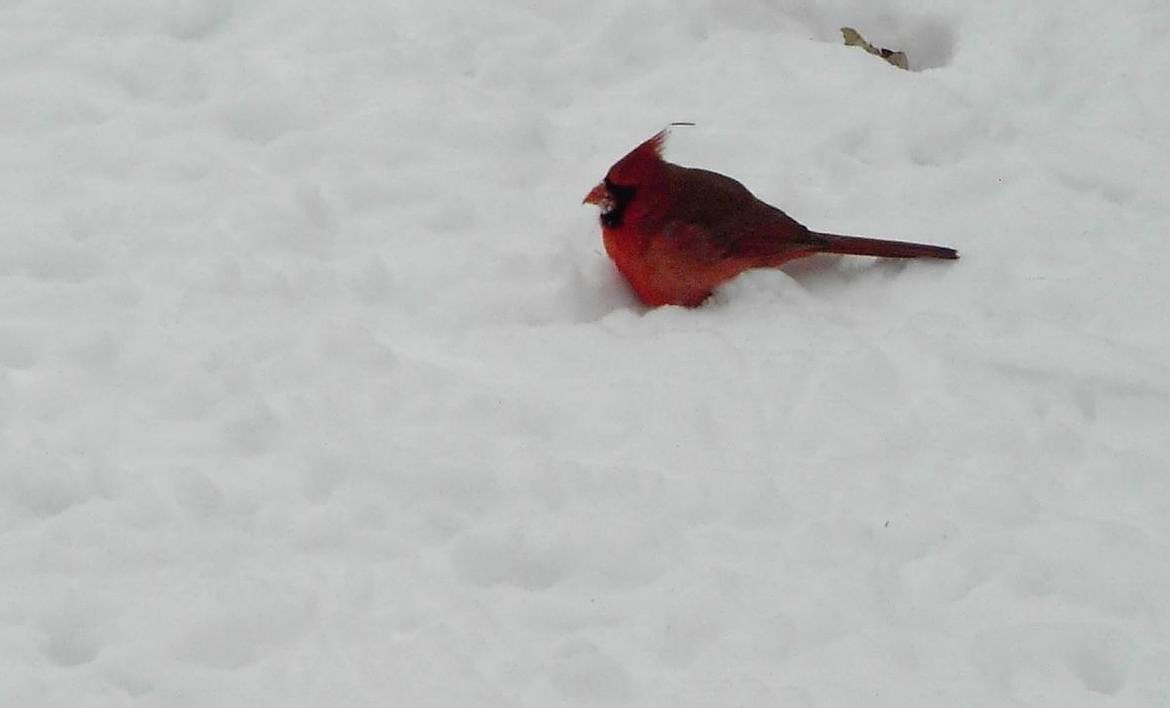
Wordless Wednesday
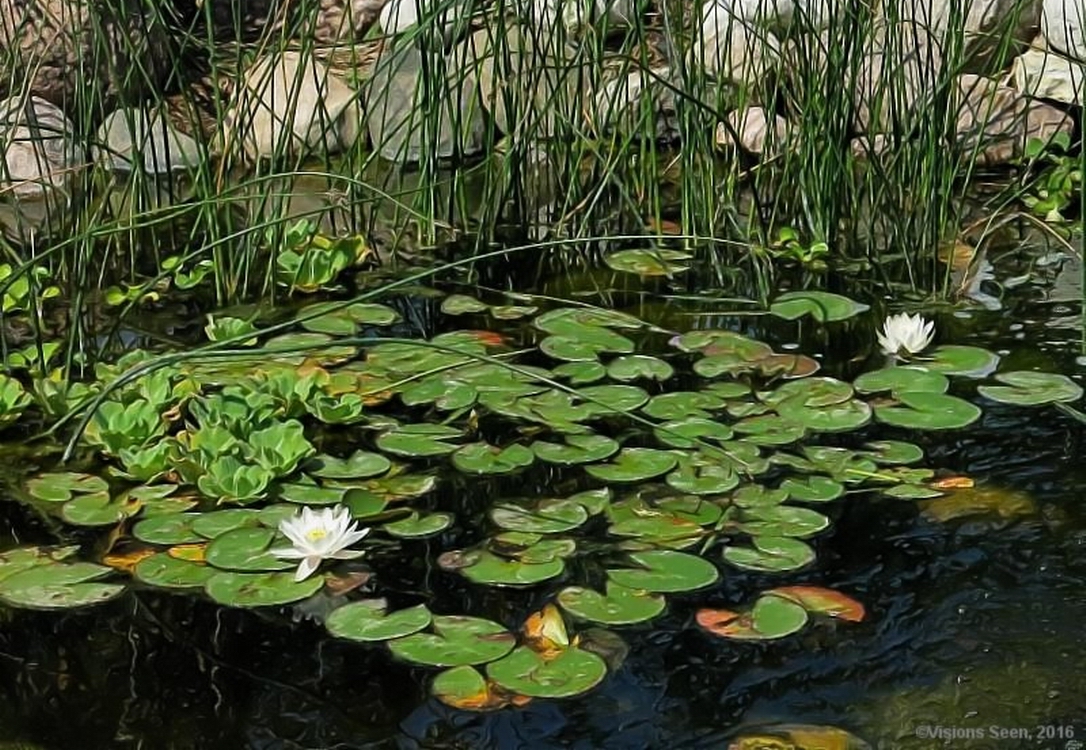


Choose the one you like best.
Check out the WP Daily Post site for instructions on how to participate.
~
 What a lovely gift at close of day.
~
~
Julia is into birds this week on her 100-word story challenge. Here’s what she says: “I am very lucky to have a garden and even luckier that a variety of birds visit each day. At the moment we have 2/3 blackbirds who are really ruling the roost so to speak. They are beautiful song birds I know, but they are having a conversation. You can tell with the intonation of the sounds and the responses from another birds.
So, your prompt this week is to write that conversation!”
So I did. It’s below the picture.
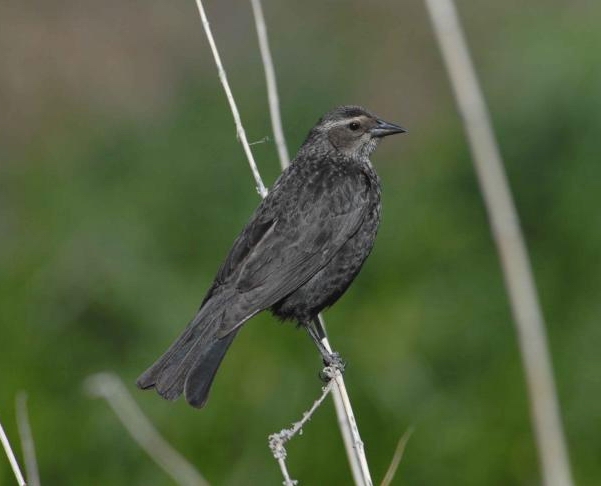
OVERHEARD CONVERSATION OF BLACKIE BIRD AND HIS FAMILY
“Mama!”
“Mama … we’re hungry!”
“Yeah, we’re hungry.”
“I’ll check on Dad’s progress.”
“Honey, found anything?”
“Not yet. Those dang Cardinals grab everything in sight!”
“They think just because they’re so splendid to look at they should get the best of everything.”
“Hey, two worms! I’ll grab ’em.”
“Oh, look out! Kitty-Kitty’s comin’ at you at 2:00!”
“If I run, I’ll lose the worms to the Bluejays.”
“Barn-a-Bee’s on the roses. Call for help.”
“Hey, Barn-a-Bee, Kitty-Kitty’s crouched to attack. Help!”
“On my way. Bzzzzzzzzzzzzzzzzzzzz … SMACK!”
“MEOW!!#%$!!#$%!!”
“Great hit! Right on the nose! Thanks, Barn-a-Bee, old pal. I owe you one.”
~
I actually got the idea for this story from a whimsical poem my mother wrote many years ago, titled “Wish I Were A Bumblebee.” You can read it at this link.
Photo courtesy of http://www.public-domain-image.com/blackbirds-pictures/close-up-of-a-female-tricolored-blackbird-agelaius-tricolor.jpg.html
~
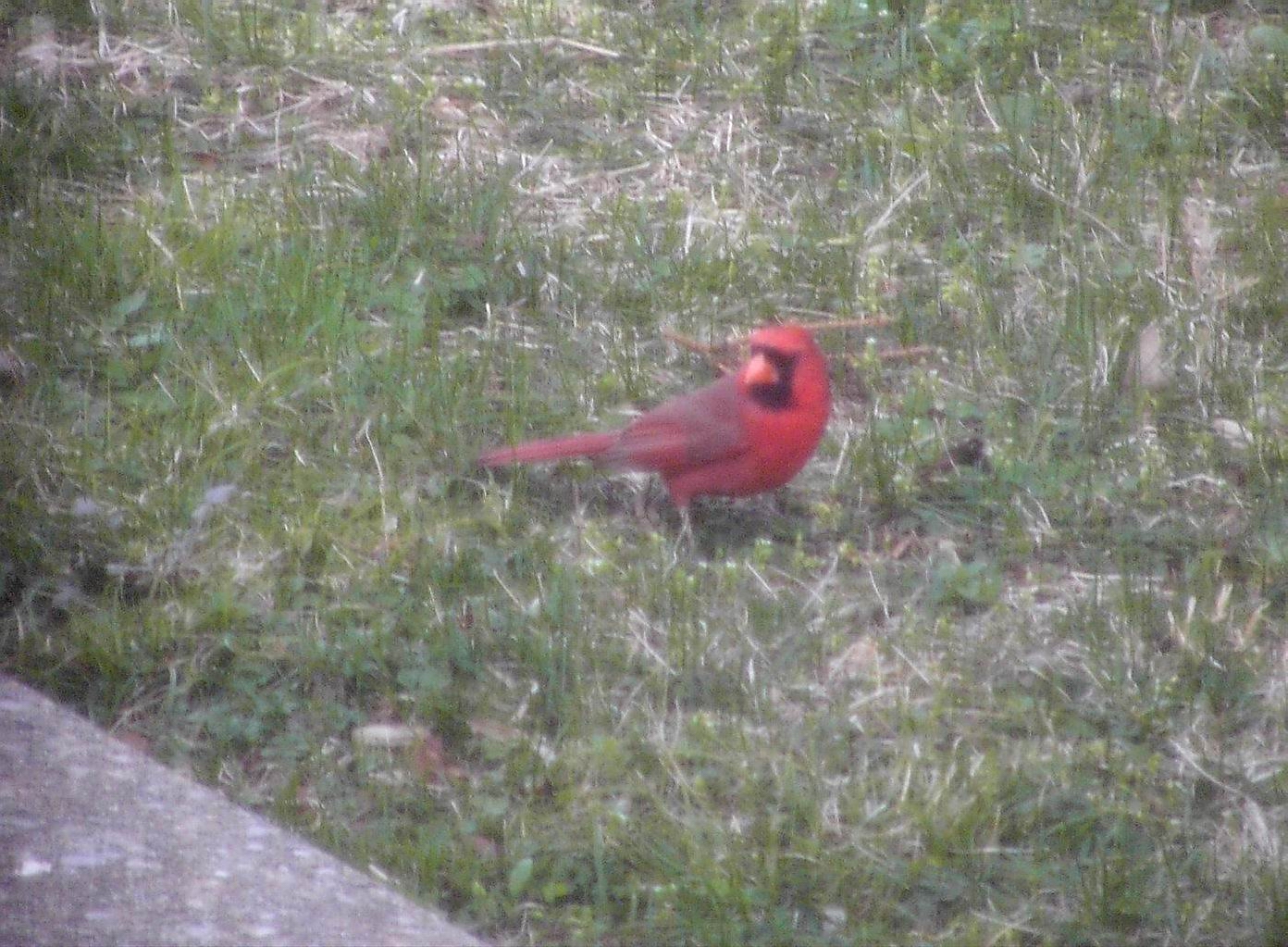
This picture isn’t super clear, but this little guy just never holds still. Often he’s on my front porch, sitting on the banister, but if I even try to slip out the door to get a picture, he’s gone before I get the door open. However, the other day, I was sitting on my porch with my camera ready, and he stopped a while in the yard. Even then, he did not hold completely still. This is the bird that inspired my poem “A Cardinal Sits With Me,” which I posted in February.
I wanted his picture, not only because he’s one of the most beautiful cardinals I’ve seen (my photo doesn’t do him justice), but also because I think he and his wife have built a nest in my huge blue spruce tree. The tree is so thick I can’t see for sure if the nest is there, but they go in and out of the branches and act like they are living there, so I’m pretty sure they are. A few years ago I had a mockingbird build a nest in that tree, and she returned a couple more years as well. But I haven’t seen any mockingbirds this spring yet.
This cardinal also reminds me of the novel A Redbird Christmas, by Fannie Flagg. I enjoy that book so much that I read it once a year — although not always at Christmas time. It is a lovely story and a happy read — just in case a few of you are interested.
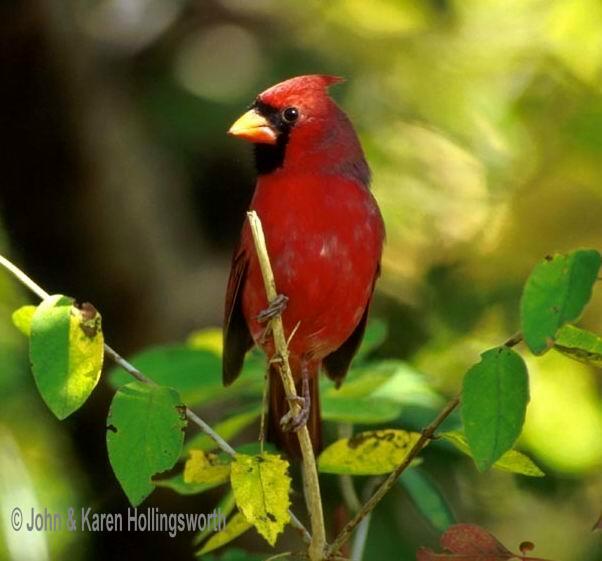 A Cardinal sits with me at end of day.
It is a bleak, unhappy time,
And I have lost my way.
He seems content to stay a while and rest,
And my front porch is cool with shade,
Sun moving to the west.
On other days I’ve seen him flit and fly
And labor quite industriously
For food that caught his eye.
And then he’d pick at wings and clean and preen,
Then dart away and back again,
Quite nervous did he seem.
He’d change his stance and cock head constantly,
Not holding still a moment long;
He agitated me.
But, suddenly, this eve he’s come to sit.
As if he knows my sorrowful plight —
That I am in this pit.
And now and then he sings aloud his song.
But when he stops to rest a while,
For much more do I long.
I’m sure his day is done; he should head home,
But here he sits beside my chair,
Just so I’m not alone.
His beauty, I have finally come to see,
Is unsurpassed: his ruby hue,
Wings black-edged perfectly.
In truth he is a masterpiece of life:
Each part of him a sculptor’s dream,
Down to his beady eye.
A good half hour he’s stayed and felt at home.
And looks right at me now and then,
To say, “You’re not alone.”
I sigh and realize I am content.
I close my eyes; begin to smile.
This is what Jesus meant.
He urged us to behold the birds of air,
And take a lesson from each one
About His love and care.
“Yes, Jesus, I’m at peace in You at last.
This little bird you sent to me
Has now fulfilled his task.
So take care of him, Lord and keep him strong,
And send him out to other souls
Who need to hear his song.”
Then opening my eyes, I seek my friend.
But he has flown while I have prayed —
His mission at an end.
~
[“Look at the birds of the air! They don’t worry about what to eat — they don’t need to sow or reap or store up food — for your heavenly Father feeds them. And you are far more valuable to him than they are.” Matt. 6:26 TLB).]
“Not one sparrow can fall to the ground without your Father knowing it. And the very hairs of your head are all numbered. So don’t worry! You are more valuable to Him than many sparrows.” (Matt. 10:30-31, TLB).]
~~~~~~~
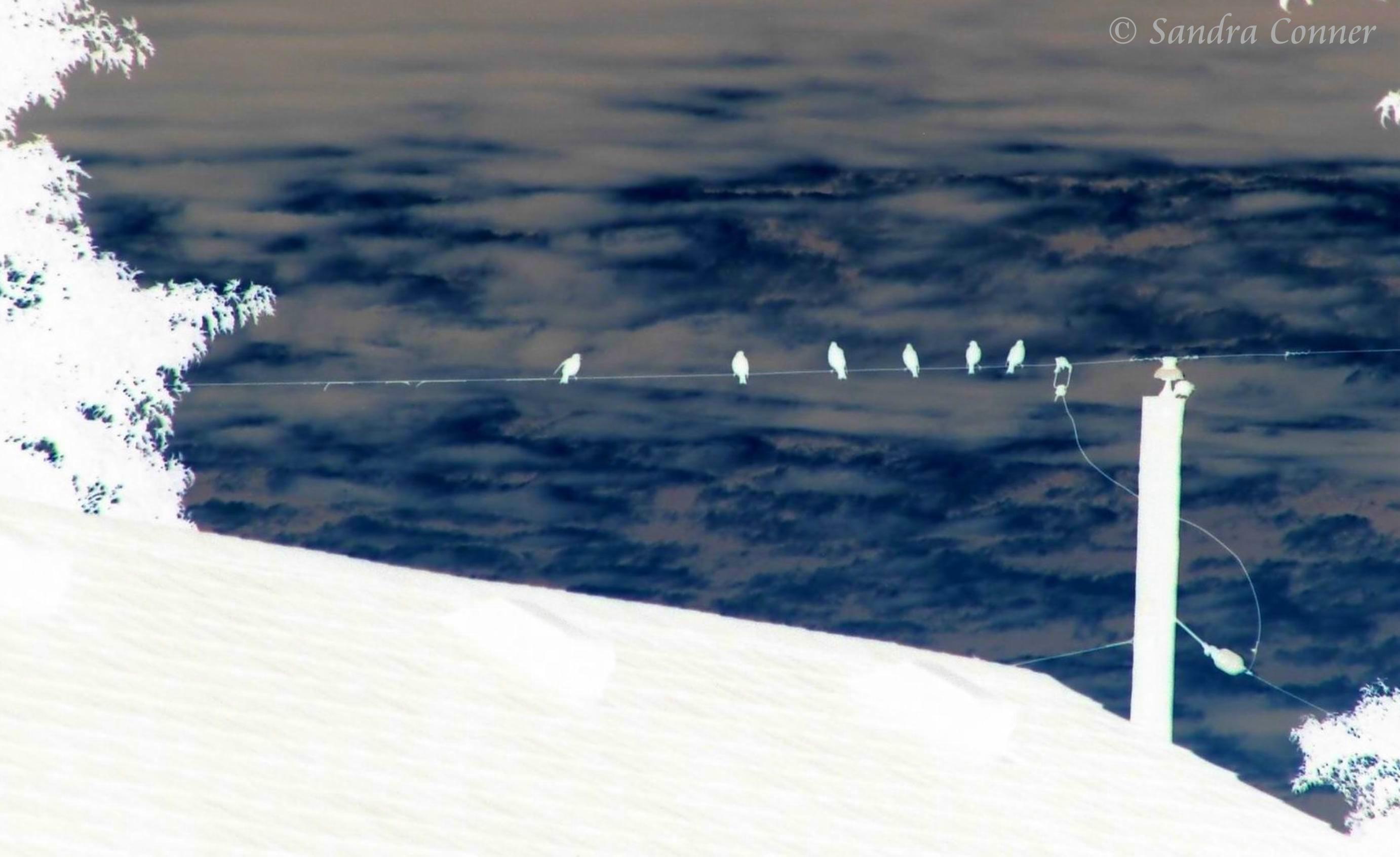
I took this photo several weeks ago and posted it in its original state. But I played around with it at the time just for fun, and when this week’s challenge came out, I couldn’t resist using this “adjusted” version for the “Silhouette” theme.
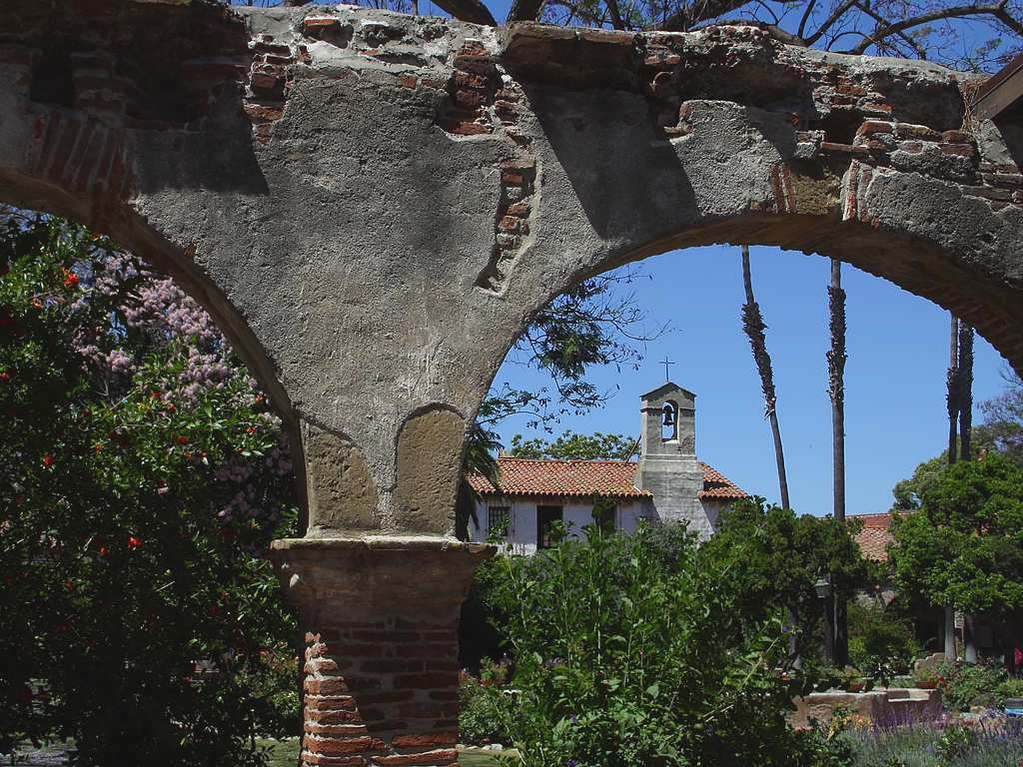
In the early morning of October 23 — just 11 days from today — thousands of swallows will lift off the grounds of the San Juan Capistrano mission, circle the mission once, and begin their pre-scheduled 7500-mile flight back to their home city of Goya, Argentina. They will have spent 7 months at the mission, enjoying the warm climate and excellent food — and offering their share of the work to keep the eco-system in its proper balance — particularly by destroying about a billion insects. But it will be time to go home, and those swallows will not fail to leave at exactly the appointed moment.
Their visit to the centuries-old California mission began in Goya at dawn on February 18 — as it has every February 18 for at least the past 200 years. They arrived at Capistrano on March 19 — as they have for at least 200 years — and, yes, all the mission bells did ring, just as Leon Rene’s 1940’s song says. There is a great celebration at the mission every year, and thousands of people turn out to welcome the birds to their summer home. All events are planned well ahead of time because there is absolutely no doubt that these lovely swallows will be right on time.
Argentinian magazine correspondent Enrique Bermudez, who writes for Para Todos Magazine, has made a thorough study of the swallows. He says they fly most of their 7500 mile journey at an altitude of 6600 feet and fly at a speed of 18 miles per hour. His research shows that swallows are masters at following a flight plan that takes advantage of every favorable wind. And somehow, in spite of all kinds of unpredictable natural events, they arrive exactly at the appointed time on March 19, year after year after year. How awe inspiring is that?
Well, it must be pretty inspiring for the majority of people because the event has been immortalized in word and song for decades now. Unfortunately most people any distance away cannot be present to celebrate the event, but all of us have the privilege of witnessing a similar miracle right in our own back yards if we care to take notice. We have scores of “closer-to-home” birds that migrate north and south at exactly the right time every year — returning at the same appointed time when the seasons change. In my neck of the woods, the most prominent migratory birds are the geese, and their v-shaped flight patters make designs across our skies for several weeks each fall as they follow their God-given homing devices to their places of winter refuge.
And so it is in every little burg and hamlet across the planet. Then when spring pops out from under winter’s blanket, ducks, geese, and birds of various sorts find themselves on the move again, and without fail, all the members of each species of bird know exactly where they are going. Just like the Capistrano swallows, they all have this built-in guidance system that we call “instinct.” It’s an internal radar, given to them by their Creator, that doesn’t fail to take them exactly where they need to go: south in the winter, north in the summer, and even to the highest rafters of the crumbling mission at San Juan Capistrano.
But what about us? People. Do we have our built-in homing device turned on? It is keeping us focused on our perfect destination? No matter what the season in our lives, our perfect place of safety and fulfillment is always the same place: The Almighty, Eternal, Living God.
What time is it in your life? Is it time to migrate to a new place in your spiritual walk? Do you find yourself feeling the need to live on a higher plane? Or is it getting a little dark and cold where you are now, causing you to long for more warmth and light and nourishment?
Well, the Word of God makes it clear that we each have a built-in homing device with its own internal radar. That Word tells us that we do not have to “anxiously look about us,” trying to find our path. (Isaiah 41:10). All we have to do is set our hearts on the one who created that homing device. (Prov. 3:6). And even more directly, we are told that we will find Him through Jesus Christ, who is “the way” into the heart of that Creator. (John 14:6).
Do you have your radar zeroed in on the almighty God of the universe? If so, you have a fantastic journey ahead of you. If not, maybe this changing season is a good time to make an adjustment.
 Yep, this is what’s known as a GENUINE high-level meeting.
~~~
My mother was a beautiful woman, inside and out. She was kind, generous, gracious, and  hospitable to everyone she come into contact with. She loved people, and she saw “specialness” in very ordinary people and very ordinary events in life. Then she celebrated that “specialness” in poetry.
Yes, my mother was a poet. I don’t imagine anyone would call her work “world-shaking,” but it was a collection of words and emotions that gently lifted up the people and events in her “ordinary” life — and lifted up the God who had given all of them to her.
As I look at the clock on my computer screen, I see that we have just crossed into the “second day of spring,” and every spring I am reminded especially of two of my mother’s poems. They are probably my favorites of all of her work. Her book, Life Is Worth Living, includes poems on many subjects, and she even wrote a poem to me specifically at one point in her life. Each of those poems has its own unique place for its own unique reasons. But, somehow, for me, these two poems best represent my mother’s gifts for seeing “specialness” in small, everyday things. I’d like to share them with you.
NEW LIFE
Why the Crocus – a pretty little thing –
Should burst forth, the first sign of spring?
Though buried and dormant in snow and cold,
Will bear new blossoms, so bright and bold.
Of all the plants, like flowers and trees,
The Crocus is the first, the smallest of these;

A rainbow of colors, like one in the sky,
Yet so close to the earth. I wonder why
He chose the Crocus, so very, very small,
To show the world there is new life for all.
WISH I WERE A BUMBLEBEE
Now I’m safe high up in this tree.
Or could he be fooling me?
Gone away far too soon;
Hardly ever leaves ’till noon.
Oh, to bark or snarl or chase
Would take that grin off of his face.
Or if I were a bumblebee,
Bet that cat would be afraid of me!
One little wren don’t have a chance
When that arched back starts to prance.
But I will figure out how, some day,
To make him prance the other way.
Oh, for two horns – like a bull;
I’d show him just who had some pull.
Or if I were a bumblebee,
Bet that cat would be afraid of me!

Just like a snake in the grass,
Lie and wait for him to pass.
Or to buzz around his ears
Would show up some of his cat fears.
Oh, to sting him on the nose
Sure would keep him on his toes.
Yes, if I were a bumble bee,
That darn cat would be afraid of me!
Oh, to sting him on the nose
Sure would keep him on his toes.
Yes, if I were a bumblebee,
That darn cat would be afraid of me!
Poems: © 1979 Vera Faye Pavloff
Crocus Photo: © 2011 Brenda Calvert
Bird Photo: © 2011 Beautiful Free Pictures
 The Happy Wordcrafter
