Friday Fictioneers – 5/17/13 — ‘Albert’s Wife’

aqueduct-sarah-ann-hallPhoto by Sarah Hall


Albert’s Wife

The estate still boasted its artistic iron fence and stone posts, although the grasses were encroaching. Trevor smiled. How the old lady would chastise that gardener.

Feisty, courageous old girl! Living alone in the home Albert had built her. Married here on a Sunday, by Tuesday, she’d kissed her soldier husband goodbye.

Next year, a scruffy teen hired to paint the fence, Trevor had won her heart – and she’d won his. He’d been there (the son she’d never have) to hold her hand as she’d read the black-edged telegram and cried. She’d refused to live in mourning, but seventy years she never loved but one man.

Today, at last, she was with Albert.

~~~

To join in and write your own 100-word story inspired by this picture, visit Rochelle’s site for the ‘how-to’ details.


NaPoWriMo – 2013 – Day 29 – ‘To Love’

NAPO 2013 BUTTON

A poem using at least five foreign words: That was the prompt for day 29 of the National Poetry Writing challenge.  (I’m running a day behind again, and will have to do day 30 today as well, since May is staring us in the face.)

Now, since the first foreign language I actually studied was Latin, I felt it was only right to start with that. Then in my college years, I switched to French, so I felt obligated to throw in a little of that as well. And … since I am an English teacher, it seemed quite appropriate that I use a verb conjugation as my format. Hope it gives you a smile today:

RED HEART, GOLD ARROWTO LOVE

Amo: I love;
Amas: You love;
Amat: He loves;
And love, it makes the world go round, n’ecst-ce pas?

Amamus: We love;
Amatis: You love;
Amant: They love;
Mai oui, there’s love enough to bless us all!

~

There’s still time to join the fun for the last day of April: http://www.napowrimo.net/

NaPoWriMo – Day 25 – A Ballad

I’m fudging just a little on today’s prompt – a ballad – because I did not write this poem today. I actually wrote it some time ago.  However, taking the definition of ‘ballad’ in its simplest form — a rhymed poem that tells a story — this piece fits the criteria perfectly. And since it’s a poem I enjoy very much myself, I decided I’d take advantage of today’s prompt to share it with you.

I should probably add that the poem is based on a true event that I read about a couple of years ago. There really was a couple that had this experience during World War II, and there actually was an operator whose kind heart helped save their romance.

TELEPHONE POLESLOVE ON THE LINE

I read about a Navy guy;
‘Twas during World War II;
He felt that he was so in love
But one thing he could do.

He was on leave, New England way,
And running out of time;
Snowed in, he could not meet his love.
His only hope – a dime.

So in the pay-phone booth, he dialed
The zero. Faith was high.
He told his soulful story to
The operator, Vi.

He gave the number for his love,
St. Louis her address,
And Vi said, “There’s no promises,
But I will try my best.”

So, hanging on the line out east,
The sailor heaved a sigh
And waited with a pounding heart
Till he heard back from Vi.

“I have your party, sir,” she said,
Three minutes’ worth of time.”
“Three minutes!” cried the sailor.
“That isn’t enough time!”

His darling’s voice broke through the wire,
Her voice so light and thrilled,
“What great surprise, your calling now!
I heard you’re snowed in, Bill.”

“Yes, dear, and now I can’t get there
Before my leave is through,
But there is something vital that
I have to say to you.

“You know I’ve loved you for a while;
And I have to know for sure — “
But Vi broke in just then to say,
“We’ve lost connection, sir.”

“Oh, no!” he cried. “You’ve got to help!
I’m ready to propose!
I couldn’t go back overseas
Unless I’m sure she knows!”

“I’ll try again,” Vi said, but then — 
Back on the line, so sad — 
“I can’t get you connected, sir;
The weather is so bad.

“But I can hear your party, sir,
And it seems she can hear me.
If you’d want me to relay your words,
I’d do so happily.”

He heaved a sigh, wiped tear from eye,
And drew deep breath somehow.
“All right,” he said. “It’ll have to do;
I need her answer now.

“Please say, ‘ I’m so in love with you
That before I go to sea,
I’m asking you to be my wife;
Please say you’ll marry me.'”

So Vi relayed the message sweet;
He waited in a stew
‘Till Vi came back online and said,
“She’d love to marry you!”

BLUE TELEPHONENow many years have come and gone;
The couple made their home.
And in every room the pride of place
Goes to the telephone.

~~~

To join the National Poetry Month Fun, visit this link:
http://www.napowrimo.net/

Hatred & War Cannot Quench Love

Civil War Soldier Sullivan Ballou Echoes King Solomon.

The Song of Songs, by King Solomon, says, “Set me as a seal upon thine heart … for love is strong as death.  … Many waters cannot quench love, neither can the floods drown it.”  (Songs of Songs  8:6-7).   Those words were penned many centuries ago by an Israelite king, but during the American Civil War, a Union soldier penned words that echoed those of Solomon, almost exactly, in a letter to his wife about one week before he died.

FLAG & CANNON EMBOSSED REDMajor Sullivan Ballou poured out his heart to the one woman he knew would understand it, his wife Sarah.  He told her, “Sarah, my love for you is deathless.  It seems to bind me with mighty cables that nothing but Omnipotence can break.  Yet my love of country comes over me like a strong wind and bears me … to the battlefield.”  In another statement he describes the level of his commitment to his love of country as well as his wife: “I know … how great a debt we owe to those who went before us, through the blood and suffering of the Revolution, and I am … perfectly willing to lay down all my joys in this life to maintain this government and to pay that debt.”

In those words, Sullivan Ballou spoke for every American soldier who has left loved ones safe at home to go into hate-filled, death-filled foreign lands and willingly give everything he had — including his own life — to make sure those loved ones were kept safe — and that the nation whose constitution undergirded that safety was defended and secured from all that would try to destroy it.

SOLDIER COLLAGE SEPIA JPGIn every war that America has fought, thousands of her soldiers have gone courageously into harm’s way because they believed in the truth that “love is strong as death.”  They believed that all the hatred and all the wars this world will ever know cannot quench love.  And they have been right:  ALL THE HATRED AND ALL THE WARS THIS WORLD WILL EVER KNOW CANNOT QUENCH LOVE — because real love comes from only one source: the eternal, unfathomable, unquenchable Creator of the universe.  It is He who gives soldiers like Sullivan Ballou the unquenchable love that he writes about in his letter — love for his wife — and love for his country and all it represents to millions of people who long with all their hearts for freedom and security.

~~~

NaPoWriMo – 2013 – Day 10 – An “Unlove Poem”

NAPO 2013 BUTTON

The challenge for Day 10 is to write “an unlove poem” or a “poem of sarcastic dislike.”  So here goes: 

MIRROR

NARCISSUS

It’s true you quicken heartbeats when you enter rooms.
And every girl around compete’s for you.
The wilting sighs float down the street as you pass by,
And “brilliant” comes to mind at all you do.

Your smile – it’s dazzle quickly melts fair maiden hearts,
Your voice – it has a timbre all its own.
And when you stay away, we girls all miss you so;
That you return to find our love has grown.

But all our smiles and sighs have no effect on you.
And year by year you manage to stay free.
Well, I, for one, know why you never choose a love:
You’re lost in love with what your mirror sees.

~

There are still 20 days to go. Hop over the Maureen’s site and get started:
http://www.napowrimo.net/


NaPoWriMo – 2013 – Day 6 – ‘Valediction To A Passing Love’

NAPO 2013 BUTTON

Day 6 of the National Poetry Writing Month challenge involves a prompt to write a valediction — to anyone or anything. I guess some people might think I should take this particular subject more seriously, but, for some reason, these challenges just seem to bring out the whimsy in me, so …..

casket over plot 2

Valediction to a Passing Love 

I have not loved you well,
Nor have I loved you long.
So it is with no strong regret
I sing this parting song.

Your passage through my life
Has barely touched my soul,
So mourning will not weigh me down.
In fact, I feel quite whole.

Adieu, my love, adieu.
I bid you fond goodbye.
But at your grave, for memory’s sake,
A few tears I will cry.

~

Photo by Susan Buck Ms: http://www.publicdomainpictures.net/view-image.php?image=8210&picture=casket-over-plot&large=1

It’s not too late to join the fun. This is just Day 6, so you can still write 25 poems in April.  Visit the link for instructions: http://www.napowrimo.net/


WordPress Weekly Photo Challenge: Kiss


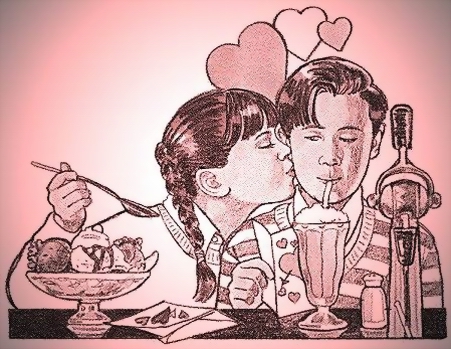
Not technically a photo, but too cute to pass up.

ENGLISH COURTSHIP

To join in the fun hop over to this site:
http://dailypost.wordpress.com/2013/02/15/weekly-photo-challenge-kiss/


Love -Through the Eyes of Opie Taylor

SODA FOUNTAIN KISS # 2In an episode of the uniquely popular TV program The Andy Griffith Show, an episode entitled “The Rivals,” Andy tries to help his son Opie come to terms with the troubling symptoms of being in the throes of first love. As they sit together in the living room, Opie opens the conversation:

“Pa, when you like someone a whole lot, that means you love ’em, don’t it?”

“It depends,” says Andy.

“Well, when I’m with Karen, I get a lump in my throat, my ears ring, and my knees get all squiggly. Does that mean I’m in love?’

“Either that or you’ve got a real bad case of the measles.”

“Pa, if I marry Karen someday, her name becomes Taylor, don’t it?”

“That’s right, and all your children become Taylors too.”

“Children? … I don’t think we’d have any children, Pa. We already know enough kids to play with.”

And so – with childhood’s blurry vision of the details of this state called marriage — Opie easily dismisses one of the most important results of engaging in the deepest mysteries of the marriage covenant. Children are a very visible product of those mysteries.

But there are other products as well. Many of them are not so easily seen or identified, but they can be just as important and just as life-changing. There is a sense of fulfillment and a greater sense of wholeness. There’s a sense of security and oneness that melts away all the coldness of being alone. And there’s a new knowledge of self – an understanding of oneself on a new level. The man and woman who have previously been “their own person” have now, for the first time, realized that they are much more complex and much more capable of enjoying that complexity as a result of this new relationship and the new identity that results from it.

But all of this change is not easy. Nor is it simple. In fact, it is so complex that sometimes it’s weeks, or unfortunately even years, before one or both partners actually realize that they have become a part of a brand new whole and are no longer exactly the same persons they were before marriage.

That realization could be frightening if not seen through the plan of God. He, after all, is Love (1 John 4:8). He created this thing called marriage – and the sex that is an integral part of it. And guess what? He knows what He’s talking about. His plan is that each partner in this holy covenant relationship will find in the mate the answer to longings that have never been fulfilled; the key to opening doors in the soul that have never been unlocked; and the love that saturates and nurtures our unique gifts and abilities so that they mature and bring us to the highest and best we can be. In short, it’s this new person, conceived from the two, that is finally complete and whole in a way that nothing but a “covenant” marriage relationship can accomplish.

It is true that our mate cannot fill the place in us that is reserved for God Himself. And we will never be truly whole until He is at home in us. But it is God Himself who has told us clearly, “It is not good for the man to be alone. I will make him a helper suitable for him. … And the Lord God fashioned into a woman the rib which He had taken from the man and brought her to the man. And the man said, ‘This is now bone of my bones and flesh of my flesh.’ … For this cause a man shall leave his father and his mother and shall cleave to his wife; and they shall become one flesh.” (Gen. 2: 18, 22-24, NAS).

So God said of his “perfect” man that he needed a woman to be complete. And He created the woman to be so much a part of the man that she would have a need of him to be complete as well. Isn’t it interesting that this “need” of each other was created into us as part of our perfection? And this unique completeness that results is probably the one most powerful and thrilling product of a man and woman entering into and enjoying the blessed mysteries of God’s kind of marriage.

I know in this 21st century – especially in the hollowed political halls of this world — it is not considered “politically correct” to make such statements. But, thank God, there is still one Document that supersedes all the political attitudes and postures of every society on the face of the earth. It still supersedes every new “law” on the books that would try to make marriage something different from what God created it to be. What a blessing to know that He still holds the patent on marriage. And that one Document — The Word of God – The Holy Bible – still gives the human race the blessed, supernatural opportunity to experience total completeness through love – when they enter into it the way God Himself created it to be experienced.

Truly, a Valentine gift to be treasured forever.

~

Love On The Line

BLUE TELEPHONEThis little poem came about as the result of a poetry challenge I discovered last year. The topic for the poem had to be the telephone, and I decided to see what I could come up with.  As soon as I started thinking about the subject, I remembered reading the true story of a WWII serviceman who had intended travelling to the Midwest (while home on leave) to meet his girlfriend and propose marriage before he went back to duty.  A blizzard kept him from making it across country, but through the kind ministrations of a romantic telephone operator (remember when we had real operators instead of computers?), he was able to convey his proposal and receive an answer. This poem is based on that unique love story.
TELEPHONE POLES

LOVE ON THE LINE

I read about a Navy guy;
‘Twas during World War II;
He felt that he was so in love
But one thing he could do.

He was on leave, New England way,
And running out of time;
Snowed in, he could not meet his love.
His only hope – a dime.

So in the pay-phone booth, he dialed
The zero. Faith was high.
He told his soulful story to
The operator, Vi.

He gave the number for his love,
St. Louis her address,
And Vi said, “There’s no promises,
But I will try my best.”

So, hanging on the line out east,
The sailor heaved a sigh
And waited with a pounding heart
Till he heard back from Vi.

“I have your party, sir,” she said,
Three minutes’ worth of time.”
“Three minutes!” cried the sailor.
“That isn’t enough time!”

His darling’s voice broke through the wire,
Her voice so light and thrilled,
“What great surprise, your calling now!
I heard you’re snowed in, Bill.”

“Yes, dear, and now I can’t get there
Before my leave is through,
But there is something vital that
I have to say to you.

“You know I’ve loved you for a while;
And I have to know for sure — “
But Vi broke in just then to say,
“We’ve lost connection, sir.”

“Oh, no!” he cried. “You’ve got to help!
I’m ready to propose!
I couldn’t go back overseas
Unless I’m sure she knows!”

“I’ll try again,” Vi said, but then — 
Back on the line, so sad — 
“I can’t get you connected, sir;
The weather is so bad.

“But I can hear your party, sir,
And she can still hear me.
If you’d want me to relay your words,
I’d do so happily.”

He heaved a sigh, wiped tear from eye,
And drew deep breath somehow.
“All right,” he said. “It’ll have to do;
I need her answer now.

“Please say, ‘ I’m so in love with you
That before I go to sea,
I’m asking you to be my wife;
Please say you’ll marry me.'”

So Vi relayed the message sweet;
He waited in a stew
‘Till Vi came back online and said,
“She’d love to marry you!”

Now many years have come and gone;
The couple made their home.
And in every room the pride of place
Goes to the telephone.

~

Love Letters: 574 and counting

ROW OF HEARTS - SEPIA - FLOW RIGHT

“How do I love thee? Let me count the ways.
I love thee to the depth and breadth and height
My soul can reach when feeling out of sight
For the ends of Being and ideal Grace.
. . .
I love thee freely, as men strive for Right;
I love thee purely, as they turn from Praise.
I love thee with the passions put to use
In my old griefs, and with my childhood’s faith.
. . .
And if God choose,
I shall but love thee better after death.”

(Sonnet # 43, Sonnets from the Portuguese, Elizabeth Barrett Browning)

As I type the words onto this page, the month of February, the ‘Month of Love’ is in full swing. Valentine’s Day – and all the trimmings! Yes, whether we’re in the mood or not, we are going to be surrounded all month by reminders that it is a good thing to love. This article is my attempt to take a look at two of the world’s greatest lovers and learn what they have to teach us on the subject.

First, let me lay just a little foundation from “The Book.” God’s Word says all of the Ten Commandments of Jehovah are fulfilled in living our lives in genuine love. It also says that fear is cast out of our hearts and our lives by love. And, most important of all, it tells us repeatedly that the God we serve is Love. He’s what it’s all about, and He’s the source of all genuine love. But when the Word talks about love, it’s referring to much more than just an emotion. Certainly, the emotion is important – and extremely satisfying. But the love that really makes a difference in this world is love that does something.

Love, according to the original language of the scriptures, is the fulfilling of a duty or a responsibility to another – whether to God or to the people in our lives. It works good toward another person whether it ‘feels’ something or not. The truth is that feelings of love – like feelings of anger, happiness, hurt, etc. – come and go. But the act of loving another person is fueled by that deliberate intent of the will to do them good. Like faith, real love is more of an action verb than a noun.

I’m grateful that in my life I have known a great many people who love in this active way. But every time I ponder the subject of love – and especially around Valentine’s Day, when people are prone to send little ‘love letters’ to each other in the way of commercial Valentine cards – my mind turns to two particular lovers of the past who knew and experienced the power of love to change people’s lives completely.

Poets Elizabeth Barrett and Robert Browning lived one of the most powerful and life-changing love stories ever experienced by human beings. Much of their poetry, especially Sonnets from the Portuguese, describes that love and the power it had to overcome enormous obstacles, and to vanquish debilitating sorrow and hovering death. While the best remembered and most often quoted lines from all of those sonnets are the words, “How do I love thee? Let me count the ways,” the truth is that some of the most riveting portions are Elizabeth’s descriptions of how that love destroyed death and renewed her life. In Sonnet VII she says this:

“The face of all the world is changed, I think,
Since first I heard the footsteps of thy soul
Move still, oh, still, beside me as they stole
Betwixt me and the dreadful outer brink
Of obvious death, where I, who thought to sink
Was caught up into love and taught the whole
Of life in a new rhythm . . . .”

In truth, it was that love that literally saved Elizabeth’s life and gave both lovers many happy years of marriage and fruitful writing that blessed the world for generations. It also gave them a son, whom they loved dearly.

But prior to their marriage, Elizabeth and Robert courted, primarily by letter, for a period of 20 months. During that 20 months, they exchanged a total of 574 love letters. Think of it: 574 love letters! In 20 months, that is an average of more than 28 letters each month. Never running out of ways to say “I love you,” and never growing tired of manifesting that love openly.

Have you, dear readers, experienced the joy of seeing that love gives life to those who need it? My Valentine’s wish for each of you is that you will experience that reality.

And, by the way, does the person you love know without a doubt how you feel? Why not take advantage of this ‘Month of Love’ to make sure?

~ ~ ~

Love’s Freedom

I turned to Love and said, “I must be free.”
And Love said, “Surely. Take your liberty.”

I asked, “In truth? You set me free to roam?”
Then Love replied, “Just please remember home.”

And so I flew to north, south, east, and west.
And finally back to home I came to rest.

Then turned to Love and said, “You were so brave,
To let me try my wings. So much you gave.”

Love smiled and said, “Refusal to set you free
Would mean I loved — not you — but only me.”


© Sandra Conner 2012

WP Weekly Photo Challenge: Love


MY FAVORITE VALENTINE:

MONKEY VAL PIC - with text

MONKEY VAL PIC - flipped, text

MONKEY VAL PIC 2 - with textPhotos are borrowed with permission. Text is mine. Couldn’t resist the chance to use them for this challenge.

To join the fun hop over to the WP site:
http://dailypost.wordpress.com/2013/01/25/weekly-photo-challenge-love/