Where should this story go from here???

MAGNIFYING GLASS CLUESKindergarten was a lot of fun. I made several friends there. I can’t say that I learned a whole lot because my parents had taught me to read books far beyond my age level and to add, subtract, and count by 2’s, 5’s, and 10’s long before I walked into the classroom at Harvard elementary school. But the joy of that initial year of getting together five days a week with twenty-five other kids my own age and sharing our thoughts and imaginations — not to mention our lunches — was an experience I still treasure.

That’s why, when Sabrina McKluckey called me last Monday evening and told me she had searched for me on Google and tracked me down because she wanted to reconnect after all these years, I was more than happy to arrange a meeting. Sabrina had been my best friend in kindergarten – from day one – but she and I actually had more in common that that. We had gone through all six grades of elementary together in the same classrooms. By junior high, though, my family had moved to a new town, and I lost track of Sabrina.

In fact, I lost track of all my early classmates. My family moved again before I had finished high school, and that broke some more relationships for me, not to mention affecting my grades during my junior year. When I got to college, I finally stayed in one place four whole years, so I did manage to make a couple close friends who are still close today. But when I picked up the phone and found Sabrina on the other end of the line, she started talking about things that we had done in school together, and, suddenly, years just sort of slipped away, and I was transported to a happier time and place.

Now, it’s not that I don’t have a good life. I guess I’d call it a basically “happy” life — depending on how one defines happiness. But once we get to the age of responsibility — college days are gone, and we’re struggling to make good on that first job so that the landlord won’t kick us out of our first apartment, and so relatives who come to visit will find more than a carton of milk and a can of sardines in the frig — things just aren’t as much fun. And for me, now well past the first job and four years into my alternate vocation (having nixed the nine-to-five high finance job I’d landed right out of grad school), life was a passel of everyday bills and aggravations, occasionally relieved by an evening with friends or a week-end holiday.

So, back to Sabrina: She said she now lived about three hours from me, so we arranged to meet at a restaurant about half way between our homes and catch up on each other’s lives over a long lunch. When I arrived, she was already at the table. I figured I wouldn’t recognize her, but to my surprise, she really did look the same: Long dark brown hair, perky nose with a sprinkling of freckles, and a sunny smile. She was slender and prettier in a mature sort of way, but definitely still looked like the Sabrina of my memory.

My hair was still the ebony color it had always been, but I had worn it quite long in those school years, and now I had a slick, short cut that lay close to my head. My blue eyes were still the same, of course, and I was moderate weight for my size, so I was pretty sure she’d consider that I was still recognizable.

And sure enough, when I was within six feet of the table, she turned her head and saw me, and jumped up to greet me, calling out my nickname. “Tessy!” She held out her arms and hugged me as I got to the table. I was glad there weren’t a lot of other people close to our table, but I did hug her back very briefly and dropped into a chair as soon as I could. “Oh, you look good!” she said. “And you really haven’t changed much except for your hairstyle.”

“I recognized you right away too,” I answered, and at that moment our waitress approached to give us menus.

Over lunch, we reminisced, but during the conversation, I felt Sabrina was a nervous and unsure of herself somehow. I couldn’t think why she should be, so I didn’t ask right away. But by the time we were to dessert and coffee, I was sure there must be something troubling on her mind, so I decided to just be honest.

“Sabrina, correct me if I’m out of line, but I keep getting the feeling that you’re agitated or nervous about something, and I’m just wondering if you wanted to talk to me about something besides our past. Is there anything else on  your mind that you’re hesitant to bring up?”

She looked at me earnestly, nibbled on her lip, looked away, took a sip of water, and then heaved a sigh and looked me right in the eye. “Yes there is, Tess. I wasn’t sure if I would bring it up or not, and after we sat down together, I thought that I’d been foolish to even think about involving you in this … situation, I guess you’d call it … but since I’ve gotten you here and you can obviously see that there’s a problem, I might as well go ahead.”

“If something’s going on that I can help with, please tell me,” I said, not really sure I was all that eager to get involved in someone else’s problems, but feeling more or less obligated to at least act as if I were willing.

She picked up her fork and sort of rolled it around in her fingers as she concentrated on her thoughts and then started to talk. “When I said I had Googled you, it was actually for a little more than just wanting to reconnect and talk over old times. I had heard from some of the other people in town who had kept in touch with your parents that  you are a private detective now. And … well —” She paused and looked me right in the eye again.

“Yes, that’s correct,” I said. “Are you saying you need a private detective?”

She glanced down at the fork she was still twisting in her hands and then back up at me. “Yes,” she said in a rush of breath. “Yes. I want to hire you.” Then she leaned closer and whispered. “I need to find out who’s ……………..”

Please go down to the “Comments” section and tell me how YOU think this last sentence should end. I’ve thought about going two or three different directions with this story, but I cant make up my mind.  I’d like to know what readers think. What direction would you like this story to go?  In your own imagination, what is Sabrina’s problem? Maybe your suggestion will give me the next paragraph — and the next chapter.


~~~


Friday Fictioneers 6/8/16 –

To join the fun of Friday Fictioneers 100-Word Story Challenge, just follow the link for the details. Photo by Jan Marler Morrill.  My story is below the picture.

PHOTO PROMPT © Jan Marler Morrill


Sebastian had said, “Follow the alley until it curves right. Stop at the blue door in the wall. Knock four times.”

Okay, here was the turn. Yes … the blue door. Four short raps. She held her breath. … No answer. … She waited. … Still no answer.

Drat the man!  Why all this mystery? Couldn’t they just meet at a cafe?

Lying on the floor inside, Sebastian stretched his arm to reach the door handle. But the knife in his back had done its work. He lost consciousness as the girl turned in frustration and left the alley.

Daily Post Prompt: Countless

Visit the Daily Post to find out how to participate in today’s prompt.

Exif JPEG
`

THE DECISION

`I’ve thought about you countless times this past year. I sometimes wish I hadn’t been so hasty to make the decision. There are days when I wake up thinking how good it would be to still have you beside me for a few hours. And, of course, every time I make the curried chicken casserole I think about you. It’s downright lonely in the kitchen these days. And I don’t even cook most of the time. I do carry-out.

I don’t order from our favorite Chinese place, though, and I don’t go in there anymore because they almost always ask me, with sadness in their eyes, how I’m doing now that you’re gone. That gentle couple who own the place really got to like you. I think you were probably their favorite customer during the three years we ate there. I miss the Chinese place, and some of the other haunts we made our own. But I’m finding new interests and new friends, and things will work out.

But — sometimes — on a summer evening — when the windows are open to the gentle night air and someone’s laughter floats across the breeze, it reminds me of your laugh. I think that’s one of the things I miss most about you. You were so abandoned when you thought something was funny. You never held back.

But then, as well as I can remember, you never held back on any emotion. And that fact, of course, is what finally led me to make my decision. You just couldn’t seem to hold back on your feelings for all the other men in your life — even my best friend — a man who I’d thought would have my back through thick and thin — especially after all we’d been through together in the war. But you were just too much for him. He fell just like all the others. And so I made the decision.

Yeah — as I consider it all again now — I know it was the right thing to do. It put a stop to the hurting for me and for all the rest of ’em too.

The only thing is that — on nights like tonight — with the fragrance of the roses you planted drifting in from the garden — and the radio playing an old song we used to dance to — well — I have to admit to myself at least — I do feel just a little sorry that I poisoned you.


~~~

Daily Post Prompts: Shadow – ‘The Beast’

BULL SILLHOUETTE EDITED -NEGATIVEThe sun was low in the sky and to my back. I lay on the ground, looking up at the clouds and turning them into all sorts of things. One looked very much like a turtle. One like a smiley face, since it had two holes where the blue peaked through, giving it eyes, and another opening that really did look surprisingly like a grin on a child’s face. One of the clouds looked a little like an old school teacher I’d had who wore her hair piled high on her head in a beehive style. Boy, did that thought give way to pondering where time has gone.

Suddenly, I heard a branch crack behind me. Now, I’m not normally skittish, but this cracking sound was loud enough that I knew it must have been more than just the normal activity of birds or squirrels in the bushes. And, since I was in my own back yard, with a fence around the perimeter, there shouldn’t have been any other creatures – human or otherwise – setting foot beyond that fence uninvited. I didn’t welcome that sound.

I didn’t sit up immediately, but sort of rolled my head to look toward my left first – and saw nothing out of the ordinary. Then I rolled my head toward the right side, and on the ground beside me I saw the shadow of a huge head – not human – but obviously belonging to a beast of a different sort. My heartbeat went into double time, but I just lay there sort of frozen. As I watched, fighting down panic as well as I could, the shadow moved, coming forward and revealing the shoulder area, two legs, and an enormous frame.

I thought about praying, but the words stuck in my throat. I suppose I did manage a silent cry for help, but my primary thought was how to manage rising from my vulnerable position without seeming a threat to said beast and prompting a vicious attack on my person. I contemplated what I had available as a weapon. Well, there was a broken branch or two close by that had blown from a few surrounding trees during a recent windstorm. I glanced again to my left to see if I might be able to reach out for one without actually moving the rest of my body.

As I did so, I felt rather than saw the beast move closer to me. Frantically, I scanned the area to my left, but found no branches big enough to provide weaponry. Just small twigs and several old leaves. Not even a big rock. Finally, I decided that I couldn’t just lie there any longer. If I did so, I was obviously going to be dead meat, and just maybe my jumping up quickly would be enough to throw off the beast’s attention and give me time to start running.

Okay. I squeezed my eyes shut and psyched myself to do it, but just as I opened my eyes, the huge shadow suddenly loomed right over my head, and I knew it was hopeless to try to escape. I could hear it breathing in my ear. Then I really did decide to pray, because if this were to be my home-going, I wanted to be ready. I squeezed my eyes shut again, bracing myself for the impact of the attack, when to my greater shock, something sloppy wet took hold of my right ear. The next thing I knew something else cold and wet nudged me in the side of my neck. And then my face was being slathered with slobber from my chin to my temple. What was it doing? Tasting me to see if I merited being eaten?

I put my hand up to try to cover my face, and when I did, this little furry body just sort of threw itself at my hand and started whining and wriggling, trying to get my hand away. Well, the body attacking mine was so much smaller than I had anticipated that I decided I could open my eyes and chance a look. So I opened one eye and squinted between my fingers, which I still had pressed against my face, and what I saw brought me into a sitting position roaring with laughter.

The little yellow lab puppy who was pouncing me and trying to give me a bath in his saliva couldn’t have been more than three or four months old. So this was the beast I’d seen in shadow form? Surely I wasn’t foolish enough to have made a mistake like that. But upon making the effort to sit upright fully and look around me in all directions, I realized that, sure enough, this little pup and I were the sole occupants of my huge back yard. He was little enough he could have squeezed under the fence if he’d had a mind to. And on further reflection, I realized that considering how low in the sky the sun had been, if it had been shining just right on that little fellow’s body, he would have thrown a shadow many times larger than his real size.

I grabbed the little guy and took him onto my lap, giving him a few good scratches behind the ears and a thorough belly rub. While doing so, I thought about how so many of the problems in my life had looked bigger than life and had threatened to destroy me. But, in truth, when I had finally decided to stand up to them and look them square in the eye and recognize them for exactly what they were and nothing more, I had forced them to show their true identity. And when all was said and done, they were always smaller than I was, and I had eventually defeated every one of them.

I determined to make a lasting mental note of my experience that day and to remember the lesson I’d learned from that little fellow with the monster shadow: Never judge a problem – or a puppy – by its fearsome shadow.

~

To participate visit Daily Post Prompts.


~~~

Friday Fictioneers 4/29/16 – ‘Sales Appeal’

I haven’t had a chance to participate in Friday Fictioneers in a while, and I’m just getting in under the wire this week. But the picture conjured up this little story, and I couldn’t pass up sharing it. The picture prompt is courtesy of Mary Shipman. My story is below the picture.

PHOTO PROMPT © Mary Shipman

SALES APPEAL

“Pops, when you asked me to come and help with the store, I had no idea you’d been losing money the past ten years. What’s the deal with all these tools and auto parts? And your line of pipe and chewing tobacco is weighing down the shelves.”

“I’m just well-stocked.”

“But your only customers the month I’ve been here are genteel ladies. They don’t buy that stuff.”

“Yeah, the men never shop here.”

“Well, get me the ladder. I’ll fix that.”

(Two hours later)

“Ivan, you can’t hang all those women’s undergarments from the rafters! It will embarrass our customers.”

“Not the customers we’re after. You just wait and see. We’ll have men customers coming out our ears by next week.”


~~~

Prompt Nights # 10 – Surely You Jest

This week the ‘Prompt Nights’ challenge offers us the choice of writing either poetry or prose, with a theme that tips its hat to April Fools’ Day. So to celebrate this day of fun and frivolity, I decided to “focus” on a bit of frivolous prose.


SEARS CHOCOLATES ONLY close upFOCUS:
A One-Act Play

Place:  A city street
Time: April Fools’ Day

Conversation:

Friend:   “Wow!  Did you see that?”

Sandra:  “I’ll say. I’m salivating even as we speak.

Friend: Oooooh, me too. Makes me feel hungry all over.

Sandra: I know what you mean. That box of chocolates must have held at least 10 pounds.”

Friend:  “The girl who gets that will be over the moon.”

Sandra:  “Mmmmm. That much chocolate candy would definitely make me one very happy lady.”

Friend:  “Huh? – Wait – What?”

Sandra:  “What do you mean, what?”

Friend:  “What do you mean? I’m talking about that drop-dead gorgeous hunk who just passed us carrying the box of chocolates, you dope.”

Sandra:  “Oh, was there somebody carrying the chocolates?”

~~~


~

Remembering Izzy — a short story

IRONING BOARD AND IRON - CLKER
http://www.clker.com/

Sometimes when I’m feeling sad and this ol’ world starts to creepin’ in on me — heavy-like — I take myself away from other people and huddle down in my old creakin’ rockin’ chair in my bedroom. I sit by the window just rockin’ away and lookin out — not seein’ anything in front of my eyes, but seein’ all kinds of things in my memories.

And at times like these — when I’m hurtin’ powerful bad in my soul — I like to remember Izzy best of all. Her real name was Isadora Bradshaw, but none of us kids ever called her Isadora — not me or my sister or any of our friends who came to visit. In fact, nobody I knew back then called her Isadora. She was just Izzy to all of us who loved her.

She was the best of the best was Izzy. About 200 pounds of love and laughter. Her full, round, black face would get all shiny with sweat whenever she was scrubbin’ the floors or haulin’ big loads of clothes from the wringer washer and carryin’ them out to the clothesline — or when she was standin’ at the ironin’ board with her feet in the tub of ice water.

Yes sir, I have to chuckle every time I think about it now. The picture’s still just as clear in my mind as it was every ironin’ day in the summer. Izzy said ironin’ on a summer day was the hottest one job in the whole world. She said it always made her think about how hot hell must be gonna be, and it made her want to go read the Good Book before she went to bed. Izzy loved that Good Book. And she loved the Lord. Gosh-a-mighty, I can still sing every old hymn that sweet ol’ black lady taught me.

But back to the ironin’ days: Izzy said she sweated so much the sweat would drip on the clean shirts she was ironin, so she decided to start standin’ in a big tub of ice water, and that way it kept her cooled down. When I was a little squirt, I didn’t understand how dangerous that could be, but when I got a little older and had learned a few things about electricity, I told her, “Izzy, you’re gonna electrocute yourself standing in that tub of water while you’re plyin’ that electric iron.”

“Lordy, Honeybear,” she’d say — she always called me “Honeybear” — from the day I was born I guess — but she’d say, “Lordy, Honeybear, if I was a goin’ to lectrify myself doin’ this, it would have done happened years ago. Now, you stop you’re worrin’ bout your old Izzy. If the good Lord did see fit to take me home while I was a ironin’, I don’t suppose it would hurt a thing — ceptin’, of course, you and your pa’s shirts would still be all wrinkled.”

I finally got to the place that I just laughed with her about it. And later on — when she was too old to work as our maid any longer and pa had a little three room house built out in the back for her to live in for the rest of her life, she and I would sit and remember those days and laugh ’til there were tears in our eyes. That was several years after I had finished high school and moved about a hundred miles away to take a job. I’d never been one to hanker after college, and I landed a job doing work that suited me and just stayed with it. I always made time to come home a couple weekends a month to see the family. But I got to be honest. It was Izzy that I really came home to.

Why that dear old black woman was like a second mama to me. My real mama was a good woman, and I know she loved me, but she was awful busy durin’ my growin’ up years with all of her society doin’s, and it was Izzy who made my breakfast, who listened to me read the stories in my grade-school reader, who listened to my hopes and dreams and fears when I’d spill ’em out non-stop the way a growin’ boy does when he’s goin’ through those years of change and uncertainty about life.

And it was Izzy who prayed for me all the time. I heard her prayin’ many a night. After she finally got her work finished up, she’d sit out on the back porch and talk to the Lord, and I’d sit by my bedroom window listenin’ to those prayers. Back then, I didn’t know the Lord yet, and my heart yearned for the kind of easy, lovin’ relationship that Izzy had with the God of the universe. And, of course, it was Izzy who finally led me to give my life to the Lord.

That one act made all the difference in my life, of course, but one of the most important things it did was to make me even closer to Izzy. She said once I was a Christian, that made her and me real family. Of course, to me, Izzy was always my family, but I eventually came to understand what she meant.

I came to understand a lot more than that too. Eventually, I realized that Izzy was a woman caught in a transition time in our nation. She wasn’t a slave. Nobody was a slave anymore. But she had been brought up by a family who had known slavery. Her own great grandparents – in their teen years – had been among the slaves freed after the Civil War. And livin’ in the deep south as they did, they just couldn’t seem to get more than one step away from it in their thinkin’ – mostly because the rest of the south couldn’t get more than one step away from it either. Their world revolved around an unspoken cast system, and Izzy and her family were still on the bottom.

She should have had opportunities for education and a career. She shouldn’t have been relegated to doing all the cooking, cleaning, and every other kind of drudgery work for someone else in someone else’s home. She should have had a home of her own with a good man and a passel of kids and a place in society where she could be involved with the rest of the world — just the way mama was able to do. But Izzy wasn’t a revolutionary. She wasn’t out to change the world. She took what came to her and thanked the Lord for a family to work for that she could also love.

By the time I understood all of these truths, Izzy was 78 years old and finally livin’ peacefully in her little 3-room house behind our big house. Most people called our house a mansion, but to me, it had always just been our house. And with Izzy there, it was all I needed for those growin’ up years.

I finally married, but we didn’t have any kids, and eventually my wife and I went our separate ways. I never took the chance again. Sometimes I wish I had, but wishin’ about it now is wasted energy. After the divorce, I used to sit and talk with Izzy about what I thought had gone wrong. She listened, but she never passed judgment on me — or on my wife. She just loved me, and that was enough.

Well, Izzy’s gone now — to live with her dear Lord. And me — I’m old and tired — and lonely. My family’s gone, and I miss ’em: my sister Ella and Mama and Papa. I miss the visits to the old home place. I live here in this place they call a “senior facility,” but it ain’t what I call really livin’. The truth is I’m just bidin’ my time until I go on home to be with the Lord too. Some days I have pain in my body, but most every day I have pain in my soul. Somethin’ in me still yearns to do things and go places and try out a few more dreams. But the will isn’t enough when the strength isn’t there.

So while I’m waitin’, I sit here in my quiet room, rockin’ and lookin’ out my window and rememberin’.  And it ain’t so bad really — as long as I sit here and remember Izzy standin’ there at the old ironin’ board, her feet in that pan of ice water, and us laughin’ together to beat the band . . . and singin’ the old hymns, and . . . .


THE END


~

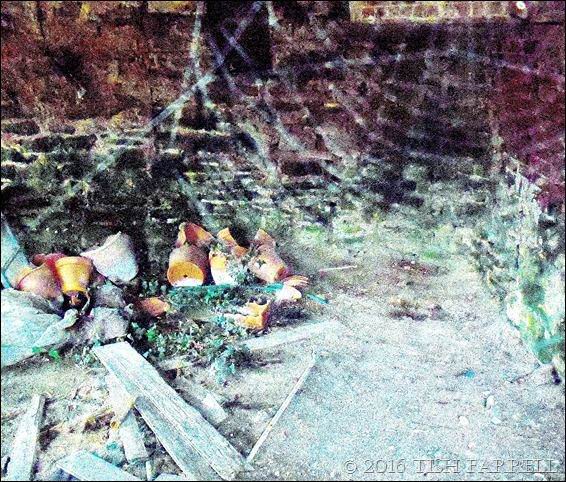
‘Beyond The Spider’s Web’ — in response to a photo by Tish Farrell

 Tish Farrell has offered this photo as a prompt for a story, so I took up her challenge.  My story is below the picture. Visit Tish’s site to find out how she came to take the picture.

TISH FERRELL'S SPIDER WEB

BEYOND THE SPIDER’S WEB

Nessa was starting to feel a little chilly. When she’d left the group of picnickers, after the argument, she had intended to walk just a little while, until her anger dissipated, and then turn back. But somewhere she had taken a wrong turn and ended up in this wooded area. Now she was good and lost. The afternoon had turned brisk, and she’d left her sweater at the picnic site. She was pretty sure she needed to be heading in the direction the sun’s rays were coming from in order to get back to the group. She wondered about why she didn’t hear anyone calling for her, but, of course, they didn’t know she was lost.

After one more turn to head directly toward the sun, she spotted an old barn in a small clearing. One side wall was leaning awkwardly, and part of the roof had obviously fallen in. But she decided she needed to sit down and catch her breath, and at least this offered a little shelter.

As she got to the window, she peered inside to make sure no ferocious animal was making his home there. A huge spider’s web covered most of the window opening, and she had to move her head from side to side to see through the silken threads. But she saw no living creatures inside — just a pile of old flower pot, a rusty pitchfork, and several pieces of rotting wood that had fallen from the roof.

Moving to the left, she finally spotted a door, and pushing against it with all her strength, she managed to get it open enough to walk inside the building. The musty smell was strong: rotting hay, dust, dead foliage, and lots of mouse droppings, if she wasn’t mistaken.

But the relief from the wind was welcome, and there was enough light to look for a dry board or two to make a seat to sit down on and stretch out her legs. She sat for several minutes, enjoying the change in position, but gradually, she realized that she was hearing something besides the silence she’d expected. It was like a tapping — rhythmic but with pauses now and then — followed by the same sounds repeated. It was a pattern that spoke to her musical soul, but it wasn’t music. It was . . . what exactly was it? It was almost like code of some kind, but she dismissed that idea as ridiculous.

But it kept repeating — light, but insistent — until she couldn’t ignore it any longer and had to get up and make her way toward the direction from which it came. Trying to tell herself that it was just a loose board being blown against the wall by the wind, she continued in that direction. But by now she knew the tapping was too light to be just a board — and too rhythmic to be the result of the erratic wind. Her first twinges of uneasiness at being lost were now growing into outright fear at what she might find when she reached the source of the sound.

She stopped. She argued with herself. “I don’t have to go on. I can get out of here and keep walking. Besides, I need to keep moving while I can still be guided by the sun.”

That line of thought sounded good, but then the tapping caught her attention again, and she couldn’t dismiss the idea that if there was someone else here who needed help, she’d never forgive herself for running away. So digging deeper for what courage she had left, she eased herself forward toward an inner door. As she pushed the squeaky door open, the tapping suddenly stopped. There was dead silence for long seconds, and then a tiny voice, choked with tears called out: “Is someone there?  Is someone there?”

Nessa’s heart almost stopped. She didn’t know whether to answer or not, but then thought how foolish to have come all this way to see if someone needed help and then refuse to offer it. Then the voice sounded again. “Please . . . is someone there? Please help me!”

Suddenly, Nessa’s heart took over from her terrified thoughts, and she answered, moving forward as she did. “Yes, I’m here. But where are you?”

“I’m up here!” the tearful voice called, and Nessa looked up for the first time. There, not ten feet from her, in the hay loft, a young boy was hanging out of a hole in the loft, with one leg still stuck up in the hole. He was holding onto a rope that hung from the loft as well, trying to keep himself balanced. With his other hand, he was tapping a piece of wood against the ladder leading to the loft. He couldn’t reach the ladder from where he hung, but he could hit it with the wooden stick.

“Oh, my goodness!” Nessa cried and ran toward him. “What happened?”

“I . . . I fell through a hole in the hay loft, but my leg got caught on something as I fell, and it won’t come loose . . . although I don’t want it to come loose if I can’t get a better hold on this rope because I would fall to the floor on my head. I called and called for help until my throat hurt too much to keep calling. Then I kept hitting this stick against the ladder, hoping someone would hear me.”

As she came closer, Nessa, realized the boy couldn’t be more than eight or nine years old. His tousledd blond hair hung down from his head as he hung almost upside down, and his face was dirty with smeared dirt and tears. “I’ll see what I can do to help you,” Nessa said, as she started to climb the ladder to the loft.

“Be careful,” the boy said. “That ladder has some rotten rungs.”

“Why on earth were you in here climbing it anyway?” she asked.

He sniffed. “I was running away from home.”

By that time Nessa was in the loft and had discovered that his leg was caught between two boards. She didn’t she any blood, but it was for sure he’d have a serious bruise on his leg when this was over.  She tested the rest of the floor around the hole, and finding it solid enough to support her weight, she went to work slowly reaching down for the boy’s shirt and gradually pulling him back in the direction of the loft.

When she had him close enough to have a secure grip on him, she worked at loosening the boards around his leg with her other hand. It was slow work, and he cried out in pain once, but she finally managed to get his leg loosened enough for him to use it to help lift his own weight back toward the opening in the loft.

After a great deal of tugging and huffing and puffing by both of them, the boy was able to reach back through the hole with his own left arm and help pull himself the rest of the way into the loft. They both just sat there, catching their breath for some minutes.

Finally, Nessa spoke. “My name’s Nessa, by the way. What’s  yours?”

“I’m Timmy Randall.”

“Do you live near here?”

“Yeah, just over that hill.” He hung his head and took a deep breath. “I didn’t get very far running away, I guess. I got tired, and I crawled up in the loft to take a nap. And that’s when I fell.”

“So why were you running away? Are your parents mean to you?”

“Well . . . they won’t let me have a horse.”

“What! Is that a good reason to run away from your family?”

“Well . . . they promised me a horse for my birthday, but when my birthday got here — yesterday — they said they didn’t have the money to get me a horse, and all they gave me was a new pair of shoes.” He started to cry again.

“But maybe something happened and your parents really don’t have the money to buy a horse,” Nessa argued.

“But you don’t understand. I bragged to all my friends that I was getting a horse for my birthday. They all  laughed at me and said I was lying — that my parents were too poor to buy me a horse — and that I was stupid to believe they would. Now I can’t go back to school with all those kids. They’ll just laugh at me even more.”

Nessa studied him, weighing her options. Deciding her best bet was to get him to feel more sorry for her than he did for himself, she said. “Well, I’ll tell you what, Timmy. I’d like to help you, but the truth is that I’m completely lost out here. I was on a picnic with my friends, and we had an argument, and I did something as dumb as you did. I just took off walking. But now it’s almost dark, and I don’t know how to get out of these woods, and I’m so scared I don’t think I can help you at all. I’ve got to try to find my way home all by myself.”

Timmy looked at her for several seconds, his eyes wide, and his mouth hanging open. Here was someone with a bigger problem than he had. At least he knew how to get home — to a warm meal and a soft bed and someone to be sure he was safe for the night. Suddenly his green eyes lit up, and a grin spread across his dirty face.”

“Hey, you know what? I can take you to my house, and my dad can drive you home!”

Nessa feigned surprise. “You’d do that for me?  But you’re running away.”

Tim thought about her words a couple more seconds. “Well, I figure it this way. You saved my life just now. If you hadn’t helped me, I would have hung there ’til all the blood ran to my head and I’d have had to let go of the rope I was hanging onto, and I would have fallen to the floor, hit my head, and died.

“But since you stopped to help me and now it’s too dark for you go get home, I’m going to take you home with me.”  The last words were punctuated by another big grin.  After all, there was no shame in changing his mind about running away in order to help a young lady in distress, now was there? He could go back home — where he’d really wanted to be all along — and save face at the same time.

“Well, Timmy,” Nessa said, as she stood up, “I’d be really, really grateful if you’d do that for me.”

Tim hopped up as well, wincing just a little as he put weight on his injured leg.  His grin widened. “It will be my pleasure, Miss Nessa,” he said, holding out his hand to grasp hers as they made their way carefully back to the ladder to start their journey home.

THE END


~~~

100-Word Challenge For Grown Ups – # 176

Visit Julia’s Place to get the details so you can participate with your own 100-word story. The prompt this week: “… but I thought we were friends …”


BLONDY06FRIENDS???

“But I thought we were friends, Trish.”

“We are friends, Kara, and quit your whining. It isn’t going to help. I just choose not to be part of your plan.”

“But I need someone to stand guard for me while I slip into his office.”

“Then you’ll have to try one of your other pals, because it’s not going to be me. We could get arrested!”

Kara crossed her arms over her chest and heaved a tortuous sigh. “I’d do it for you.”

Trish smirked and rose to leave the room. “Of course you would; you’re a lot more stupid than I am.”


~~~

My Christmas Anthology Came Out in the Kindle Store Today: $1.99

Exif JPEG

Hooray! Merry Christmas! Happy Holidays! Season’s Greetings!

My Christmas Anthology — STOCKING FULL OF STORIES — went digital today, and it’s priced right for the holiday shoppers at $1.99

Christmas is about love – and laughter – and hope – and second chances. This collection of 11 original Christmas stories covers all those subjects and then some. From poignant to funny to heart-warming and faith-inspiring – you’ll find a little bit of everything in this Stocking Full of Stories. Read the book straight through for an evening of well-rounded Christmas pleasure. Or pick and choose, one story at a time, depending on your mood.  (It’s 82 pages in regular print, but with digital, only your own personal device will determine how many “pages” you actually have once the book is downloaded.)STOCKING W. STORIES FRONT COVER FOR KINDLE - ED 2.

Some of you will have read a few of these stories, since I’ve posted many of them right here on the blog, but several have been re-written and enlarged since their original posting.

So if you’re looking for a little more holiday atmosphere, check out STOCKING FULL OF STORIES at the Kindle Store. Give yourself a gift this Christmas: fill your stocking with these stories of the season. And while your ordering, go ahead and send one to someone you love.

(If you don’t own a Kindle device, you can download a free Kindle app for any device you use.)

~~~

Friday Fictioneers – 11/27/15 — Beloved Sentinel

This week’s Friday Fictioneers challenge. The photo is courtesy of Sandra Crook. My story is below the picture.

PHOTO PROMPT © Sandra Crook

BELOVED SENTINEL

“Does she stand on that cliff every day?” Tobias asked.

“Every day,” Raulf replied, looking at the young girl wrapped in her woolen shawl, black hair windswept like a flag.

“But five years! Surely she doesn’t still hope.”

Raulf nodded his head. “Serena insists Jamie will not fail her. He promised, and she must keep trusting.”

Tobias frowned. “She’s so beautiful. I’d gladly have her for my wife. There must be some way to make her see that she needs to move on with her life.”

“She’ll move on … when she sees his sails on the horizon … and not before.”

~~~


`

The Sidewalk

BRENDA'S COBBLESTONE STREET BROWN“Well, what’a ya know,” Ben whispered to himself, grinning, seeing his breath form vapors on the Christmas air. “Who would have thought it would be the brick sidewalk?”

He sighed. In one unexpected instant – as his feet had tread the bricks of this dear old sidewalk that had run the length of Main Street all his life – it had happened. He knew for sure the place he’d returned to was still ‘home.’

Just yesterday he’d been dreading coming back – as he had been for a week – from the time the doctors had told him he was almost well enough to make the trip. He knew for sure how much he had changed, and he couldn’t shake the deep, gut wrenching fear that the whole world had changed as well – including the little town nestled at the foot of the mountains in Montana. He’d grown up here, played high school basketball, and dated the girl from three houses down the street until she’d decided to elope with the captain of the basketball team.

He had to chuckle to himself when he remembered how devastated he’d felt back then. It had been his first serious relationship with a girl, but in hindsight, he realized that he hadn’t really been in love – just fascinated with the boy-girl relationship.

Sometimes when he’d been hunkered down in the trenches, waiting the next command to move out into the threat of enemy fire, he’d started thinking about Allyson, and even though she belonged to someone else now, the memories comforted him. He’d known even during those hours that it had nothing to do with Ally or their time together, but it was all about ‘home.’ When he thought of Ally, it took him away from the cold, wet, ugly war he was fighting.

Sometimes he’d remember his mother and could smell again the warm vanilla scent that so often clung to her from her constant baking. He’d conjure up the image of Granddad, sitting with his feet propped in front of the living room fireplace, sweet-scented smoke curling from his pipe. He’d hear again his father’s voice as he read the latest news stories from the paper as the family sat soaking up the security of their home and their quiet life together.

Then, sometimes, when he and his unit were on the move and trekking through secure territory, on their way to the next battlefront, he had remembered walking down that old brick sidewalk – past Old Man Chesterfield’s hardware store, Woolworth’s Five & Dime, the candy and tobacco shop, where he’d bought Ally that huge box of chocolates for the Valentine’s Day they’d celebrated together. There was Mrs. Gallagher’s Boutique next, and then Pansy’s Pancake House. Some days, when his senses were crystal clear, he could nearly taste those light, fluffy concoctions smothered in her special Cherry Cordial Syrup.

When he let his memory take him wherever it willed, he usually ended up thinking about Christmas, and he’d see again the decorations strung the entire length of Main Street, with lights in the windows of every storefront, snowmen standing sentry at almost every corner, and wreaths and holly hanging everywhere. He could almost feel the frost in the air and the festive atmosphere that surrounded shoppers and merchants alike from Thanksgiving to Christmas. And oh those chestnuts! The scent of roasted chestnuts hung over the main business district for two whole weeks before Christmas Day. And often he thought that sweet aroma was his favorite memory of all. Sometimes he swore he could smell those roasted chestnuts even though he was thousands of miles away on foreign soil with no hope of even a warm dinner for that night.

He’d been wishing he could have some of those chestnuts just minutes before the ambush occurred, but then bullets and grenades had killed all thoughts and images of anything but the hell breaking loose in every direction. Those same bullets and grenades had killed twenty of the men in his unit as well. When he’d taken the first hit in his leg and fallen, his best buddy had turned back to help him up. But the bullet that caught his rescuer in the head snuffed out his life in seconds, and as Ben had tried to hoist himself with his friend’s help, he’d taken a second bullet in the chest, blacking out at that point.

Five days later, when he regained consciousness in the hospital, he was hooked to all kinds of tubes and machines. The doctor had been compassionate and kind, assuring him that he was going to make it, but that it would be a month or so before he’d be fit to leave the hospital. When he’d asked about his unit, the news had been brutal, and he’d found himself so frozen by the grief that he hadn’t even been able to cry.

The day he’d been released and given his extended leave for home, his doctor had been wreathed in smiles. “We’re going to get you back to your family in time for Christmas, Son,” he’d said. And as much as the news brought a spurt of joy to Ben’s heart, it also brought a stab of fear.

He’d made a short journey first to the home of the man who’d been his best friend in combat, the man who’d lost his life trying to save Ben. He’d learned that Rick’s body had been shipped home for burial in the family plot. Ben knew he had to visit that grave and spend some time with Rick’s family before he could get started on the longer journey to his own family. And it was with that family, sitting in Rick’s home, remembering his buddy, that he’d finally been able to let the tears come. With his head on Rick’s mother’s shoulder, and her arms holding him tightly – the way she would never be able to hold her own son – Ben had finally cried out the pain and bitterness and loss.

Eighteen hours later, on the day before Christmas Eve, he boarded the bus that would take him to Montana. He had purposely refrained from letting his family know what bus he was taking. He had to walk out this journey one step at a time – in his own way and in his own timing. He had to find out what kind of world awaited him at the end of this journey, and he had to have the security of facing it on his own terms.

His physical wounds were almost healed, but the wound’s in his soul would be with him forever. And that’s what made him afraid. As long as he didn’t go home, he could always try to tell himself that it was still a place of peace and safety and love and laughter – and that life was still good there. But all the time he sat on the bus, heading to that little town in Montana, he battled with the fear. The questions kept circling through his mind: when he walked down the streets of his old hometown – when he stepped into his mother’s kitchen – when he visited the high school campus – when he sat in the park watching the breeze blow across the lake – when he met with friends in a restaurant –would he find what he’d left behind – or would it all be gone – forced out of existence by the same powers that had changed him forever?

Finally, at the end of the seven hour trip, he stepped off the bus, retrieved his suitcase and stood for a few moments just looking across Main Street at the row of well-remembered businesses – those stores and shops that had filled his dreams and imaginations hours at a time in the rare instances between battles.

Everything glowed with Christmas. It looked the way he would have expected it to look back before he’d had to wade through hatred, filth, and slaughter in another land. But could he relate to this place any longer? Could he ever belong here again? Would it welcome him – would he welcome what he found here now? He slowly walked across Maine and stepped onto the sidewalk that would take him from the north end of town to the south, where his parents lived.

He walked – slowly – hesitantly at first. His eyes caressed the old, worn bricks that stretched out ahead of him the whole two-mile distance of the business district, and he began to realize that each step he took was a familiar experience – the same experience he’d enjoyed for years, day in and day out – treading those warm brown bricks woven together by expert hands generations ago – just slightly uneven but plenty smooth enough for easy walking.

And every step reassured him. He began to breathe easier now, and as he took a good, deep breath, his nostrils twitched a little. Chestnuts, roasting, in a cart just up the street about two more blocks. He walked with more purpose then, his eyes still caressing the worn, welcoming bricks beneath his feet, stretching out before him invitingly.

Finally, he chuckled out loud. Yep … it was okay. … It was really okay. … He was okay. And he really was home. … Yep … this good old brick friend told him everything was going to be all right.

THE END


~

Wordle Writing Challenge 220 – ‘The Letters’

This post is my second foray into the Wordle Writing Challenge, where we are encouraged to write a short story or poem that includes all of the words in a specific box. Each Sunday we receive a new box — the work of Brenda Warren over at “The Sunday Whirl.” So if you’re interested in taking part, hop over there and get started. My story’s below the box.

WORDLE 220


THE LETTERS

He stuffed the letters back into the manila envelope he kept them in. Since they’d arrived last week, he’d read  every one of them at least a dozen times. He wasn’t sure why, except that he hoped reading them would help give him the courage he needed to make the trip.

He laid the envelope on top of his desk and sat down with a weary sigh. Thrumming his fingers on the desktop, he let his mind drift back to those days nine years ago. The minutes turned into hours as he sat there, but it didn’t matter. He was caught once again in that heavy flow of traffic, the chill of the icy winter weather soaking into him as he waited for his 20-year old Buick’s heater to kick in.

He’d put off making that trip to the store that night, but he was completely out of milk and bread both, and since he hated cooking, the lack of those two essentials left him hungry. Even the ham and peanut butter that he often existed on couldn’t do him much good without the bread, and he certainly couldn’t face his cereal in the morning with no milk. So bundling up as well as possible against the 10° weather, he’d risked the icy side roads and made it to the main highway.

He’d spotted her blue car pulled off on the shoulder while he was still almost a mile away. Ordinarily, he never stopped for strangers, but that day he felt such a unique urge to pull over and offer help. He pulled in behind her car as carefully as possible, and by the time he had walked to her door, she had powered down her window. The first thing that struck him was how cold she looked, but that thought was immediately replaced by the warmth in her beautiful green eyes when she smiled at him.

•  •  •

He stirred himself in his desk chair, sighing deeply, and pulling himself out of his reverie. Another heavy sigh escaped him, and he looked around the room, trying to make the final transition from nine years ago back to the present moment. They’d been together — happily, he thought — for seventeen months, and, then suddenly, she had packed her bags and walked out the door.   Her only explanation was that she just couldn’t handle being tied down in one place. That’s why she’d never agreed to a legal marriage between them. She’d insisted she had to feel free.

He picked up the envelope of letters again. Everyone of them had been dated on the same day of the year, beginning the year after they had separated, but they’d arrived at his door packed together in a small box — each letter in an envelope — each envelope stamped — but not one of them postmarked.

He pulled out the cover letter that had come with the others: “I know you’ll be surprised at this package,” she had written. “But by the time you read this note, I’ll be gone from this earth, and I felt it was right to let you know the truth. I wrote each one of these letters, fully intending to mail them the day they were written, but then I lost my courage to do so. Now, however, I have no choice, and I think it’s important that you know you have a son. You’ll find all the details in these unmailed letters. The only thing I can add is that I’m sorry I couldn’t become what you wanted me to be.”

He picked up the last of the individual letters from the stack. She had included her parents’ home address and their phone number. She and the boy had been living with them during the past year. She had written that letter on his birthday — as she had all the others — and on the date of the last letter, the child had turned eight years old.

A kind of rage surged through him, and he crushed the letter in his hand. How could she!  How could she do such a thing to him — and to the child? But the rage soon gave place to tears. He’d run through that gamut of emotions several times since first opening that package of letters. Part of him wanted to burn them and forget it all so that he didn’t have any more hurt and pain. But the other part of him handled them with trembling fingers, treasuring them because they were his only link to his son.

Suddenly, he rose from his chair, stuffing the letters back into the manila envelope once again. He walked to his bedroom, took his suitcase out of the closet, and started to pack. He made a quick job of it, then tossed the envelope of letters on top of his clothes and  snapped the case shut.  Taking a deep breath, he carried the case to the front door, where he picked up his coat, stepped outside, and locked the door behind him. Once outside, with his suitcase in hand, he felt his courage getting stronger. He had made the first step now, and the momentum would carry him through.

He was a father. And it was worth risking everything to be able to know and love his son. ~


~~~

History Through the Eyes of Ogden Owl

Lee Dusing, over at Lee’s Birdwatching Adventures Plus, has posted the picture on her site of this owl with his eyes bulging as he takes in some scene before him. Lee has asked us to write a caption or a story based on the picture — taken by Peter K. Burian.  So, naturally, I had to take up the challenge — even though I’m not much of an owl person in general. My story is below the picture.

LEE'S OWL PIC -- PETER K. BURIAN

HISTORY THROUGH THE EYES OF OGDEN OWL

Ogden Owl couldn’t believe his eyes. He was sure they must be bulging because he was straining so hard to see what was really going on. He’d lived in these sparse clumps of trees close to the sandy beaches of Kitty Hawk, NC, for almost three years now, and ever since he’d moved here, there had been some strange things going on.

Two human beings had spent months at a time out on the sandy stretches of land between the hills, half rolling – half carrying – some contraption that looked a little like a huge, ugly bird, but that seemed to be bound to move on the ground. Ogden was usually up doing his hunting during the night, and by morning, he was ready to get some rest, so he hadn’t bothered with the humans much, except to shake his head at their ability to waste time and energy out here on this almost barren stretch of land.

But early this morning, when he really should have been considering getting some rest again, he had noticed that the two human beings had an even bigger monster of a machine – even more ugly – and this time it made a horrible noise as they moved it across the ground.  They pushed it onto some kind of inclined track, and the next thing Ogden knew, one of the men seemed to climb right into the middle of the machine.

Ogden could hardly hold his eyes open, but he was determined to find out what was going on practically right under his nose. Suddenly the huge machine began moving along the inclined track, picking up speed, and then, to Ogden’s astonishment – and horror – it lifted up from the ground, all the time making a roaring noise. It seemed to catch the wind with its enormous wings and sailed through the air just like he did when he took off from his tree limb and weaved through the sky looking for food.

It couldn’t be! Surely not! Human beings flying??? His eyes stayed glued to the scene. For long seconds, the huge, ugly contraption floated and soared – and scared the heck out of Ogden.

When the machine came back down to the ground and sat down without breaking apart, Ogden took a deep breath. He hadn’t realized that he had been holding his breath the whole time he watched that ugly, noisy machine fly. He shook his head now and stirred restlessly on the branch where he sat. He sighed and stretched his wings a little, wanting to feel their strength once more before he moved back onto one of the hidden branches of his tree to get some rest. He felt sad – and fearful. He had a feeling that life was never going to be the same again after today.  ~

~~~

Wordle 219 Writing Challenge: ‘The Case of the Copy-Cat Crimes’

I just discovered a writing challenge called “Wordle,” which you will find at “The Sunday Whirl.”  It involves writing a poem or short piece of fiction that uses the words in a prescribed group for each week. Writers can use any form of the words that fit their stories/poems. Below, you’ll see the green box with the group of words for this week. If you’d like to take part in the challenge, just follow the link to “Wordle 219” for October 4, 2015 and join in.  My story is below the box of words.

WORDLE 219

THE CASE OF THE COPY-CAT CRIMES

Detective Becker pressed his left hand against his temple. It was tender from the pain where a migraine was threatening, but he had to go over this list of people who had received threats in the past month. The letters had all been made out in the same way: typed words that had been cut and pasted – one word at a time – onto a black sheet of paper and mailed in red envelopes. He’d sworn he’d figure out the nexus they shared that had made them victims of such a hateful attack, but time wasn’t on his side any longer, because the first two people on the list had already been killed.

His buzzer sounded, and his secretary reported that he had a call waiting on line one: his superior, Detective Holmes. “Yes sir,” Becker spoke into the phone. “What can I do for you?”

“The press has gotten wind of the fact that eight other people have received threatening letters. They’re pushing for a story, but, of course, we can’t tell them anything that could disrupt the investigation. I just wanted you to be forewarned that they’ll be waiting outside the front door when you leave the office.”

“Thanks for the warning. I slip out the basement entrance.”

“Have you figured out any connection yet between the two who are dead and the other eight?”

“I think I may have, Sir. All of these people served on a jury together about fifteen years ago. The decision of that jury was unanimous and resulted in the death sentence for the man on trial.”

“Who?”

“Malcom Leiberman.”

Dead silence on the other end of the line caused Becker to stay quiet and wait. He could hear that the wind outside had started blowing harder, and he knew the storm that had been predicted was almost upon them. Finally, Holmes responded: “You know, of course, that Leiberman was convicted of perpetrating a series of murders after sending out threatening letters to his victims.”

Becker sucked in his breath. “No sir … no, I haven’t had time to research the case yet. But that’s too weird.”

“Yes,” replied Holmes. “And now I think I know who we’re looking for. His brother swore he’d get revenge. But then he got sick with some disease that the doctors said was incurable, and he was hospitalized for years. I guess everybody forgot about his threats. I know I did. But we need to find out if he’s still alive, and if so …”

“I’m on it, Sir,” Becker said. “I’ll call you back as soon as I have the information.”

Two hours later, Becker walked into Holmes’ office with a medical report. “He’s alive all right,” he said, laying the report on his superior’s desk. “And living right here in the city.”

“You’ve got an address?”

Becker nodded.

Holmes rose from his chair and strapped on his gun. “Let’s go get him and save eight people’s lives.”

~~~