(Throughout this article I will be referring to people of the Negroid race as Negroes or black people. I do not use those terms in any derogatory manner. It’s currently considered “politically correct” in the U.S. to refer to people of this race as “African-Americans,” but, to me, that is a slap in their faces. To separate these people with darker skin color into a “segregated” group and label them AFRICAN-Americans rather than AMERICANS just like the rest of us is a terrible insult. I have always and will continue to use the proper name for their race: Negroid — and the proper name for my own race: Caucasian.
But since we have for generations considered it acceptable to shorten those formal race identifiers to simply “black” and “white,” I see nothing discriminatory in continuing to use those less formal terms. I believe that my words (labels, if you will) show more respect for the race than does the term that labels all black Americans as “Africans.” Should anyone reading this article feel required to take offense at my terminology, feel free to stop reading at any time. I am not a “politically correct” journalist, nor will I ever be one. But I will continue to write honestly and passionately about what I know, what I believe, and what I feel.)

I Drank From the ‘Colored’ Fountain
I was 10 years old. My parents, my little sister, and I had moved to Nashville, TN, from a little town in Southern Illinois the previous year. We were on an adventure, and everything – but everything! – was different.
Most of those differences were good and wrapped us in happy experiences and precious memories. The people were warm and friendly – eager to help in any capacity at all. We began making instant friends from the very first day, and many of those friendships lasted far into future years. In fact, I can honestly say that my greatest disappointment when we eventually moved back north was that there was absolutely no answering friendliness or help coming from the people in our new hometown. And developing genuine friendships when back in Illinois again seemed very hard.
The schools in Nashville were different as well. They seemed to be much more education oriented, with no ‘playing around’ like that allowed in our schools back in Illinois. Structured lunch periods, structured recess (for only one half hour each day), and intensely focused academic work at every grade level were the earmarks of the Nashville school system. In fact, when we returned to Illinois, my sister and I were almost one whole year ahead of the students in the same grades in our new school.
And then, of course, there was so much more to see and do than there had been in our former hometown. The all-night convenience stores had never even been dreamed about in Southern Illinois back then, but they were prolific in the big city and its suburbs. There were multiple museums, libraries, movie theaters, restaurants of every conceivable sort, lovely little independent bookstores, and huge department stores.
Our favorite department store was right in the middle of the city. It was the epitome of the department store of the 1950’s. Everything you could possibly want in the way of clothing, furnishings, appliances, entertainment equipment, and tools could be found under one roof. Prices ranged from exorbitant in some of the departments to modest when customers shopped the “Bargain Basement.” But everyone shopped the basement as well as the rest of the store, and it wasn’t unusual to see one of the big stars in country music purchasing petticoats in the basement right beside “ordinary folk.”
There was an exquisite restaurant on the fourth floor, with food and service that made guests glad they had “dressed up” to visit. But there was a “Lunch Counter” in the basement, and that was just as much fun in its different way. The counter was shaped in a huge square that wrapped around the center area where the food prep was done. Most week days, it was so crowded at the middle of the day that there were people standing and waiting their turn to sit down and order.
I loved that department store, and it was in that very store that I experienced a strange and disturbing epiphany. It was there that I first came face-to-face with the one difference in lifestyle that was not good – not good at all. Strange and disturbing as it was, though, I welcomed it and have been grateful for it ever since. The experience was not one that took place in a split second, as epiphanies often do. This experience developed within me over a period of time, mainly because I was gradually accumulating data and meditating on all of that data, examining my own emotions and my responses. And let me hasten to add that this one department store was not the only place where the situation I’m addressing could be found. In fact, it was in every public place throughout the city – throughout the south. And years later, I was to learn that many places in Illinois and other northern states had their own version of this problem, but it was not emphasized quite so publicly.
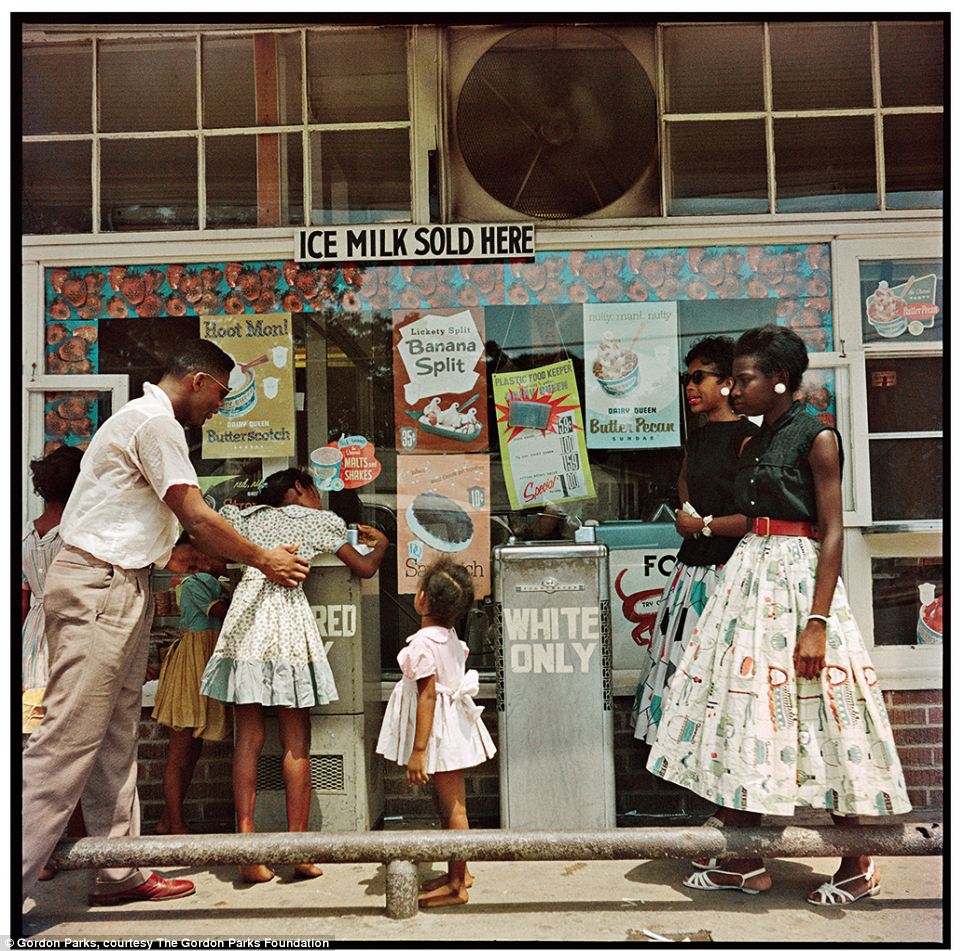
My epiphany began one seemingly inconsequential day as I stood in the midst of that department store and realized I needed a drink of water. Mom found the water fountains. There were two. One was labeled “White.” The second was labeled “Colored.” We were busy, so mom directed my sister and me to drink from the one labeled “White,” which we did and hurried on our way.
But the next time I was in that store and wanted a drink of water, since I knew where the fountains were located, I went on my own. I stood in front of those two fountains and read the signs and wondered. The question rolling through my ten-year-old mind was “Why would one have colored water?” And, naturally the next question was “Why couldn’t I have some of the colored water?” But because I had been admonished to drink from the one labeled “White,” I did so and went on my way.
Now, a handful of readers might possibly surmise at this point that I was lacking in normal intelligence. So just to put those ideas to rest I will tell you that I had been reading from my toddler years and had taught myself to write in cursive before I ever started into second grade. I frequently carried on conversations with adults and held my own. So, no, the explanation for my confusion does not lie in the level of my intelligence — but rather in the fact that I was fortunate to have Godly and wise parents.
My parents had never, in all my ten years, hinted in the slightest manner that black people were unequal to white people. They never talked negatively about black people, nor did they treat them any differently in business or social activities. In fact, my dad, in later years, told us about a Negro gentleman who had been a great friend to my grandfather in the years before I was born. Moreover, my mother was descended from the Cherokee nation, and that being an altogether different race as well, we knew that our blood line was mixed. However, the point never seemed important to us, nor did it ever come up in conversations. There had not been a great many Negroes living in the Illinois town where we lived, but I do remember one or two people of that race who crossed our paths occasionally, and I don’t recall having any feelings about them that differed from my feelings for white people.
In short, I was totally ignorant about racial prejudice and discrimination. To any readers who do not believe that racial prejudice must be carefully taught in order to be carried on from generation to generation, I will tell you that I am living proof you are wrong. I honestly did not know that it existed. And having absolutely no frame of reference for discerning the meaning of those labels on the two water fountains, I had no choice but to believe that the labels referred to the water itself.
So I continued to believe that the water fountain labeled “Colored” held colored water. And finally one day, as I stood alone before those fountains, preparing to get a drink, I took my courage – or my rebellious nature – into my own hands. I had been instructed that the store did not allow me to drink from the “Colored” fountain, so I assumed the store authorities would be watching to make sure I did not. But I just had to sample that colored water. So I looked around to make sure no one was watching. Not a sole was looking my direction. In fact, no adult was even within speaking distance at that moment. So I hurried up to the “Colored” fountain, pressed the lever, and waited expectantly.
It’s difficult to describe my level of disappointment. “Why it’s just plain water – just like the other one,” was my obvious overt reaction. But I drank anyway, hoping maybe it would taste different. Again, disappointment. But inwardly, I was more than disappointed. I was thoroughly confused.
That confusion stirred me to the point that I was willing to face punishment for my “crime” in order to get my curiosity satisfied. So I confessed to my parents that I had drunk from that fountain. “But the water wasn’t colored at all,” I complained. “It was just like the water in the “White” fountain.” When my parents confirmed that they had known that fact all along, I asked. “Then what does that sign mean?”
They explained the situation the best they could to a 10-year-old, emphasizing the fact that they did not agree with the practice, but that it was the law in that state. I was just flummoxed. Never, even in my inordinately active imagination, had I ever dreamed that people were treated this way because of the color of their skin. And for the first time, I think I realized that I should give some serious thought to who black people really were.
Adding fuel to that decision was another peculiar phenomenon that I became aware of during the same time. My sister and I discovered that black people were allowed to eat only at the lunch counter in the basement, and never in the Carousel Room. Then when we went into the store’s public restroom, which always had a black lady in attendance, we found that there were two stalls with unlocked doors, and one locked stall that required the person to pay in order to use it. By asking insistent questions, I was finally able to ascertain that no black people were allowed to use that pay stall, and white people who wanted a stall that they “believed” to be “cleaner” paid to use that particular stall.
Now, my parents were not paupers, and paying a nickel to use the toilet would not have affected their financial standing at all, but my mother never chose to use the pay toilets – except on the rare occasion that the restroom was packed with a waiting line, and we were rather desperate to go. On such occasions, she would acknowledge that wisdom dictated using the pay stall and getting the job done quickly. But my point here is that my mom never even considered that the restroom used by black people was any less clean than that used by whites. Again – I had no frame of reference for racial prejudice.
I cannot adequately describe how troubled I was as a result of those experiences. There was a heaviness and a sadness in my heart every time I thought of it from that time forward, just knowing that one group of people treated another group so shamefully. I had been taught the Word of God all my young life, and I believed it in my own heart. And, try as I might, I could not rationalize that holy Word with such unholy treatment. Yes, those two experiences dealt with seemingly minor issues, but they were just the tip of the iceberg – the surface symptoms of a raging internal disease. And the injustice of all of it weighed heavily upon my heart.
When I returned to that store, I wanted to stand by those drinking fountains and announce to people, “Hey, I drank from this “Colored” water fountain, and everything’s fine! We’re all the same! There’s no reason to separate us! You can take off the signs!” There wasn’t anyone around who cared to know, of course, but in my own ten-year-old heart, I was so glad that I had drunk from that fountain and could testify that we really are all the same.
My mind turned to the problem frequently during my growing up years, and the sadness grew as my understanding grew. I am now about five decades past those experiences, which initiated me into a level of man’s inhumanity to man that I would not have dreamed up even for a piece of fiction. Unfortunately, the years that followed would teach me much about that inhumanity and how painfully real it was in this world – not just for blacks, but for all the American Indians as well.
I want to think that some few things I’ve written, or said, or prayed over the years have made a difference. And most assuredly, the Lord has brought into my life an enormous number of Negro brothers and sisters who are believers and have become part of my family in the Lord. Those precious saints have enriched my life so much, and I can’t bear to think that they could be subjected to such treatment as that which has stained our past history. I do want to think – and believe – that the prayers and actions of each one of us individually – just like those of a ten-year-old child – can make a lasting difference.
I never freed a slave. I never took part in a civil rights march. My name won’t be found on any of the legal documents that gave black people the right to vote or that ended segregation in this nation. Nor am I listed in any roster of heroes of the Civil Rights Movement. And, no, I still have never been forced to pay for the privilege of using a public restroom. Nothing I did will seem the least bit important to anyone else, and there’s probably no one who would credit what I did as having any significance in the battle against prejudice and inhumanity in our society. But I know. And that’s enough. I drank from the “Colored” fountain, and I was so glad that I had done so. And it matters to me that, in the depths of my ten-year-old heart, I took a stand against those evil forces.
The signs are gone now from the water coolers. And all the doors on the stalls in the ladies’ bathrooms have swung free for years without the deposit of any coins. But the echos linger. Every time I remember, tears fill my eyes. And even though thousands of us honestly felt no prejudice whatsoever, I still feel some faint sense of guilt on behalf of all of us who called ourselves “white” back then. And I worry sometimes – plagued by the hints I see and hear every now and then – that the prejudice and inhumanity are not really gone from our land. But I pray: “Lord if, in the future, we ever face another time like that time – in which we dehumanize our God-created brothers and sisters for any reason — please give me the courage once again to deliberately drink from the ‘Colored’ fountain.”
~~~
(The photo is the personal work of photographer Gordon Parks, whose photographs were well-known by readers of Life magazine. His works have been published in a collection by Steidl, and can be found at this site:
http://www.steidl.de/flycms/en/Books/A-Harlem-Family-1967/2940425559.html.
More information about Parks and his work can be found at the Gordon Parks Foundation site:
http://www.gordonparksfoundation.org/)