‘Releasing the Creative Writer in You’ – Lesson 6

To access other lessons in this series, click on “Creative Writing Class” in the navigation bar and scroll through to find the lessons you need.
releasing-the-creative-writer-icover-editedLESSON # 6: BODY MOVEMENT AND DIALOGUE MAKE A STORY COME ALIVE

As you develop your plot, remember to use as much dialogue and body movement as possible to help the reader see and hear the words and actions. Simply narrating it is much less effective. Quote your characters directly, and let the reader hear a sigh or see the character lean against a door frame. Describe a smile or the sound of the laughter. Allow your character to lean forward or backward, prop his foot on a stool, rest his head against the back of a chair, or fold his arms across his chest. No real person carries on a conversation without body movement as well, and you need that kind of description to keep your reader’s attention and make your characters “real.”

Beginning writers often find themselves skipping this very important principle. They get involved in “telling” their story and just continue to narrate the events without any individual detailed action and without letting their characters carry on real conversations. That lack of material is generally why some beginning writers have problems filling out scenes and developing entire novels. But once you get into the habit of adding these two very important elements to your writing, you will find that you enjoy writing even more, and that you have less problem creating real-life, fully developed scenes for your story.

Now, of course, adding just any old movement or dialogue will not work either. The characters’ behavior and conversations have to fit the story and be totally relevant – even important – to the story itself. Keep checking to be sure that every conversation and every scene is actually moving your story forward and not just taking up space.

Remember also, that tag words (things like “he said / she asked”) need to be kept at a minimum and need to be simple, ordinary words as often as possible. Some new writers have the mistaken idea that they should reach for a variety of words or for unusual words to use with quotes. That’s exactly what you don’t want to do. Those unusual words stick out like the proverbial “sore thumb” in the middle of dialogue and interrupt it. Except in very rare instances, you’re much better off using the ordinary words like “said” or “asked.” Occasionally, in a scene where they would be perfectly applicable, you might venture out to tag words like “whispered” or “shouted.” But the number one rule is to keep those tags as inconspicuous as possible.

The next rule you want to remember is to begin a brand new paragraph each time the speaker changes in a conversation – even if the previous speaker said only one word. When you stay faithful to that rule, you end up needing far fewer tag words to begin with – particularly if you have only two speakers. Once you identify the original speaker and then identify the person who answers him, changing paragraphs for each one will keep your reader aware of who is saying what. If your conversation lasts for more than a page, you need to throw in a couple more tags here and there, just for extra clarity, but it’s amazing how easily readers will follow your conversations with no other help when you follow these two basic rules.

QUIVER FULL COVER - GOLDBelow, I’ve given you two versions of the same excerpt from my novel A Quiver Full of Arrows. The first excerpt uses very little body language and dialogue. The author narrates what is happening, but does not show the characters in action or let them speak on their own. In the second, you will see how much more color and interest is added by letting the characters speak their own words in normal conversation and by showing the reader even small unremarkable body movements.

In order to better grasp the way these writing tools are used, I’ve made the dialogue a sort of turquoise color and the body movement sections a shade of purple. I tried highlighting them, but could not get the highlights to copy and paste into this editing window. So I’ll work with what I’ve got.  And the color variation will help you see exactly what was added to get the better version.

Version # 1 – Mostly narration with only a small amount of body movement or dialogue. (Remember: dialogue is only the words within quotation marks. Any other mode of letting your reader know what a character said is narration.)

Peanut shells! Again! Handfuls of peanut shells scattered around the steps of the front porch!

How were they getting there?

Lawson Wainright walked around the small piles that were littering the sidewalk and the edge of the grass beside the steps. He stood for several more minutes, looking around the yard, turning his tall, lean body full circle . . . but there was no one in sight.

He looked up into the branches of the tree just a few yards away. He supposed it could be birds or squirrels. But he just didn’t think an animal would leave the shells looking like this. The nuts had obviously been broken open carefully. . . . .

He went to get a rake and some garbage bags to gather up the shells. While he was raking up the shells, Elmer Peabody, his 75-year-old neighbor from across the street came over. “Looks like you’re rakin’ up peanut shells again,” he said.

Lawson agreed and asked Mr. Peabody if he had seen anyone unusual in the neighborhood recently. Mr. Peabody replied that he hadn’t seen anything so far and asked if the shells were all still intact the way they had been the other times. Lawson told him that they were.

Eventually Mr. Peabody began to walk around the area himself, looking closely at the foundation of the house, where Lawson had added white latticework that ran along the front, below the porch, and met the steps on each side.

Elmer was leaning down close to the foundation right where Lawson had been raking up the shells, and all of a sudden he shouted. “By Jove! Did you know that your lattice is broken here, L.W.?”

“Broken?” Lawson asked. “Where?”

“Right here,” Mr. Peabody answered and handed Lawson a piece of the loose lattice.

Lawson couldn’t understand how it could have broken because he had put it in place last summer, and it was all secure. He finally stooped down and looked more closely.

The area under the porch was spacious and dry, and Lawson crawled in to have a better look.

“What in heaven’s name!” he shouted from under the porch.

“Did you find something?” Elmer asked.

Lawson crawled back out from under the porch and looked up at Elmer. “I found two sleeping bags and a can of peanuts under there,” he said. He was hoping Elmer might be able to help explain what was happening, but Elmer was equally stunned.

After a few seconds, Lawson laughed out loud. He told Elmer that he felt like the three bears who had come home and found someone had been sleeping in their beds. Elmer asked Lawson if he had any idea who it could be.

“I don’t have a clue,” Lawson said. But, suddenly, he remembered something.


Version # 2: A considerable amount of dialogue and body movement has been added to this version. Compare the effectiveness of Version # 2 with that of Version # 1. Which story will hold your reader’s attention better and help him relate to your characters?

Peanut shells! Again! Handfuls of peanut shells scattered around the steps of the front porch!

How were they getting there?

Lawson Wainright walked around the small piles that were littering the sidewalk and the edge of the grass beside the steps. In frustration, he ran his hands through his short brown hair, and as he did so, the sunshine caught sections of it and highlighted them with streaks of copper. He let his hand slip down to the back of his neck, massaging it a little as he shook his head back and forth slowly, still trying to reason out the solution to this strange development.

Then he stood for several more minutes, resting both hands on his hips and looking slowly around the yard, turning his tall, lean body full circle . . . but there was no one in sight. He looked up into the branches of the tree just a few yards away. He supposed it could be birds or squirrels. But after a moment, he shook his head again. No … he just didn’t think an animal would leave the shells looking like this. The nuts had obviously been broken open carefully. . . . .

He shrugged his shoulders now and let out a sigh, turning as he did so to walk around the house to the garage, where he extricated a lightweight rake from a jumbled collection of yard care equipment. He returned to the front yard, where he began to rake the small piles into one larger heap in order to scoop them into a garbage bag he had carried over along with the rake.

“Hey, L. W.” The voice of his seventy-five-year-old neighbor across the street got his attention. “Looks like you’re rakin’ up peanut shells again.”

Lawson couldn’t help chuckling and shaking his head in consternation again as he stilled his rake and looked at Mr. Elmer Peabody. “Looks like,” he called back, leaning slightly on the rake now as he gave his attention to his favorite neighbor.

“Still no idea how they’re gettin’ into your yard?” Elmer asked as he started across the street.

“Nope. You still haven’t seen anything or anyone unusual, have you?”

“Not so far.” Mr. Peabody took off his gardening hat as he crossed the yard and scratched his almost bald head. “’Course, that don’t mean nothin’,” he added. “I hardly ever look outside after dark, and early in the mornin’ I’m eatin’ my breakfast and lookin’ out my back window at the birds.” By the time he’d finished answering Lawson’s question, he was beside him, watching him finish his clean-up job. “Were the shells all neat and clean again like the other times?”

“Yeah … just exactly like the last three times.”

“Mm-mm!” Elmer Peabody grunted, shaking his head back and forth. He began to walk around the area in tight circles, finally bending over and looking along the foundation of the house, where Lawson had added white latticework that ran along the front, below the porch, and met the steps on each side. …

All of a sudden Elmer shouted, “By Jove! Did you know that your lattice is broken here, L.W.?”

“Broken?” Lawson asked, stepping over to stand beside his neighbor. “Where?”

“Right here,” Mr. Peabody said, reaching out to take hold of a loose 3-foot section of the white lattice and lift it away from the rest of the porch. He held it up for Lawson to inspect.

“Well, I’ll be!” Lawson said, taking the piece of latticework in his hands. “How on earth did that happen? I just put that up last summer, and it was all secure.” He studied the piece of wood he held in his hands. “Hmm … it looks like the nails have been worked loose and just pulled out, but nothing’s broken off.He stooped down to look more closely under the porch.

The area beneath the porch was quite spacious, and stayed fairly dry most of the year, unless they had heavy rain or snow. He could easily crawl under it himself and move around, but he hadn’t done so since he’d put up the lattice. Now he got down on his hands and knees and eased his way into the three-foot opening.

“What in Heaven’s name!” His voice came out sounding muffled from beneath the porch, and Elmer Peabody leaned a little closer to hear better as Lawson spoke again. “I don’t believe my eyes!”

“What’d you find?” Elmer asked, excitement filling his voice now. This was an adventure for him. He hadn’t had this much interesting activity in his neighborhood since Hilda Gates, next door to him, had set her kitchen on fire trying to make a big rum cake. ….

Lawson hadn’t said anything else for a minute or so, and Elmer leaned in even closer and stuck his head inside the opening.What did you find? What’s going on?”

“Sleeping bags!”

Sleeping bags?” Elmer couldn’t believe he’d heard right.

“Yeah … two of them, and a big metal can full of peanuts!” Lawson began to ease backwards out of the opening, and Elmer moved away to give him room.

“Did I hear you right? Sleeping bags?”

Lawson was still crouched down close to the ground, and he looked up at Elmer, his face a perfect picture of consternation. “Elmer, there are two rolled-up sleeping bags under my porch, and a large metal can full of peanuts in the shells.” His eyes still registered his shock, and then a quizzical look came into them, almost as if he hoped that his neighbor, somehow, would have the explanation.

When he realized that Elmer’s face was as full of surprise as his own must be, he added, grinning in spite of himself, “I feel a little like the three bears who came home and discovered that someone had been sleeping in their beds.” He laughed out loud then. In spite of the obvious seriousness of the discovery, he couldn’t help himself. “Mr. Peabody … somebody’s been sleeping under my porch!”

“And havin’ a midnight snack on top of that,” Elmer said, chuckling and scratching his head again. “By Jove! I wonder who in the world it could be.”

Lawson shook his head again and picked up the piece of lattice to replace it. “I can’t imagine – unless – ” His voice trailed off, and he sat back on his haunches, looking off into space. . . . He had just remembered a recent news story. …


With this second version, not only is the scene fully fleshed out, but the reader actually feels that he is getting to know the two people involved. As we discussed in the chapter on developing characters, we get to know real people in our lives by talking with them, seeing them in action, and learning how they treat and interact with others. That’s also the best way for readers to get to know the characters in a story. As a result, those characters seem real, and the reader connects with them enough to want to read to the end.
__________________

* Releasing the Creative Writer in You, © 2013 by Sandra Pavloff Conner

NOTE:  My schedule has become a little over-loaded this month, so I’m going to have to hit the ‘pause’ button on my plan to offer a creative writing lesson every Saturday. I’ll try to post a lesson at least once a month for a while, but that may be the best I can do. I hope these have been a help and encouragement to some of you, and I’ll add more as often as I can.

~~~

‘Releasing the Creative Writer in You’ Lesson 5

To access previous lessons in this series, simply click on “Creative Writing Class” in the navigation bar, and scroll through to find the lessons you need.

releasing-the-creative-writer-icover-editedLESSON # 5: DEVELOPING CHARACTERS

Plot-Driven Stories vs. Character-Driven Stories

(Plot, remember is basically the action – problem/conflict, attempts to resolve problem, climax, resolution)

Plot-Driven stories focus on the action. However, great-selling authors also develop their characters with care and detail. The most popular action novels generally have a large following because the readers can identify with the hero/heroine. It is hard to identify with characters that have no depth – are only one-dimensional. This problem is the biggest hazard of writing plot-driven literature. You must resist the tendency to let characters remain as one-dimensional beings who are obviously just manipulated by the author to fit the action.

Stories with no character development can entertain for the short-term but generally have no lasting quality.

Character-Driven stories give the reader someone to identify with. But those characters have to be “real, and they have to be living, changing, growing. (Unless your bent is focused on degeneration. Then they need to degenerate.) Every single character may not change significantly, but certainly your hero/herione will, and his changes will normally effect changes in other characters as well.

How Does Your Reader Get To Know Your Characters?

All great stories reveal and develop each individual character through use of three basic tools:

1. Pointedly describing the characters – physically, psychologically, emotionally. Giving your reader the details of the characters’ physical appearance or his psychological bent works well up to a point. But this tool needs to be used sparingly. It leads to just “telling” the reader about the character instead of letting the reader himself get to know that person the way he would get to know any person in real life.

2. Revealing a character’s speech, thoughts, and behavior. “A picture is worth a thousand words” is a quote often used to praise photography over verbal descriptions. But the truth of it applies to writing stories even when photographs or illustrations are not used. When an author uses his words carefully enough to show the reader what a character is like, rather than explaining through narration, the reader gets a much better handle on that character. Let your character speak and carry on dialogue with others. Let him act and react to others. His true nature will come out in his words and actions. It’s when the reader can discover for himself what a character is like that he more fully connects with him.

3. Describing opinions and reactions of other characters to that character. What the other members of the cast of your story feel and say about each character – and how they react to him — reveals that character in light of relationships within the story. That aspect of characterization adds much more depth to the story as a whole.

MAN PROFILEWhat About Your Hero/Heroine?

Hero/heroine: The principal figure in an action, event, or story. This person will obviously be the central focus of your story, and it is his development – his learning, changing, experiencing epiphanies, maturing, growing, becoming better, stronger, wiser, healthier, etc. that will give the story its meaning and satisfy your reader. It is the hero – along with the help of the other characters – who is the driving force behind the action.

WOMAN SILHOUETTE, PONYTAILAll other characters need good development as well. Having a well-developed hero with no one to interact with except one-dimensional, cardboard characters will stifle the hero’s development as well.

The Hero/Herione’s Progression:


Most good stories will take that hero through about 6 main stages as the story moves along:

1. Hero is introduced: You need to know how and why he is the center of your book.

Why will this guy – instead of someone else — do the job of making this book a great read?

2. The hero has experienced – or is experiencing – a certain amount of preparation for what he will do in the story. Let the reader see that he is a certain type of person and that he has had experiences that will eventually lead him to specific action or reactions later in the story. His actions and reactions need to seem real.

This process can include some involved background – if you have a long enough story to work with – and it can be added a little at a time as the action ensues. Or it can be a well-placed couple of sentences that use exact descriptive words. In a novel, you may tell the reader a little of the character’s background, but then let the rest come out through conversations with other characters, or a situation that causes the character to remember events in his past, etc. You may even introduce a separate character who reveals some of the main character’s past that lets the reader know what caused the hero to be the person he is today. Even in a short story, try to avoid just telling the facts. Let them come to light through as much natural action and interaction between characters as possible.

3. The hero moves into his journey – his quest – his effort to reach his goal – his effort to defeat an enemy. This aspect of the story will involve a series of battles or conflicts that come against him, and he must decide whether to go forward or pull back. His nature – that you have developed well – will determine that decision. (Now your reader may still be learning about his nature, and these decisions will give that reader a clearer and clearer picture of who this guy is. But YOU should already know his character well-enough to know what he will do and WHY.

(Occasionally, authors will find themselves in the middle of a scene, and suddenly feel the character pulling to go an unexpected direction. That situation can lead to a whole new aspect for the story that makes it better. However, it can also sidetrack a good story that’s well underway. So if this happens, take a little time to re-evaluate and determine if what this character seems to want to do really has value. You may even pull up a new document page and allow yourself to write the alternative scene with the character acting “out of character,” but don’t delete the original plan unless you are totally convinced that plan number two is much better.)

*** Keep double checking your story to make sure that every sentence is actually moving the story forward and not just filling up space on the page.  ***

4. The hero/herione will eventually come head-to-head with the main antagonist. You must decide how soon that takes place. They may have met very early in the story, but their battle for the climax of the story will not take place until your character development and your action is ready for it.

Who is that antagonist? He will be the killer, the rival lover, the mean banker ready to foreclose, the evil totalitarian government system that is taking over a free nation, a killer storm raging across the country, destructive beings from another planet, some mysterious disease that can’t be stopped by drugs, the devil himself. Whatever mask the antagonist wears, he is the embodiment of evil as opposed to the hero who is the embodiment of good. This antagonist, too, must be well-developed prior to this climaxing battle.

Note: Modern novels have had a tendency to produce heroes who are so imperfect and fallible that they offer no “higher level” of character or lifestyle to which the reader can aspire. That is certainly acceptable, of course, but the greatest novels of all time – those that have outlasted the millions that see bookstore shelves for 3 months and then dwindle away – are those with heroes or heroines who have something above and beyond the “average” or the mundane in their make-up. And in spite of the fact that people say they want “realism” in their books and movies, the truth is that almost every human being secretly wants a role model that is just a little “bigger than life” to identify with – and wants a level of life that is just a little bit better/higher/freer/more successful/more loving than what he is experiencing now.

So while you may not want to write a book that is particularly positive in theme or that has a “happy ending,” you may still want to be sure that your hero/heroine offers the reader something “better” than ordinary to identify with and aspire to.

By the time the hero enters into the decisive battle with the main antagonist, you must have made him so believable and reliable that your reader will know what to expect in his actions and reactions.

5. The hero will win the battle with the main antagonist. This action – whether physical, spiritual, or mental, will be the end of the climax of the story.

6. The hero will be changed/transformed by the end of the story. He will be different in some way. He may have learned something, found new qualities in himself he didn’t know were there, realized he’s capable of giving/loving/creating more, etc, etc. Also, as he moves into and enjoys these changes, they transfer to the reader, and the reader benefits from them as well.

This kind of strong identification makes for memorable, lasting stories – and also builds a strong base for any sequels or series that you want to create.

Needless to say, the other characters in the story will undergo their own changes, and these will be important to your reader as well. But the process of developing the hero and moving him through his 6-step process works the same way for each character. For the most part, you need to create each character with as much care as you do your hero. The “realness” of the other characters can make or break the story as well.

DRAGON W. BOY - LARGERThese basic rules of good character development apply equally in children’s literature — whether the characters are children or animals. The principles are still the same, and the readers respond to characters pretty much the same way at all levels.

So take time to get to know your characters personally. Write out a checklist that will clarify the basics aspects of their personalities, experiences, and relationships. Even writing up a complete character sketch on each one is never a waste of time. Everything you can do to make sure those characters are “real” will give your story that much better chance to find a special place in the hearts of readers for generations to come.


* Releasing the Creative Writer in You, © 2013 by Sandra Pavloff Conner

~~~

Coffee Thursday – 3/15/17

`
COFFEE STEAMING - SEPIACoffee: It’s the elixir of love.  I know there are those who believe that title belongs to various other concoctions, but not so. It’s coffee. I’m sure of it.  In fact, as I was preparing to do this week’s “Coffee” post, I started thinking about how I’ve used coffee as the primary beverage between the romantic couples in all my novels. So I thought I’d throw together three excerpts from those stories for today’s take on the subject.

From Cameron’s Rib, page 119.

Thursday morning Suzanne sat across from Cameron at his desk and placed her tape recorder between them as she prepared to begin their interviews. The room was fragrant with the chocolate, hazelnut coffee they were enjoying, and as Cameron looked across at Suzanne, he felt a sense of deep contentment, sharing this time with her. …


`
From Jonah’s Song, pp. 95,96.

That decision being made, they decided to play a game of Scrabble and have more coffee, and before they knew it, the evening had grown late, and all four of them were ready to turn in.  At the door to his room, Jonah turned to Vallie, who was just opening her own door.  …  “Why don’t we plan on setting down around 9:00 tomorrow morning,” he said. “And see what we can come up with.  That way we’ll have time to run through the music a couple of times before tomorrow night.”

Vallie nodded her head.  “That sounds fine.”

“Good,” he said, smiling his signature smile at her now.  “And thank you, Valentina … for agreeing to be my partner in this venture.”

Vallie smiled back, genuine happiness in her face.  “I’m happy to do it, Jonah.  Goodnight.”

“Goodnight, my dear,” he said, and turned to open his door.

As Vallie prepared for bed, she kept thinking about how he had called her “my dear” several times recently.  Every time he had said those words, Vallie had felt a tingling all through her.  She told herself he hadn’t meant anything special by the term, but still, the endearment lodged in her heart, to be taken out again later and treasured. …


`
From Slate, pp.3-6.

Slate sat in a back booth at Katy’s Koffee Korner,  his eyes slowly scanning the room. They came to rest on a woman sitting alone in a booth across from his. She was sitting with her head bent forward and was massaging her temples.. Headache, he surmised, and glanced back at the waitress, winking at her as she set his coffee on the table and promised to be back with his breakfast in a couple minutes.

While he ate,  Slate glanced occasionally at the woman across from him. She had raised her head now and was sipping her coffee, her eyes closed. Her hair was a warm light brown shade, with just a tinge of highlights from the sun here and there. It barely skimmed her shoulders in soft waves. Her features weren’t classically beautiful, but she was really pleasant to look at. Her complexion was unblemished, and her eyes and eyebrows seemed to be etched in at exactly the right angles to highlight her whole face. Her mouth was rather wide, and her lips looked as if an artist had sculptured them. Yes, all in all, the sight was something he took pleasure in this morning.

He’d evidently taken just a little too much pleasure, because he’d been staring. Suddenly, she looked up and right at him, a question in her large, brown eyes. Almost exactly the color of a copper penny, Slate thought to himself as his attention focused on those eyes. He was caught off guard by the vulnerable look on her face, and instinctively he smiled his most genuine smile at her and then went back to concentrating on his food. A minute later, he heard her conversation with the waitress who had come back to bring her a fresh carafe of coffee.

“Can you give me exact directions from here to the Sandstone Motel?” she asked.

“Sure, Hon. It isn’t hard. I’ll write it down for you and be right back.”

“Thank you,” she answered, smiling and lighting up her face for just a moment, but when the waitress left, she went back to rubbing her temples and then her eyes. She finally leaned her head back against the high divider of her booth and closed her eyes, but Slate, glancing sideways at her, noticed a couple of tears trickling down her cheeks. After a minute more, she took a deep breath and opened her eyes, wiping the tears from her face with her hands, and by that time the waitress was back with her directions.

“Thank you so much,” she said and handed the waitress some bills. “This is for you.”

“Thanks, and you come and see us again, Okay?”

“If I have time,” she said smiling slightly at the retreating waitress, and then she slid out of her seat and stood up. Before she could take a step, she swayed and reached for the back of the booth to regain her balance. She was sitting in the last booth across from him, and no one else had noticed the unusual action. She sat back down on the edge of the booth, holding her head. Slate had learned better than to interfere in someone else’s business, but something about her just seemed so vulnerable that he couldn’t keep from getting up and walking over to her booth.

“Are you all right, Miss?” he asked, resting one hand on the table and leaning towards her. She looked up at him then, her eyes registering her pain.

“Yes,” she answered in almost a whisper. Then she cleared her throat and tried to speak louder. “It’s just this stupid migraine headache. They often make me woozy. Eating should help, but I guess the food just hasn’t had time to get into my system yet. I’ll just sit here another minute. Thanks,” she added, smiling wanly.

Slate sat down in the other side of the booth. “How about another cup of coffee?”

She turned back into the normal sitting position in the booth and nodded her head as he picked up the carafe and poured some into her cup. She began drinking it immediately, and Slate stepped over to his own booth and retrieved his cup, bringing it back with him. He poured fresh coffee for himself and topped hers off again. She smiled at him, her eyes seeming to show a little relief now. …


If you’d like to join in the fun for “Coffee Thursday,” just post your own picture, story, article, or poem on the subject and hop over here to leave us the link in a “Comment” window below. I look forward to seeing your take on coffee this week.

“`
~~~

‘Releasing the Creative Writer in You: Lesson 4

To access other lessons in this series, simply click on “Creative Writing Class” in the navigation bar, and scroll through to find the lessons you need.

releasing-the-creative-writer-icover-editedLESSON # 4: PLOTTING YOUR STORY

First, let’s look again at the main parts of the plot of a story:

Most authors and writing teachers agree that all stories should have an arc of somewhere between five and eight steps. That arc takes the reader from a state of rest (before the story opens) into action, then through the process of one action causing another and another, until those actions reach a climax and finally ebb into the resolution of the story. A normal arc generally includes all of the following:

A. The presentation of the conflict

B. The hero’s attempts to resolve that conflict

C. His deliberate choices to fight or give up – use force or peaceful measures – take the legal way or the illegal way, etc.

D. His ultimate success or failure (the climax of the story)

E. The resolution into a changed situation, due to the outcome of the climax.

Each writing course will label these steps a little differently, but, in the end, they represent the same 5 simple parts of a plot that we’ve mentioned here. In the chapter coming up, “Developing Characters,” you will see a similar list of steps through which every hero and heroine move as they progress from beginning to end of the story. It is not particularly important that the writer label each individual step based on one writing course or another. What is important is that the writer understand that the natural progression of action or character development is most successful if it follows the pattern we see in real life, which generally does include an arc similar to the one we’ve just described.

SWORDS
CONFLICT

Conflict is always based in the very broad primary concept of Good vs. Evil. However, that “good” and “evil” can wear many faces.

Conflict can be rooted in the relationship and/or rivalry of two individual characters, two families, two nations, two worlds. It can also be rooted in one individual character’s battle with an ideology or a system (for example, a battle to avoid or annihilate a totalitarian government). Some stories create conflict between a character and some force of nature or some element or power outside of the human realm – such as a killer storm, a deserted island, a sorcerer’s curse, etc.

However, conflict can be totally internal as well – within one character himself – possibly between the character’s realization that he needs to overcome some aspect of his nature or personality and the desire on his part to avoid working at overcoming it or letting it go. Conflict can also be internal in the sense that the character is battling an enemy coming against his own mind or body (for example, a deadly disease).

Any or all of these kinds of conflict make for great stories, but you want to be sure that the type of conflict you choose is the best carrier of the story you’re telling so that the story accomplishes exactly what you want it to accomplish.

Also bear in mind that most good stories have more than one conflict going on. The major conflict will decide the resolution of the story, but while it is played out, many of your characters can be experiencing their own minor conflicts that affect how they act and react to the major conflict and how they fit into the climax of the story.

For example, you may have a story in which the main conflict is between law enforcement officers and a huge crime syndicate in their city, which they are trying to bring down. While much of your conversation and action will involve the actual fight between these two elements, some of your individual characters may be battling a sickness, or a divorce, or some kind of character flaw that they can’t seem to overcome. Each of those individual conflicts will have some effect on the job these characters do in resolving the main conflict. Of course, the longer the story, the more possible conflicts you can include.

WHERE TO START

In all fiction, the first three pages of any novel (and the first few paragraphs of any short story) are the author’s only chance to grab the reader’s attention. Once he has that attention, the action or characters must develop quickly enough and realistically enough to hold that attention and keep the pages turning.

Make sure you have your reader securely in your grasp by the end of chapter one. If he isn’t in a hurry to turn the page to chapter two, there’s a moderate chance that he will do so anyway, but most of the time, at that point, he’s usually made his decision about whether or not he’ll finish the book. (A few readers out there force themselves to finish every book they start, whether they like it or not, but you cannot count on that handful of people picking up your book.) And for the short story writer, it’s safe to say that after the first 500 words, the reader has decided whether the story is worth his time.

So how do we capture that reader and hang onto him? Science has the answer. Does that surprise you? Well, believe it or not, two of the world’s greatest physicists have provided the basic truths that generations of writers have used as foundational principles for telling stories. Albert Einstein, after years of scientific work and research came to the conclusion that “nothing happens until something moves.” And another great physicist and mathematician, Isaac Newton, is credited with giving us the basic understanding of the laws of motion. He proved that an object at rest stays at rest unless it receives pressure from an outside force. Then he further proved that an object in motion will remain in motion, going in the same direction, unless acted upon by an outside force.

SOCCAR PLAYER KICKING BALLSo what does that have to do with writing fiction? A LOT: Good plotting puts things into motion quickly and then makes sure they stay in motion, or change direction, or come to a complete stop in such a way that those actions carry the reader along at a satisfying pace. And the gifted story plotter makes sure that every one of those actions and reactions – every motion and counter-motion – has realistic motivation and cause. (And remember: ‘motion,’ as we refer to it here, can be physical, mental, or emotional. However, be careful to avoid getting  your reader bogged down in thoughts or emotions with no physical action to relieve them.)

When the writer begins his story, he needs to have some kind of action taking place in those first few pages – even if his story is mainly character driven. The reader wants to get to know the characters the way he gets to know real-life people – through talking with them, seeing them interacting with other people, and seeing what they do and how they do it. A couple centuries ago, authors got away with giving lengthy descriptions of characters early in their books, and readers put up with it. But in the 21st century, we can’t find those kinds of readers.

All rules have exceptions, of course, and if you are writing a totally character-driven story that requires your reader to be thoroughly acquainted with the thought processes of the main character, you just might be able to begin your story with a monologue of that character’s own thoughts. However, the point we made earlier bears repeating here: keep in mind that too many pages of thoughts with no accompanying actions does get boring for most people.

That being the case, even if you’re focusing on your reader getting to know and understand your main character in the first chapter (or the first page of your short story), you’ll want to let the character say and do some things that will make his nature and personality clear.

So when your reader sees the words “Chapter One,” he will generally expect to see a situation that was at rest before the story started now beginning to move in a specific direction because a character does something or a specific event takes place that starts the ball rolling. Some people like to line up long rows of dominoes and then knock them all down with just the touch of a finger on the first domino in line. Until the outside force – with a motive – does something to the first domino, they all just keep standing there, silent and boring. However, as soon as the outside force causes domino number one to fall against number two – at just the right angle – there’s no stopping the chain reaction. That’s the process of good story telling.

Now, the guy who pushes down that first domino has a motive. He wants to enjoy watching all the other dominoes fall down. In the same way, your first movement in your story –whether it’s by a character, a force of nature, or even a big machine – will have to have a motive. You may not want to disclose that motive in the first chapter, but you, as the writer, have to know what that motive is, and you have to build your story so that when the reader finally does discover the motive later on down the line, the whole story makes sense.

Directly below this article, I have included a sample Plotting Questionnaire that writers can use to help them lay out the important points of their storyline and get a good picture of whether they  have all the bases covered before they start.

It’s interesting to note that in the past few decades, the literary world has seen a slight shift in what readers want when they pick up action (plot-driven) novels. Even these readers now seem to want at least a lead character that they can relate to and develop feelings for. They want to know what makes that guy tick – what’s important to him and why – and what it is that he wants to accomplish. Because, ultimately, it’s what that main character wants to do – save a city – a country – the world – and all the battles he has to fight in order to do it – that makes the story.

So one of the most important things a good story teller can do — even in plot-driven stories —  is develop three-dimensional, true-to-life characters that his readers can relate to. And if the story is intended to be character-driven, then all of the characters need to be carefully developed so that the reader feels so attuned to them that he really cares whether they manage to get what they want by the end of the story. And if the reader really cares, he isn’t going to put that book down until he reads the words “The End.”

In the next lesson, we will discuss in depth the best ways to develop well-rounded characters.


* Releasing the Creative Writer in You, © 2013 by Sandra Pavloff Conner

PLOTTING QUESTIONNAIRE SAMPLE: USE THESE QUESTIONS TO BEGIN PLOTTING YOUR STORY.

PLOT QUESTIONNAIRE

Opening Sentence OR Opening Scene: Write this out to get started. Keep it down to about 1 to 3 sentences. You can always edit or augment it later.

Then write out the answers to the questions below. No need to use complete sentences unless you just want to do so.

Question 1: Does the reader need to know how or why the main character got to the place/position he is in when the story opens? If so, how did he get there?

Question 2: What is the main character’s primary goal or aim in this story? What will he be working toward that will make the reader want to see him succeed?

Question 3: What problems or conflicts will arise to hinder the main character’s carrying out his wishes/goals/plans?

Question 4: Is the main character going to solve the problem(s) and carry out his plans?

Question 5: Will he try some solutions that do not succeed before he finds the right solution? What will he try, and how will they fail.

Question 6: What final solution does he use that is successful?

Question 7: If he is NOT going to solve the problem(s), what will he try to do, and how will he fail?

Question 8: How does the story end?

Question 9: Have I put all necessary characters into place in the answers to the questions above?

Once you have these answers, you’re ready to lay out your outline of scenes in order, from beginning to end. It’s not necessary to use complete sentences or write in paragraph form in that outline. It’s  just for your own personal use: a picture of where you are going and how you plan to get there. The picture and the plan will sometimes change a little — or a lot — as you work through the story, but that’s okay. Ideas grow out of each other, and you may find that your story has a lot more to it than you originally imagined. Just keep double-checking to make sure that what your characters are doing and saying makes sense. Are their actions and reactions connected in a logical, realistic manner?

~~~

Daily Post Prompt: Abstract Art According to Hillbillies

`ART WITH BLACK

Two Hillbillies in an Art Museum:

“What is it?”

“It’s an abstract.”

“A what?”

“An abstract. You know – that’s where somebody who thinks he’s an artist takes a canvas and slops a bunch of paint onto it in weird patterns. Then somebody else who thinks he’s an art expert comes along and says it represents that artist’s feelin’s when he was rejected by his lover or it represents man’s inhumanity to man, or somethin’ like that.

“Where’d you learn that?”

“We got Internet up on our mountain now. I been readin’ about all kinds a stuff. I come to this one place on there with all these god-awful weird pictures, so I stopped to find out what they was all about.”

“And it told all about these here abstracts?”

“Right. And purty dern boring stuff if you ask me.”

“Hmmmm. Ain’t there any abstracts that say somethin’ positive?”

“Oh, yeah, there’s a few that are supposed to represent man’s great intelligence or his overpowerin’ love for the world or that kind of thing. But, according to this here report I read, the real value of an abstract is supposed to be that each separate person who sees it will give it his own — a — interpretation I think they called it — based on his own personality and life experiences.”

“Hmmmmmmm. So what do you think this one represents?”

“I have to go to the outhouse, and I’d better get there quick.”

_____________________________________________________


To participate in Daily Post Prompt, follow the link.

~~~

A Novel in Progress – New on ‘Debut Writers Journal’

As most of you know, I am the editor of the Debut Writers Journal – an online magazine that showcases the work of students in my creative writing classes at John A. Logan College in Southern Illinois, USA. This term, I will be adding work by at least two or three new writers, and today begins those additions.

train-track-through-field-area-w-titleI’m excited to announce our publication of this first chapter of a brand new novel in progress. Joe Corso is one of the few creative writing students who is working on a  project of this magnitude, and he’s offering us the opportunity to publish several of his first few chapters. It’s a great way for Joe to keep himself challenged, and for readers of the Journal to see the growth and progress of a new novelist in real time.

The Summer of ’32 takes readers on a journey into a time and place in American culture that is gone, but certainly well remembered by many people even in this modern age. Joe enjoys relating the feel of that time in history, but he is also seriously focused on his characters, and their depth and development are what give the story its impact.

Click on this link to read “Chapter One: Death of a Friend”, and if you find yourself caught up in the story and wanting more, be sure and leave a comment for Joe and let him know. Or if you have anything else encouraging to share, please use the “Comment” window and tell us.

Thanks to all of you who take the time to read the work of these new writers and encourage them.

~~~

‘Releasing the Creative Writer in You’ – Lesson 3

releasing-the-creative-writer-icover-editedTo access other lessons in this series, click on “Creative Writing Class” in the navigation bar and scroll through to find the lessons you need.

LESSON # 3: WRITING FICTION

Fiction covers a wide range of genres, including short stories, novels, novellas, novelettes, scripts, screenplays, young adult literature, and children’s literature. Having a knack for writing well in one of those genres does not guarantee that a writer has an equal knack for the others. However, most of the time writers find that, with experience and practice, they can write successfully in several different genres at the same time. While all good writing requires some of the same characteristics, each of the different genres of fiction has certain elements that are peculiar to it alone.

SHORT STORIES

There are no hard and fast rules followed by all writers and publishers concerning what constitutes the length of different genres of literature. Each literary guide has its own specifications, but the information given in this text offers an average that takes into consideration the high and low ends of various guides. In general, short stories are considered any stories between 100 words (generally referred to as “flash fiction”) and 20,000 words. Often the stories that run between 100 and 3,000 words are referred to as “short-short” stories. Length does not matter, except for the purpose of meeting the requirements of a particular assignment. (Ex. Writing for a magazine that has a word limit, etc.)

What matters is whether you have all the elements required to satisfy the readers of the stories, and if you have developed the characters, setting, and plot thoroughly – without letting any areas of the work drag or become unnecessarily verbose. The writer must tell a complete story: an attention-grabbing beginning, the development of a problem or conflict, attempts to resolve that conflict, the climax, and a resolution/conclusion.)

In short stories, word choices are even more pressing than in longer fiction. Character development is trickier, due to less time. There are also fewer words for describing setting and characters, as well as for developing plot.

NOVELS

Novels require a larger tale – so a larger scope. You have more time to develop setting and characters, as well conflict and climax. Generally readers expect a little more than one simple conflict in a story of any significant length – simply because real life is that way.

Word choices are still extremely important because nothing drags as badly as a novel that is too wordy.

Novel length is generally considered anything between 50,000 and 300,000 words. But most publishers have a policy concerning length of each genre they publish, and authors will need to consult each individual publisher’s guidelines when considering submissions.

Novellas: When you have a story that really needs more than a short story format, but hasn’t enough plot for a full novel, novellas offer a good alternative. If you find yourself working on a short story, but realize you are up to 30,000 words, you need to consider expanding the story a little more and making it a novella. (Generally 40,000-50,000 words on average).

Novelettes: This category offers one more level in alternatives to short stories and novels. Novelettes also give the reader a story that is more involved than a short story, but that does not have enough plot to carry it the length of a full novel. Any work running between 10,000 and 30,000 words can be considered novelette length.

SCRIPTS AND SCREENPLAYS

For scripts and screenplays, dialogue will generally rule, and action must be 100% do-able. Words are at their highest premium in a story that must be acted out. The author must also consider and write in all the stage directions as well.

CHILDREN’S LITERATURE

In children’s literature, writers deal with all the elements common to adult short stories and novels, but children’s works require special attention to the level of language and frames of reference so that they fit exactly the age group for which the pieces are written. The ONLY way to do that successfully is to SPEND A LOT OF TIME WITH CHILDREN. Children’s literature is also generally much more successful with pictures and illustrations. Therefore, the author needs to be able to provide these elements or develop a good relationship with an artist/photographer who can.


ELEMENTS REQUIRED BY ALL FICTION GENRES

So what are the elements of a good story?

1. Characters

Get to know your characters personally. Your reader may never need to know how your main character did in school, whether he played baseball or worked cross-word puzzles, whether or not he took vacations with his family, etc. But you need to know him well enough to know those things. That doesn’t mean you have to list every event in his life before he steps onto the stage of your book, but you do need to sit and think about him from every direction. What are his strengths, his weaknesses, his fears, his goals, etc. It’s a good idea to sit down and write out a few of those traits and qualities for each character before you build your story around those people.

Chances are most of your characters will come from a real person you have had experience with, or – more likely – a composite of a number of real people. That is why keeping a journal and making character sketches is so important. You may be surprised how often an unusual trait you jotted down in a journal as you watched a man on the bus will come in very handy in making a person in your book seem more real.  Also, think about the fact that your characters had lives before they came into your book, and you need to know what those lives were like so that each character will seem REAL and not just an automation you have invented to walk through the pages and say certain words.

Sometimes the characters will be there to carry out the plot (Plot-driven story)

Other times, the characters will be the main story, and their inner struggles, changes, and growth (or deterioration) are what constitutes the story. (Character-driven story).

2. Setting

You know yourself best, and you must decide if you are a person who enjoys detailed descriptions of settings or not. If you enjoy them, chances are you will write them well enough that your readers will also enjoy them. However, if you do not enjoy them, then you must work at giving your story a setting that needs a minimum of description and that has no real importance to the story itself.

The purpose of your story will also determine a lot about the degree of attention paid to the setting. If you write a story focused solely on a romance, making the characters and their personal, emotional interaction the meat of your story, you can get by with simply letting the reader know the characters live in a large American city, or a village in the English countryside, etc., with very little detail. But if you write a story set on another planet, you need to be prepared with loads of details so that your reader will not feel out of sync with the characters they want to identify with.

(You will find more details concerning setting in the upcoming chapter on that particular element.)

3. Plot (Action – either physical or mental)

The plot of a story includes the following  5 basics:

A. Introduction.

Occasionally, a story may open with ordinary action shortly before the important action begins, but this method is tricky because of the need to engage your reader from page one. It’s generally better to open in the middle of some important action or conversation that will be explained in subsequent pages. Or you may use a prologue if you have to lay some groundwork that is not part of the main story. However, you need to use prologues and epilogues very sparingly. Some readers skip them altogether. This course discusses good opening ideas in a subsequent lesson.

B. Development of a Problem or Conflict

This problem/conflict can be physical, mental, emotional, or all three. (More details are available in the chapter on conflict, which will be included in a later lesson.)

C. Attempts to fix the problem, which generally do not resolve the main issue.

D. Climax – Problem comes to a head and meets the solution head-on

E. Resolution/Conclusion/The End

For more details concerning plot, see the chapter entitled “Plotting Your Story,” coming in a future lesson.

4. Theme: The central, recurring, unifying idea of a piece of literature.

What is the Purpose of Specific Action or Dialogue in Your Story?

Your theme can generally be found in the answer to the questions of why something happened or what effect it is meant to have. As your story develops, you (and your reader) will generally find that virtually all of the action and dialogue is happening – ultimately — for the same purpose: to bring about specific outcomes – all of which work together to affect the reader the way you want him affected.

5. Body Language and Dialogue

As you develop your plot, remember to use as much dialogue and body language as possible to help the reader see and hear the words and actions. Simply narrating them is much less effective. Quote your characters directly, and let the reader hear a sigh or see the character lean against a door frame. Describe a smile or the sound of the laughter. Allow your character to lean forward or backward, rest his head against the back of a chair, or fold his arms across his chest. No real person carries on a conversation without body movement as well, and you need that kind of description to keep your reader’s attention and make your characters “real.”

(More discussion on this aspect of writing stories is covered in the material on Developing Characters and in the chapter on Dialogue and Body Language. These segments will be included in upcoming lessons.)


cartoon-writer-pink-spikey-hair-2Do you need an outline before beginning?

The short answer is ‘No.’ Sometimes stories just jump out at us when we are doing a simple writing exercise or sitting quietly and meditating. It’s fine to just sit down to the keyboard and start writing out what is flowing through our minds.

However, do not expect to write excellent stories on a regular basis without having a strong idea of what you want the story to do – how you want it to play out – and who the characters are. You will need some kind of guidelines to help you stay focused and to make sure you have a thoroughly developed plot.

If you find that a story begins coming to life in your mind, go ahead and start writing it. Write until you know you are finished with what was pressing to get onto paper. However, once that is done, you do need to try to determine where you are going – what is going to happen to your characters – what do you want the ending to be – are you wanting the story to stir up particular emotions or teach any particular lesson or moral?

Then lay out a “loose” outline. You will, no doubt, change this outline a number of times, but having something to look at now will at least help you stay with your story instead of writing two or three different stories because of running off on tangents as you write.

You can use the old tried-and-true classic outline format to do your planning, or you can simply write out a few notes or a paragraph for each scene you plan to include in your story. Many authors plan out their entire novels in such paragraphs. And some writers plan out each individual scene as well as the effects of each scene on the people who were involved in it.

One plan includes writing each scene on a note card, followed by a second card explaining the effects of that scene. The writer can then lay out the cards in front of him as he begins each new chapter and write out what he sees in his notes. Naturally, there may be a number of additions or subtractions – or some moving scenes around – putting them into a different chapter – but that’s what creative writing is all about.

(NOTE: If, while you are writing one story, you do get an idea for a totally different story, stop long enough to jot down the main idea that came to you – along with any notes about a character that you know will be a part of that story. Then put those notes away until you are finished with the story in progress. EXCEPTION: The exception to this rule is that if you find yourself pulled back to the new story again and again – or the ideas for it are coming much easier than the ideas for the first story, then, by all means, put #1 away in a drawer, and write # 2. This may be your masterpiece!)

Most of the time, characters and plot tend to take on a life of their own as you write. Do not be alarmed if you find a character wanting to do some things or say some things that you had not intended. If you are brave, let it happen. Then go back to the piece a day later and see how you feel about it. The same is true with plot. You will very likely have new ideas that come along as you write, and your story may turn in a direction you hadn’t even considered in the beginning. You may end up with an entirely different ending than you planned.

Now, there is a thin line between letting your imagination and creativity have this freedom and in being confused about what you are writing. That is one reason to have an initial loose outline. Each time you find a character changing his or her nature, you can stop and ask yourself, is this helping the story or hurting it? The same is true with plot. Often, you will have to wait a day or two and go back to the story to make that decision, but most of the time, you will not be on a strict deadline.


* Releasing the Creative Writer in You, © 2013 by Sandra Pavloff Conner

~~~

Daily Post Prompt: Squat

`
“You don’t know diddly squat about it!”

bathroom-door-for-girlsjpg“Oh, yes I do. I know you broke a date with Mary Jane to go out with Hildy.”
Sam Paskell stood toe-to-toe with his best friend, Herman Gates. “Herman,” he growled, grasping his friend by the shirt collar and pulling him forward, “if you say one word about that to anyone else, I’ll clobber you.”

“Hey, I don’t squeal on my friends; you know that. It just made me mad that you insisted I didn’t know what I was talkin’ about.”

“How’d you find out?”

“I heard some girls talkin’ about it when I was listenin’ outside the girls’ bathroom door.”

Sam smirked. “I’ve told you over and over that one of these days the teacher’s going to catch you doin’ that.”

“Yeah … prob’ly … but in the mean time, I get me some good learnin'”

“So who was talking about me?”

“Della Thompson. She said she saw you out with Hildy at the movies that night. Mary Jane had already told her you broke your date because you got sick.”

“Darn! I gotta think of somethin’ to tell Mary Jane.”

“Well, I got a idea.”

“What?”

“Tell her your mom is best friends with Hildy’s aunt, and she insisted that you take Hildy out. Then tell Mary Jane you was too ashamed to admit that you couldn’t stand up to your mom about it, because you care so much for Mary Jane that you couldn’t bear for her to think badly of you. And then ask her to please forgive you for not being completely honest. Tell her you don’t deserve anyone as good as her, and that you’ll understand if she can’t forgive you, but you’ll be broken-hearted over it.”

“You think that’ll work?”

“Gets ’em every time.”

“How do you know all this?”

“Man … I keep tellin’ ya. I learn all this stuff standin’ outside the girls’ bathroom door.”

“They do all this talkin while they’re squatting over the stool?”

“Heck no, man. Don’t you know nothin’? Girls don’t go to the bathroom just to squat over the stool. They go to talk. Ain’t you ever noticed how one girl don’t ever go to the bathroom alone? They always go in two’s and three’s. It’s to do all the gossipin'”

“Well, I’ll be. Maybe I need to spend some time outside that bathroom door getting myself a real education.”   

_______________________________________________________________
Okay, I know it’s a stupid little story, but I didn’t have much time to think of a better one. And besides — there’s a lot of truth in it.”

To participate in today’s prompt challenge visit here.

~~~

Daily Post Prompt: Sound / ‘The Approaching Silence’

Ear 2
In response to today’s Daily Post Prompt (Sound), I’ve offered the first few pages of a story in progress. Just a little sci-fi to flavor your day.

THE APPROACHING SILENCE

“In other news today, Dr. Leopold Barnes, director of the U. S. Atmospheric and Meteorological Testing Center located inside the Arctic Circle, issued reports of unusual occurrences of silence in a fifty-mile radius surrounding their base. ‘For a period of eight or nine hours, there was no sound of any kind,’ said Barnes. ‘It was the strangest phenomena I’ve ever experienced,’ he added, ‘and all of my co-workers here agree. We could hear nothing, even when we spoke or pounded on a door.’ Barnes went on to say that the experience lasted only for that time period, and then things returned to normal. Scientists from the AMTC are doing further investigations, and Dr. Ruben Perez, director of the center’s headquarters in Leadville, Colorado, has declined comment until those investigations are finished.”

Ruben switched off the small TV in his office, his thoughts whirling, his adrenalin building. He walked to his desk in the next room and pulled a file from his drawer. It contained hard copy of a report that had been e-mailed to him yesterday from the British-manned testing base at the South Pole. The e-mail had been sent to seven scientists on a pre-approved list, and he’d been unable to get the words off his mind all night. “… total and absolute silence for a period of 7 hours,” it had said.

He picked up the sheet he’d printed out earlier. “Not one machine noise could be heard. We spoke to each other, but could hear nothing and, in fact, had to rely on reading lips and sign language even to do the work necessary to run some tests and figure out what was happening. So far, we just don’t know. But at the end of the 7 hours — can’t be more precise since it took several minutes to even realize that the situation existed all over the base – but at the end of that time, all sound returned and hasn’t fluctuated at all in these past 3 hours.”

That report had come in at almost midnight last night, and now this similar experience involving their own people up by the North Pole today was too much of a coincidence to be coincidence. Based on his experience – which covered the first twenty years of the new millennium – it was one for the books. He picked up the phone, punching in numbers memorized long ago. “Hello, John.” He spoke briskly, but the warmth in his voice denoted his long friendship with the listener.

“Ruben, my boy. Good to hear from you.”

“Same here, John, but I’m going to get right down to business this morning. You’ve, no doubt, been apprised of the report coming out of Barnes’ Arctic base this morning.”

“Yes, I read it this afternoon.” He paused, and Ruben waited. After the slight hesitation, John continued. “Boy, I’ve experienced some odd phenomena in my forty years of research, but this one beats the best of them in my book.”

“Right. I agree, but there’s more. Have you received any word about the e-mailed report from McGregor at the South Pole?”

“McGreggor? No, is he experiencing something similar?”

Ruben picked up the printed report again to read it to his colleague. “Well, I’m on the list of seven men who are kept updated on the work there, and let me read you my e-mail from last night.” He read the whole text and waited.

A long, low whistle sounded through the line. “Man!” Another pause as both men processed the facts they’d encountered. They couldn’t refute them, but they certainly didn’t want to believe them. Finally Ruben broke the silence.

“No thoughts on it?”

“Hmmm. Well … I have to say I’m stymied. No … more than that. … I guess I’d have to admit I’m a little troubled.”

Ruben sighed. “That’s not like you, John. You’re generally the last one to consider something alarming. What’s the difference here?”

John Cartwright sighed heavily. “I think it’s time for me to share some things that I’ve been keeping an eye on – privately – for the past few months. But, Ruben, this information has to be kept confidential until I decide how far to spread it. I’m sure I can trust you – and Soren Petroff. Does anyone else come to your mind who would be the soul of discretion in the face of some evidence that could – just possibly – be world-shaking?”

“Whoa! You mean you’ve been looking into something connected with this loss of sound for several months?”

“Let’s just say that I’ve been checking out a couple of minor – very minor – events that I’ve encountered and wondered about. Now … in the face of these two larger events … I don’t think I want to keep it to myself any longer. But I can’t begin to impress on you how vital secrecy is at this point, Ruben. I’m sure you can appreciate that fact.”

Ruben nodded, even though he knew his friend could not see him. “I do understand. I’m not arguing that point. I guess … well, I guess I’m just still in some degree of shock where all of it’s concerned. But, as far as a good man with a closed mouth is concerned, I do have a suggestion – although it’s not exactly a good man.”

“What?”

Ruben couldn’t resist a chuckle. “I’m talking about Dr. Lenora Coleman, John. She’s worked with me here in this center for three years now, and I’ve rarely worked with anyone more intelligent – or wise. She not only has what it takes in the brains department, but she seems to have a kind of sixth sense about how to use the knowledge she has to the best advantage for all parties concerned. That’s a rare quality in our work.”

“Well, if you have such high regard for her, I’m willing to let her in on the meeting. But, Ruben, it will have to take place at my home in Denver. I’m not taking any chances of being overheard by anyone else at this point. This whole situation may be one short, aberrant period of atmospheric distress and may have no meaning for the future at all. So I don’t want anyone overhearing bits and pieces and running wild with them. I don’t think we can afford not to be careful with our discussions at this point.”

John’s words were reverberating through Ruben’s mind even as he answered. “Agreed. When should we set the meeting?”

“I’d like to suggest tomorrow morning if you and Lenora can make it that soon. Say 10:00. I’ll give everyone lunch.”

“I’ll check with Nora and get right back to you.”

“Good. I’ll do the same with Soren, but I’m pretty positive he’ll drop anything else when I tell him the details.”

“Thanks, John. I’ll call back soon.”

“I’ll be waiting.”

Ruben couldn’t sit still. He got up and paced his office, hearing John’s words over and over: “… may be just one short aberrant period … may have no meaning for the future …” Ruben rubbed the back of his neck, trying to erase the tension that had grabbed him with those words. Before that statement, he’d felt they were dealing with a weird, but interesting phenomenon of nature that would prove to be one for the text books but little else. With those few words – coming from one of the nation’s most eminent scientists, whose hunches Ruben had learned long ago to trust implicitly – he could feel something else creeping in. He refused to acknowledge it as fear. He tore his thoughts away from the repetition of words and started down the hall to Nora’s office.

~

The following morning four puzzled scientists convened in the dining room of Dr. John Cartwright. The three men knew each other well since they had worked on several projects together over the years. Ruben introduced Dr. Coleman to his friends and explained that he had briefed her on all that he had discussed with John the previous day.

“Nora told me during our drive here that she spent two years working with Dr. Armond Newman in Germany.”

Soren looked up sharply. “The physicist who received so much notoriety for his work in acoustics?”

“Yes,” Nora said. “He discovered some interesting fluctuations in how sound waves traveled through air and through several other substances when there was a change in the magnetic field around the immediate area in which the sounds were being emitted.”

“But tell them about the experiments he did even after his article was published,” said Ruben.

“I was fascinated by some of the work he was doing and kept asking so many questions that he finally confided in me about some private experiments he was conducting and eventually allowed me to observe them and take part in them. He manipulated the magnetic fields in these experiments until he was able to strike a metal gong with a metal hammer, but not one sound came from it. Or, at least that’s what seemed to be the case. But when he checked the instruments that measured the sound waves themselves, he discovered that sound had been emitted, but was not picked up by our ears.”

“Fascinating,” John said, scooting his chair closer to the table and leaning his elbows on it, allowing him to come closer to Nora as she spoke.

“Yes,” she said. “I was totally fascinated – in fact I was captivated by all of it. “He then called in his dog and had him sit with us as he repeated the striking of the gong. Again we heard nothing, but his dog did. And, as I’m sure all of you know, dogs are capable of hearing a much higher pitch than humans, but are deaf to sound pitches below 40 hertz. His dog heard the gong, but in a later experiment, where Dr. Newman tried several different materials which would produce sound at much lower hertz than the gong, his dog heard only one of those experiments, and he and I still heard nothing.”

“And you say it was the change in the magnetic field? Nothing else?” asked John.

“That was the most fascinating part of the experiments. Absolutely everything remained the same in every experiment except the magnetic field around the instrument emitting the sound and its immediate area. With every significant change in that magnetic field, the ability to hear the sounds changed as well.”

“But physics doesn’t lead us to believe that the magnetic field plays that large a part in the emission and transmission of sound waves,” said Soren.

Ruben spoke for the first time then. “Well, up to this point in time, science hasn’t proven a connection, but you know as well as I, Soren, that one of the things we pride ourselves on as scientist is that we are learning more about the universe and its vagaries all the time.”

John spoke again. “Ruben, you have a degree in geomagnetics. Was there anything – anything at all – in your studies that hinted at a possibility of connection?”

“I did come across one interesting theory, proposed during the early 1940’s.” ………………


©2014 Sandra Conner

‘Everything’s Jake’ – Love at the Auto Repair Shop

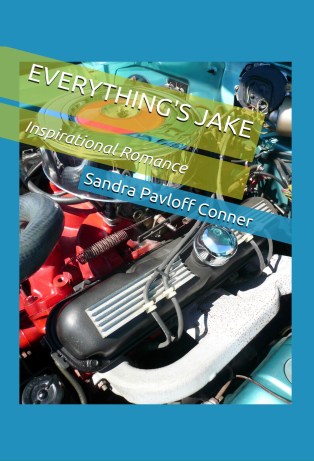
everythings-jake-amazon-cover-2-for-e-bookIt all began with a dream. Yep, it’s another one of those stories. Two of my novels came from dreams that stayed with me long after I woke. I just knew I had to pick up from that point and finish those stories — one of which turned out to be EVERYTHING’S JAKE.

In fact, I can’t even take credit for the title because it was part of my dream as well.

It’s just a little love story. But, then again, it’s a whole lot more than a love story. It’s about finding out who you really are and learning to like that person – and discovering that liking who you are opens the door for the best relationships with other people. It’s about family – and friends who are just like family. It’s about letting God’s way of loving take control of your heart.

In this inspirational novella, you’ll meet Mariah Jacoby. She’s happiest working under the hood of a car, but she’s convinced that grimy hands and greasy smudges on her face aren’t exactly what guys are looking for in a girlfriend. Unfortunately, though, she’s having trouble holding down a job in any other field, despite college degrees and an upbeat personality. Desperate to change her unemployed status, she finally admits it’s time to face the fact that she’s really a “grease monkey” at heart. But dare she hope there’s a guy in her future who’s dreaming of a girl who smells like engine oil?

It’s a relaxing read, and it’s available from Amazon in print as well as in digital format.

Print Version is $4.99

Digital Version is $1.99

Check it out, and please don’t forget one other thing. If you like it, please go back to Amazon and leave a short review telling everyone how you enjoyed it. As most of you know, we authors are dependent on word of mouth from our readers to help us find more readers. So thanks in advance. (Oh, and if for some reason you don’t happen to like it — well — just don’t say anything, okay?) 🙂

~~~

Friday Fictioneers 1/27/17 – The Date

This week’s Friday Fictioneers 100-Word challenge was hard for me. I just couldn’t get “connected” with those antique cars. But finally, thanks to Orville and Julie-Bell, I managed to come up with something. If you’d like to join the fun follow the link and get the details.

My story is below Al’s photo prompt.

PHOTO PROMPT © Al Forbes
Copyright Al Forbes

THE DATE


“Orville! Stop pretending we’re out of gas, and get me home!”

“But – ”

“Stop. Aunt Pearl always said never trust any man who drives a crank-up machine with no top.”

“Oh, Julie-Bell … Honey,” Orville cooed, wrapping his arms around her. “Just one little kiss.”

Julie squirmed, blushed, fluttered her eyelids. “Well …”

“That’s my girl.”

Just as Orville’s lips settled firmly in place, the sky burst open, and drenched the lovers.

“Now look what you’ve done,” Julie wailed.

Orville hopped out and went to crank the motor. “Well, at least I can skip the cold shower when I get home.”


~~~

Prompt Nights – Glimpse Into the World of Edgar Allen Poe

This week on “Prompt Nights” Sanaa has challenged us to get our inspiration from Edgar Allen Poe. I’m super pressed with my regular teaching this week, so I don’t have time to write a brand new piece, but Sanaa assures us that previously written work is welcome. So since the theme immediately brought to mind a story I wrote some time ago — and since it’s a story I think even Ol’ Edgar himself would appreciate — I’ll share it this week. (Those of you who have read it previously have my permission to skip it this time.)

THE FOG

LIGHTHOUSE WITH FOG
The fog’s especially heavy tonight. I can’t see three feet past the door, so I guess it’s a good time to stay inside and write this letter. The lighthouse on the island has sounded the foghorn every two minutes for hours now.

I haven’t been back to the island since that night. In some ways, I wish I had moved away when you did. I’m sure it’s a lot easier on you not having to look out across the water and see that island every day. I know the spot is overgrown now, but I can still pick it out as clearly as if we’d left a marker. And hearing that blasted horn blow every time the fog moves in really gets on my nerves.

Tonight it’s as thick out there as it was the night we buried him. I often wonder what would have happened if the fog had lifted in time for someone to see us digging the grave. But, of course, that wasn’t likely to happen. Once the dratted stuff moves in, it clings to us like a shroud for the whole night.

I wish you were sitting here with me, sharing a bottle of our favorite whiskey. I hate being alone with my thoughts. I’m always chilled and shaky when there’s fog. And it feels as if something’s choking me. I wonder if that’s how he felt as we tightened that rope around his neck until he stopped breathing.

I sure wish you were here with me. I hate fog.

~~~

Saturday Mix – Lorraine

Lorraine is the challenger for this week’s Saturday Mix. She has offered three possibilities to stir up our writing egos. I was most drawn to the 25-word challenge based on the picture. But you may enjoy the other two as well. So if you like writing and want to stretch yourself a little, take a look at the details of the challenge here.

My story is below the picture.

untitled-4
Photo copyright: Lorraine

FROM THE CELLAR

A twelve-year-old, I gaped at the twister roaring toward us, tossing houses and livestock like matchsticks. From the cellar, I watched my world change forever.

~~~

Saturday Mix 1/14/17 – ‘Last-Minute Decisions’

This week is the first time I’ve taken part in the “Mindlovesmisery” writing challenges. This week we are to write a story in 100 words or less. The host site offered a picture for inspiration, but I put that aside because the idea I wanted to work with didn’t fit that particular picture. To take part you can visit here.


wedding-cakeLAST-MINUTE DECISIONS

The auditorium was full of guests, the organist waiting for her cue. The best man stood at the door, ready to enter as soon as the groom came back inside. He’d just stepped out for some air. Where the heck was he?

Suddenly Carter hurried into the room, passed by his best man, and entered the auditorium. Looking at the guests, he took a deep breath and spoke:

“Sorry folks. Seems my bride eloped with someone else.” He laughed. “She took the car I’d arranged for my own last-minute escape.”


~~~

Prompt Nights -1/6/17

This week’s prompt: ‘Tomorrow when the sun will rise, who knows what the tide could bring.’

brendas-ocean-side-cropped

TREASURE FROM THE TIDE

Each morning eight-year-old Aran, his mahogany skin warmed by the sun, trekked to the shore to greet his best friend. The brilliant blue of the water delighted him, and as the waves danced and frolicked on their way to the beach, Aran waited eagerly for them to spill onto the sand at his feet so that he could dance with them.

After splashing in the tide to his heart’s content, he then hurried to the small cave set into the rocky cliff overlooking the beach, where he kept his stash of sea-polished rocks. Daily, he scoured the beach, collecting new ones, always anticipating some special treasure that he was sure, one day, would be deposited on this tiny island by this best of friends, the ocean.

Today he’d found that gift. But what was it? Coral? It didn’t feel like coral. It wasn’t quite hard enough. He examined it closely, his nimble fingers tracing the scores of tiny hollows that formed a pattern and offered a mystery.

He carried it home at lunch time to show his mom and Grandfather. “What is it, Poppy?” he’d asked Grandfather. He knew Poppy had traveled to distant lands many years ago, and he would surely know what this beautiful treasure was.

“It’s a wasps’ nest,” was the rep!y, and then, because the island had no wasps, Poppy had to explain about the insects and how they built their homes.

Fascinated by Poppy’s words, Aran held the delicate structure close. Here it was! His anticipated treasure from another world! His connection with people and adventures that were beyond his ocean! He would treasure this gift … keep it safe … and some day … some day he would set off from this tiny island that had been his home for eight years, and – carried in the arms of his best friend – he would discover the rest of the world for himself.

~~~